Results by title
101 books match the query 'Liberty' and 3 start with o
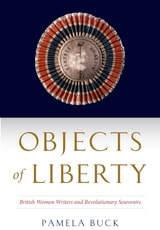
Objects of Liberty
British Women Writers and Revolutionary SouvenirsPamela Buck
University of Delaware Press, 2024
On Knowing--The Social Sciences
Richard P. McKeon
University of Chicago Press, 2017
This volume—the second in a series—leaves behind natural science themes to embrace freedom, power, and history, which, McKeon argues, lay out the whole field of human action. The authors McKeon considers—Hobbes, Machiavelli, Spinoza, Kant, and J. S. Mill—show brilliantly how philosophic methods work in action, via analyses that do not merely reduce or deconstruct meaning, but enhance those texts by reconnecting them to the active history of philosophy and to problems of ethics, politics, and history. The waves of modernism and post-modernism are receding. Philosophic pluralism is now available, fully formulated, in McKeon’s work, spreading from the humanities to the social sciences.
Oppression and Liberty
Simone Weil
University of Massachusetts Press, 1973
Simone Weil was an extraordinary woman whose brief life was intensely devoted to searching for answers to some of the gravest questions inherent in the human condition: the nature of justice, the reasons for human exploitation, the problem of faith. Although debate still lingers about the interpretation of her life and her writings, many contemporary scholars consider her one of the most brilliant, original minds of the twentieth century. This collection of essays by Simone Weil deals with the controversial sociopolitical issues which have confronted us since the time of the French Revolution. The first essay was written in 1932 or 1933 when she was still in her twenties. The last remained unfinished when she died in England at the age of 34, a French-Jewish refugee from Nazi-occupied France.
The essays take a long, close look at Marx and Marxism, and at socialism versus capitalism vis-à-vis labor and the working class. Weil evaluates individuals, ideologies, and institutions with reference to two kinds and uses of power: oppression, which leads ultimately to enslavement or death; and liberty, which leads to humaneness, justice, and charity.