642 books match the query 'Linguistics' and 13 start with o
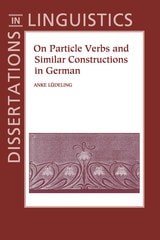
cover of On Particle Verbs and Similar Constructions in German

On Particle Verbs and Similar Constructions in German

Anke Lüdeling

CSLI, 2001

Linguistic distinctions between the notions of a phrase, a word, and their components are challenged by so-called particle verbs in German and similar features in other languages. Particle verbs look like single words, yet are typically assembled from word-like fragments that together behave more like components of a phrase than of a word. The resolution of existing scholarly ambivalence has exciting ramifications, from questioning the existence of particle verbs to a broader understanding of what constitutes a word.

Particle verbs have previously been analyzed as morphological objects or as phrasal constructions, but neither approach fits cleanly within its chosen framework. The resolution presented here is that particle verbs should be seen as lexicalized phrasal constructions. Emphasizing morphological and syntactic testability, over a hundred colloquial examples are shown to break the rules of previous approaches while remaining consistent with this book's proposition. To distinguish particle verbs from similar constructions, and to demonstrate how structural and morphological factors have been misidentified in the past, preverb verb constructions (PVCs) are introduced and diagrammed. This reveals the roles of listedness and non-transparency in word formation and clarifies the conclusion that particle verbs do not form a definable class of words.
[more]
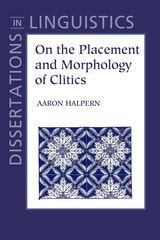
cover of On the Placement and Morphology of Clitics

On the Placement and Morphology of Clitics

Aaron Halpern

CSLI, 1995
Using data from a variety of languages, this book investigates the place of clitics in the theory of language structure, and their implications for the relationships between syntax, morphology and phonology. It is argued that the least powerful theory of language requires us to recognise at least two classes of clitics, one with the syntax of independent phrases and the other with the syntax of inflectional affixes. It is also argued that prosodic conditions may influence the surface position of clitics beyond what may be accomplished by filtering potential syntactic structures. Finally, the relationship between syntactic, morphological, and phonological constituents within wordlike elements is explored.
[more]
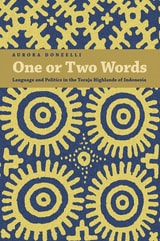
cover of One or Two Words: Language and Politics in the Toraja Highlands of Indonesia

One or Two Words

Language and Politics in the Toraja Highlands of Indonesia

Aurora Donzelli

National University of Singapore Press, 2020
The Toraja highlanders of Indonesia use the expression “one or two words” to refer euphemistically to their highly elaborate form of political speechmaking. Taking off from this understatement, which signals the meaningfulness of transient acts of speech, One or Two Words offers an analysis of the shifting power relations between centers and peripheries in one of the world’s most linguistically diverse countries. Drawing on long-term fieldwork, Aurora Donzelli explores how people forge forms of collective belonging to a distinctive locality through the exchange of spoken words, WhatsApp messages, ritual gifts of pigs and buffaloes, and the performance of elaborate political speeches and ritual chants. Donzelli describes the complex forms of cosmopolitan indigeneity that have emerged in the Toraja highlands during several decades of encounters with a variety of local and international interlocutors, and by engaging wider debates on the dynamics of cultural and linguistic change in relationship to globalizing influences, the book sheds light on a neglected dimension of post-Suharto Indonesia: the recalibration of power relations between national and local languages. One or Two Words will be of interest to scholars of language, politics, power relationships, identity, social change, and local responses to globalizing influences.
 
[more]
cover of Open-Domain Question Answering from Large Text Collections

Open-Domain Question Answering from Large Text Collections

Marius Pasca

CSLI, 2003

Many books have indexes, but most textual media have none. Newspapers, legal transcripts, conference proceedings, correspondence, video subtitles, and web pages are increasingly accessible with computers, yet are still without indexes or other sophisticated means of finding the excerpts most relevant to a reader's question.

Better than an index, and much better than a keyword search, are the high-precision computerized question-answering systems explored in this book. Marius Pasca presents novel and robust methods for capturing the semantics of natural language questions and for finding the most relevant portions of texts. This research has led to a fully implemented and rigorously evaluated architecture that has produced experimental results showing great promise for the future of internet search technology.
[more]
cover of Optimal Communication

Optimal Communication

Edited by Reinhard Blutner, Helen de Hoop and Petra Hendriks

CSLI, 2005
This volume explores how the effectiveness of communication is shaped by aspects of semantics and pragmatics such as compositionality, the role of the speaker and hearer, and the acquisition of meaning. Optimal Communication surveys recent research in the fields of syntax, semantics, and pragmatics, and draws from optimality theory to argue that optimal meanings result from a compromise between competing constraints. Optimal Communication will be an invaluable resource for students in cognitive science, linguistics, and natural language semantics.
[more]
cover of Optimality-Theoretic Syntax: A Declarative Approach

Optimality-Theoretic Syntax

A Declarative Approach

Jonas Kuhn

CSLI, 2003

With this book, Jonas Kuhn greatly advances Optimality Theory (OT) by clarifying the significant choices in the design of a formally precise OT approach to syntax. Building on OT work that uses the representation structures of Lexical Functional Grammar (OT-LFG), Kuhn defines the notion of an OT-syntactic grammar in a declarative, non-derivational way.

Along with the standard OT architecture, which is based on a generation metaphor, Kuhn also formalizes parsing-based OT, and goes on to discuss possible combinations of these two architectures. This is followed by an examination of assumptions under which the computational tasks of generation and parsing are decidable for an OT-syntactic grammar.
[more]
cover of Optimizing Structure in Context: Scrambling and Information Structure

Optimizing Structure in Context

Scrambling and Information Structure

Hye-Won Choi

CSLI, 1999

This book examines the scrambling phenomena in German and Korean from the perspective that different ordering possibilities are motivated and constrained by interactions among syntactic, semantic, and discourse principles. Using Optimality Theory, Optimizing Structure in Context demonstrates how these principles from different modules of grammar interact and thus resolve conflicts among themselves to yield the most optimal output, that is, a sentence with a particular word order, in a given semantic and discoursal context. This way, it explains various meaning-related effects associated with scrambling such as definiteness effect and focus effect. While developing constraints in the discourse domain, it also proposes a new model of information structure based on basic discourse features. By expanding the core idea of constraint interaction in Optimality Theory to interactions 'between' modules of grammar as well as 'between', this book provides a model of interface theory.
[more]
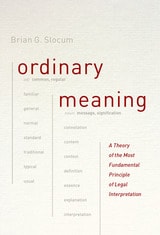
cover of Ordinary Meaning: A Theory of the Most Fundamental Principle of Legal Interpretation

Ordinary Meaning

A Theory of the Most Fundamental Principle of Legal Interpretation

Brian G. Slocum

University of Chicago Press, 2015

Consider this court case: a defendant has traded a gun for drugs, and there is a criminal sentencing provision that stipulates an enhanced punishment if the defendant “uses” a firearm “during and in relation to a drug trafficking crime.” Buying the drugs was obviously a crime—but can it be said that the defendant actually “used” the gun during the crime? This sort of question is at the heart of legal interpretation.
 
Legal interpretation is built around one key question: by what standard should legal texts be interpreted? The traditional doctrine is that words should be given their “ordinary meaning”: words in legal texts should be interpreted in light of accepted standards of communication. Yet often, courts fail to properly consider context, refer to unsuitable dictionary definitions, or otherwise misconceive how the ordinary meaning of words should be determined. In this book, Brian Slocum builds his argument for a new method of interpretation by asking glaring, yet largely ignored, questions. What makes one particular meaning the “ordinary” one, and how exactly do courts conceptualize the elements of ordinary meaning? Ordinary Meaning provides a much-needed, revised framework, boldly instructing those involved with the law in how the components of ordinary meaning should properly be identified and developed in our modern legal system.
[more]
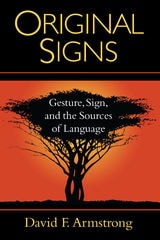
cover of Original Signs: Gesture, Sign, and the Sources of Language

Original Signs

Gesture, Sign, and the Sources of Language

David F. Armstrong

Gallaudet University Press, 2002

In the ongoing debate about evolution, scholars frequently argue either the perspective that humans stand as the end product of a deliberate process or that they derive from a series of random acts of natural selection. David F. Armstrong’s new book Original Signs embraces the Darwinian concept of natural selection and extends it to apply to the formation of language. While most current linguistic theory envisions language as a system for translating the contents of the mind into linear strings of arbitrary symbols, Armstrong asserts that this model does not characterize signed languages. He shows that language is inherently a multichannel activity, of which the two primary channels are auditory and visual.

Original Signs employs a more expansive notion of language that takes into account the full range of human communicative behavior. By making no strict separation between language and gesture, this thought-provoking work reveals that the use by deaf people of signs to create a fully formed language is also a natural facet of communication development for hearing people.

Armstrong explores the influences of Plato and Descartes on modern linguistics, and delineates the theories of earlier anthropological linguists Edward Sapir and Benjamin Lee Whorf, who thought of language as natural experiments connected to individual cultures. This exceptional work of scholarship methodically demonstrates that the intricacies of how languages develop, whether they depend upon words or signs, and that the complexity among languages that contact one another cannot be accounted for by the sequential hierarchical processes previously put forth by linguists and logicians. Original Signs will prove to be a fascinating, watershed work invaluable to linguists, anthropologists, and all other scholars and students engaged in the search for the origin of language.
[more]
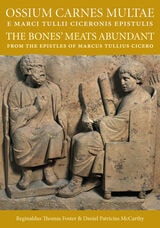
cover of Ossium Carnes Multae e Marci Tullii Ciceronis Epistulis / The Bones’ Meats Abundant from the Epistles of Marcus Tullius Cicero

Ossium Carnes Multae e Marci Tullii Ciceronis Epistulis / The Bones’ Meats Abundant from the Epistles of Marcus Tullius Cicero

Reginaldus Thomas Foster

Catholic University of America Press, 2021
Beginners and experts alike will find a complete immersion into the workings and nature of the Latin language embodied in the incomparable, insuperable epistles of the great Marcus Tullius Cicero, something which other commentators pass over or scorn. This second volume puts “meat on the bones” of the Latin language presented in the first volume: Ossa Latinitatis Sola: The Mere Bones of Latin. The personal letters of Cicero provide ample meat to enflesh the skeletal structure of the language, thus the title: Ossium Carnes Multae: The Bones’ Meats Abundant from the epistles of Marcus Tullius Cicero. Part 1 presents 51 complete letters from the Tyrell-Purser text. Facing each letter is an image of its oldest manuscript edition as early as the ninth century, which are preserved and guarded in the Medicea Laurentiana library in Florence, Italy, witnessing to the human hand preserving this monument of world heritage for over two millennia. Part 2 follows with a most careful rendition into English of Tully’s living, telephone-like Latin discourse. A thorough treatment and explanation of noteworthy elements of his natural talk follows with numerous references to the Encounters in Volume I. All this has students, learners, teachers, experts of the Latin language in mind and is humbly designed to deepen the understanding and appreciation of specific expressions and peculiarities of Cicero’s language itself. Part 3 provides 500 sentences consisting of from 1 to 5 words and suited for the beginnings or continuation of Latin conversations: 200 declarations, 100 questions, 100 exclamations, 100 injunctions drawn from his letters. The volume is amply indexed. All this has been done to enhance the study and use of Latin, to popularize Cicero’s correspondence, to prepare the reader for Volume III which will deal again with the letters and their usefulness for Latin conversation.
[more]
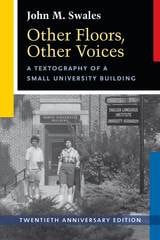
cover of Other Floors, Other Voices, Twentieth Anniversary Edition: A Textography of a Small University Building

Other Floors, Other Voices, Twentieth Anniversary Edition

A Textography of a Small University Building

John M. Swales

University of Michigan Press, 2018

“John Swales’ textography might also be called ‘comparative rhetoric in a small building,’ offering proof, once again, that another culture may be only a trip up or down a flight of stairs. . . .such an appealing and original book.” ---BAAL News
 
Originally published in 1998, Other Floors, Other Voices uses texts to capture the lives of three communities operating within a single building (the North University Building, or NUBS) on the University of Michigan campus. Swales' thoughtful exploration of the three units—the Computer Resource Site, the University Herbarium (botany), and the English Language Institute—centers around the individuals who work on each floor and the discourse-related activities they engage in.
 
The Twentieth Anniversary Edition of Other Floors, Other Voices includes: a new preface, an introductory essay on the value of rereading this volume many years after publication, and an epilogue that reflects on and reveals what has happened to the three units in the past 20 years.
 
[more]
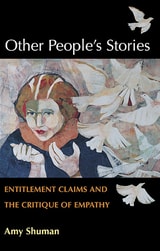
cover of Other People's Stories: Entitlement Claims and the Critique of Empathy

Other People's Stories

Entitlement Claims and the Critique of Empathy

Amy Shuman

University of Illinois Press, 2010
In Other People's Stories, Amy Shuman examines the social relations embedded in stories and the complex ethical and social tensions that surround their telling. Drawing on innovative research and contemporary theory, she describes what happens when one person's story becomes another person's source of inspiration, or when entitlement and empathy collide.
 
The resulting analyses are wonderfully diverse, integrating narrative studies, sociolinguistics, communications, folklore, and ethnographic studies to examine the everyday, conversational stories told by cultural groups including Latinas, Jews, African Americans, Italians, and Puerto Ricans. Shuman offers a nuanced and clear theoretical perspective derived from the Frankfurt school, life history research, disability research, feminist studies, trauma studies, and cultural studies. Without compromising complexity, she makes narrative inquiry accessible to a broad population.
[more]
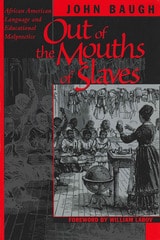
cover of Out of the Mouths of Slaves: African American Language and Educational Malpractice

Out of the Mouths of Slaves

African American Language and Educational Malpractice

By John Baugh

University of Texas Press, 1999

Winner, A Choice Outstanding Academic Book

When the Oakland, California, school board called African American English "Ebonics" and claimed that it "is not a black dialect or any dialect of English," they reignited a debate over language, race, and culture that reaches back to the era of slavery in the United States. In this book, John Baugh, an authority on African American English, sets new parameters for the debate by dissecting and challenging many of the prevailing myths about African American language and its place in American society.

Baugh's inquiry ranges from the origins of African American English among slaves and their descendants to its recent adoption by standard English speakers of various races. Some of the topics he considers include practices and malpractices for educating language minority students, linguistic discrimination in the administration of justice, cross-cultural communication between Blacks and whites, and specific linguistic aspects of African American English. This detailed overview of the main points of debate about African American language will be important reading for both scholars and the concerned public.

[more]