Results by title
50 books match the query 'Marine Biology' and 5 start with o
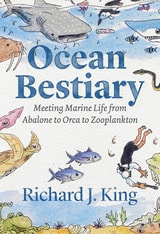
Ocean Bestiary
Meeting Marine Life from Abalone to Orca to ZooplanktonWritten and illustrated by Richard J. King
University of Chicago Press, 2023
A delightful A-to-Z menagerie of the sea—whimsically illustrated, authoritative, and thought-provoking.
For millennia, we have taken to the waves. And yet, for humans, the ocean remains our planet’s most inaccessible region, the place about which we know the least. From A to Z, abalone to zooplankton, and through both text and original illustrations, Ocean Bestiary is a celebration of our ongoing quest to know the sea and its creatures.
Focusing on individual species or groups of animals, Richard J. King embarks upon a global tour of ocean wildlife, including beluga whales, flying fish, green turtles, mako sharks, noddies, right whales, sea cows (as well as sea lions, sea otters, and sea pickles), skipjack tuna, swordfish, tropicbirds, walrus, and yellow-bellied sea snakes. But more than this, King connects the natural history of ocean animals to the experiences of people out at sea and along the world’s coastlines. From firsthand accounts passed down by the earliest Polynesian navigators to observations from Wampanoag clamshell artists, African-American whalemen, Korean female divers (or haenyeo), and today’s pilots of deep-sea submersibles—and even to imaginary sea expeditions launched through poems, novels, and paintings—Ocean Bestiary weaves together a diverse array of human voices underrepresented in environmental history to tell the larger story of our relationship with the sea. Sometimes funny, sometimes alarming, but always compelling, King’s vignettes reveal both how our perceptions of the sea have changed for the better and how far we still have to go on our voyage.
[more]
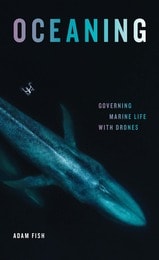
Oceaning
Governing Marine Life with DronesAdam Fish
Duke University Press, 2024
Drones are revolutionizing ocean conservation. By flying closer and seeing more, drones enhance intimate contact between ocean scientists and activists and marine life. In the process, new dependencies between nature, technology, and humans emerge, and a paradox becomes apparent: Can we have a wild ocean whose survival is reliant upon technology? In Oceaning, Adam Fish answers this question through eight stories of piloting drones to stop the killing of porpoises, sharks, and seabirds and to check the vitality of whales, seals, turtles, and coral reefs. Drone conservation is not the end of nature. Instead, drone conservation results in an ocean whose flourishing both depends upon and escapes the control of technologies. Faulty technology, oceanic and atmospheric turbulence, political corruption, and the inadequacies of basic science serve to foil governance over nature. Fish contends that what emerges is an ocean/culture—a flourishing ocean that is distinct from but exists alongside humanity.
[more]
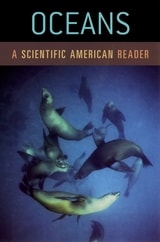
Oceans
A Scientific American ReaderEdited by Scientific American
University of Chicago Press, 2007
Covering nearly three-quarters of our planet, the world’s oceans are a vast and unique ecosystem from which all life on Earth originated. But each year the marine realm is more susceptible to harm by careless exploitation, and as demands for food, waste disposal, transport, and travel increase, the fate of the world’s oceans hangs in the balance. This timely guide offers the nonscientist an opportunity to appreciate the importance of this expansive—and fragile—frontier.
With selections chosen for their value in identifying the multiple uses of oceans, their resources, and the hurdles they face as the world’s population continues to expand and consume their resources at a staggering rate, Oceans collects more than thirty thematically arranged articles from the past decade, including recent pieces written in the wake of the 2004 tsunami. The bookfeatures articles that investigate the origins of the world’s oceans, the diversity of life in the water, the state of global fisheries, the dangers of natural disasters, and the perils oceans face, whether induced by nature or by humans.
With breadth of topics as wide as the ocean is deep, this Scientific American reader will engage general readers interested in the evolution, ecology, and conservation of the oceanic ecosystem and can be used in courses on introductory oceanography, environmental science, and marine biology.
[more]
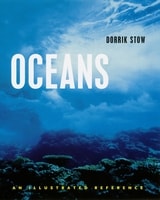
Oceans
An Illustrated ReferenceDorrik Stow
University of Chicago Press, 2005
Four billion years old, the oceans formed as the Earth's scorching surface cooled, the primordial atmosphere condensed, and torrential rains fell. Their color is the unique signature of our blue planet, their composition a chemical cocktail of remarkable variety, their waters a theater of constant change.
Oceans: An Illustrated Reference tells the story of this last great frontier. With hundreds of beautiful full-color photographs and explanatory diagrams, charts, and maps, Oceans combines the visual splendor of ocean life with up-to-date scientific information to provide an invaluable and fascinating resource on this vital realm. Covering all major areas of oceanographic knowledge and research, Oceans is divided into two parts. The first, "Ocean Systems," examines the physical nature of the oceans, including plate tectonics, temperature and climate, waves and tides, natural resources and much more. The second, "Ocean Life,"explores biodiversity, evolution and adaptation, marine ecosystems and complex communities, and the preservation of fragile marine environments.
Oceans also offers readers a host of tools to better understand the magnificent world of the sea. A special section of bathymetric maps-made possible by satellite observation, deep-towed surveying craft, and remotely operated submarine vessels-provides a view of the depth and texture of ocean floors around the globe, giving us a glimpse of worlds rarely seen. And throughout the book, engagingly written special features delve into specific marine environments and phenomena such as the lost Tethys Ocean, from which the Himalayas were born. Cross-references and a detailed index help readers navigate this multifaceted volume, and a glossary provides clear definitions of scientific vocabulary.
Although the oceans are vast, their resources are finite. Oceans clearly presents the future challenge to us all-that of ensuring that our common ocean heritage is duly respected, wisely managed, and carefully harnessed for the benefit of the whole planet. Lavishly illustrated and filled with current research, Oceans is a step in that direction: a rich, magnificent, and illuminating volume for anyone who has ever heard the siren song of the sea.
[more]
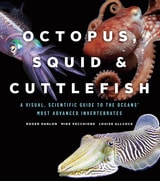
Octopus, Squid, and Cuttlefish
A Visual, Scientific Guide to the Oceans’ Most Advanced InvertebratesRoger Hanlon, Mike Vecchione, and Louise Allcock
University of Chicago Press, 2018
"Cephalopods are often misunderstood creatures. Three biologists set the record straight."—Science News
Largely shell-less relatives of clams and snails, the marine mollusks in the class Cephalopoda—Greek for “head-foot”—are colorful creatures of many-armed dexterity, often inky self-defense, and highly evolved cognition. They are capable of learning, of retaining information—and of rapid decision-making to avoid predators and find prey. They have eyes and senses rivaling those of vertebrates like birds and fishes, they morph texture and body shape, and they change color faster than a chameleon. In short, they captivate us.
From the long-armed mimic octopus—able to imitate the appearance of swimming flounders and soles—to the aptly named flamboyant cuttlefish, whose undulating waves of color rival the graphic displays of any LCD screen, there are more than seven hundred species of cephalopod. Featuring a selection of species profiles, Octopus, Squid, and Cuttlefish reveals the evolution, anatomy, life history, behaviors, and relationships of these spellbinding animals. Their existence proves that intelligence can develop in very different ways: not only are cephalopods unusually large-brained invertebrates, they also carry two-thirds of their neurons in their arms.
A treasure trove of scientific fact and visual explanation, this worldwide illustrated guide to cephalopods offers a comprehensive review of these fascinating and mysterious underwater invertebrates—from the lone hunting of the octopus, to the social squid, and the prismatic skin signaling of the cuttlefish.
[more]