Results by title
161 books match the query 'Material culture' and 5 start with o
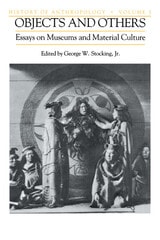
Objects and Others
Essays on Museums and Material CultureEdited by George W. Stocking, Jr.
University of Wisconsin Press, 1988
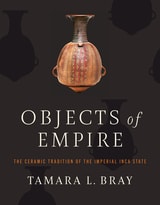
Objects of Empire
The Ceramic Tradition of the Imperial Inca StateTamara L. Bray
University of Texas Press, 2025
A comparative, empire-wide study of the ceramics associated with the imperial Inca state, theorizing the role of these highly recognizable vessel forms in legitimizing Inca rule and establishing imperial identities.
The beautiful polychrome ceramics of the imperial Inca state have long been noted for their seemingly repetitive nature but little considered beyond this basic observation. The widespread distribution and general uniformity of the Inca pottery, however, hints at its larger importance to the imperial project. Moving beyond the pervasive "seen one, seen 'em all" mentality, Objects of Empire brings to light the variability and rich semiotic content of imperial Inca vessels. Taking a comparative, empire-wide approach, Tamara Bray identifies the parameters and significance of this variability, and defines the core elements of the imperial state style. She then investigates where, when, and why differences and deviations from the perceived norm occur.
This study illuminates the strategies of territorial expansion and political control that lay at the heart of the Inca juggernaut, as well as the role of objects in the calculus of would-be rulers and subjects. Based on a unique and extensive database of imperial Inca pottery developed through detailed study of archaeologically recovered and museum-based collections, Objects of Empire reveals how power and legitimacy were produced and reproduced under the Inca through the material culture of everyday life.
Other Things
Bill Brown
University of Chicago Press, 2015
The book ranges across the literary, visual, and plastic arts to depict the curious lives of things. Beginning with Achilles’s Shield, then tracking the object/thing distinction as it appears in the work of Martin Heidegger and Jacques Lacan, Bill Brown ultimately focuses on the thingness disclosed by specific literary and artistic works. Combining history and literature, criticism and theory, Other Things provides a new way of understanding the inanimate object world and the place of the human within it, encouraging us to think anew about what we mean by materiality itself.
Out of Many, One People
The Historical Archaeology of Colonial JamaicaEdited by James A. Delle, Mark W. Hauser, and Douglas W. Armstrong
University of Alabama Press, 2011
Normal0falsefalsefalseEN-USX-NONEX-NONEMicrosoftInternetExplorer4
Oysters in the Land of Cacao
Archaeology, Material Culture, and Societies at Islas de Los Cerros and the Western Chontalpa, Tabasco, MexicoBradley E. Ensor
University of Arizona Press, 2020
This book synthesizes data from multiyear investigations at a coastal site complex in Tabasco—Islas de Los Cerros (ILC)—providing the first modern, systematic descriptions and analyses of material culture that challenge preconceptions while enabling new perspectives on cultural developments from the Formative to Late Classic periods through the lens of regional comparisons and contemporary theoretical trends. Ensor introduces a political ecological understanding of the environment and archaeological features, overturns a misconception that the latter were formative shell middens, provides an alternative pottery classification more appropriate for the materials and for contemporary theory, and introduces new approaches for addressing formation processes and settlement history.
Building on the empirical analyses and discussions of problems in Mesoamerican archaeology, this book contributes new approaches to practice and agency perspectives, holistically integrating intra- and interclass agency, kinship strategies, gender and age dynamics, layered cultural identities, landscapes, social memory, and foodways and feasting. Oysters in the Land of Cacao addresses issues important to coastal archaeology within and beyond Mesoamerica. It delivers an overdue regional synthesis and new observations on settlement patterns, elite power, and political economies.