Results by title
138 books match the query 'Meaning' and 2 start with o
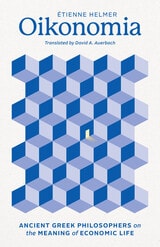
Oikonomia
Ancient Greek Philosophers on the Meaning of Economic LifeÉtienne Helmer
University of Chicago Press, 2024
In this book, Étienne Helmer offers a comprehensive analysis of oikonomia in ancient Greek philosophy. Despite its similarity to the word “economy,” for the ancients, oikonomia named a branch of knowledge—the science of management—that was aimed at studying the practices we engage in to satisfy our needs. This began with the domestic sphere, but it radiated outward from the oikos (house) to encompass broader issues in the polis (city) as well. Helmer explores topics such as gender roles and marriage, property and the household, the acquisition and preservation of material goods, and how Greek philosophers addressed the issue of slavery in the ancient world. Even if we are not likely to share many of ancient thinkers’ beliefs today, Helmer shows that there was once a way of thinking of “economic life” that went beyond the mere accumulation of wealth, representing a key point of departure for understanding how to inhabit the world with others.
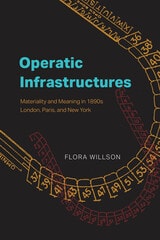
Operatic Infrastructures
Materiality and Meaning in 1890s London, Paris, and New YorkFlora Willson
University of Chicago Press, 2026
An exploration of the fundamental relationship between opera and urban modernity in three iconic cities: London, Paris, and New York.
At the end of the nineteenth century, London, Paris, and New York were quintessential modern metropolises and vital centers for opera. In Operatic Infrastructures, Flora Willson examines opera’s roots in the material worlds of these cities. Reaching beyond histories of opera as spectacle, she investigates the physical underpinnings of opera at the century’s end as an inter-urban, multimedia network.
Operatic Infrastructures considers emergent technologies such as the telephone and the subway, but it also retrieves the hidden, forgotten, and otherwise effaced traces of systems such as storage facilities and colonial trade routes. It takes seriously the mundane aspects of materiality, from the blandest clichés of newspaper columns to the fine print of insurance certificates. In doing so, the book reveals just how far these interfaces with modern urban life reached into opera’s own systems of meaning-making and performance in the 1890s—making it impossible to demarcate neatly between “opera” and its “context.” Without such operatic infrastructures, Willson shows, there would be no opera at all.