Results by title
80 books match the query 'Medical (incl. Patients)' and 3 start with o
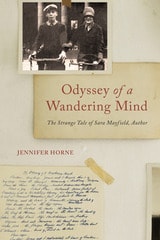
Odyssey of a Wandering Mind
The Strange Tale of Sara Mayfield, AuthorJennifer Horne
University of Alabama Press, 2024
A carefully rendered portrait of a brilliant but troubled daughter of the Old South who struggled against the conventions of gender, class, family, and ultimately of sanity, yet survived to define a creative life of her own
Sara Mayfield was born into Alabama’s governing elite in 1905 and grew up in a social circle that included Zelda Sayre, Sara Haardt, and Tallulah and Eugenia Bankhead. After winning a Goucher College short story contest judged by H. L. Mencken, Mayfield became friends with Mencken and his circle, then visited with Scott and Zelda Fitzgerald and hobnobbed with the literati while traveling in Europe after a failed marriage. Returning to Alabama during the Depression, she briefly managed the family landholdings before departing for New York City where she became involved in the theater. Inventing a plastic compound while working on theatrical sets, she applied for a patent and set her sights on a livelihood as an inventor and businesswoman. With the advent of World War II, Mayfield returned to her family home in Tuscaloosa where she expanded her experiments, freelanced as a journalist, and doggedly pursued a bizarre series of military and intelligence schemes, prompting temporary hospitalization. In 1945, she mingled with a host of cultural figures, including Frida Kahlo, Diego Rivera, Orson Welles, Rita Hayworth, and even a young John F. Kennedy, while reporting on the creation of the United Nations from Mexico and California. Back in Tuscaloosa after the war, however, she struggled to find her way with both work and family, becoming increasingly paranoid about perceived conspiracies arrayed against her. Finally, her mother and brother committed her to Bryce Hospital for the Insane, where she remained for the next seventeen years.
Throughout her life, Mayfield kept journals, wrote fiction, and produced thousands of letters while nursing the ambition that had driven her since childhood: to write and publish books. During her confinement, Mayfield assiduously recorded her experiences and her determined efforts—sometimes delusional, always savvy—to overturn her diagnosis and return to the world as a sane, independent adult. At 59, she was released from Bryce and later obtained a decree of “having been restored to sanity,” enabling her to manage her own financial affairs and to live how and where she pleased. She went on to publish noteworthy literary biographies of the Menckens and the Fitzgeralds plus a novel based on the life of Mona Lisa, finally achieving her quest to become the author of books and her own life. In Odyssey of a Wandering Mind, noted writer Jennifer Horne draws on years of research and an intimate understanding of the vast archive Sara Mayfield left behind to sensitively render Mayfield’s struggle to move through the world as the person she was—and her ultimate success in surviving to define the terms of her story.
On the Ragged Edge of Medicine
Doctoring Among the DispossessedPatricia Kullberg
Oregon State University Press, 2017
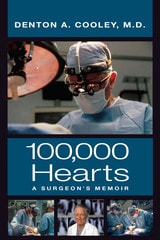
One Hundred Thousand Hearts
A Surgeon’s MemoirBy Denton A. Cooley
University of Texas Press, 2012
The pioneering surgeon Dr. Denton Cooley performed his first human heart transplant in 1968 and astounded the world in 1969 by conducting the first successful implantation of a totally artificial heart in a human being. Over the course of his career, Cooley and his associates performed thousands of open-heart operations and pioneered the use of new surgical procedures. Of all his achievements, however, Cooley was most proud of the Texas Heart Institute, which he founded in 1962 with a mission to use education, research, and improved patient care to decrease the devastating effects of cardiovascular disease.
In 100,000 Hearts, Cooley tells about his childhood in Houston, his education at the University of Texas, his medical-school training at the University of Texas Medical Branch in Galveston and Johns Hopkins, and his service in the Army Medical Corps. While at Johns Hopkins, Cooley assisted in a groundbreaking operation to correct an infant’s congenital heart defect, which inspired him to specialize in heart surgery.
Cooley’s detailed descriptions of working in the operating room at crucial points in medical history offer a fascinating perspective on the distance medical science traveled in just a few decades.