Results by title
1107 books match the query 'Memoirs' and 32 start with o
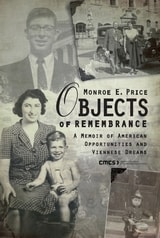
Objects of Remembrance
A Memoir of American Opportunities and Viennese DreamsMonroe E. Price
Central European University Press, 2009
This is a memoir about the power of American assimilation and opportunity in the face of persisting refugee realities. Like Isaac Bashevis Singer, Monroe Price recounts the continuing impact of European identities as families, cast from their homes by the rise of Hitler and the Third Reich, struggle to find their way in a new and challenging environment.
In a series of reflections, Price, who was born to a Jewish family in Vienna in 1938 and left when he was seven months old, seeks to create the Vienna of his infancy, including Jewish life, anti-Semitism, the Anschluss, and Kristallnacht (during which his father was arrested). He shifts to scenes of American socialization in the places he moved with his parents:: Macon, Georgia, Cincinnati, Ohio, and the experience of New York City. Through these reflections, Price illuminates ideas about family, religion, friends and schooling as well as deeply personal issues such as home, food and intimacy.
Price’s memoir weaves complicated strands—his Viennese origins, campaigns to distribute Jewish refugees away from New York City, the special qualities of Midwestern Ohio life in the 1950s—and the contrasting patterns of adjustment by different generations in his family in the American landscape. As he traces the particular path of his own life, Price reveals a more universal story of adjustment, and the relationship between a marginal community and the drama of American citizenship.
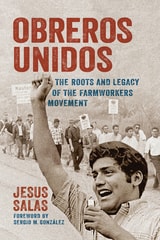
Obreros Unidos
The Roots and Legacy of the Farmworkers MovementJesus Salas
Wisconsin Historical Society Press, 2023
Taking inspiration from César Chávez, as a young man Salas and others led a historic march from Wautoma to Madison to demand that lawmakers address rampant violations of Wisconsin’s minimum wage laws and housing codes. These young labor leaders founded Obreros Unidos—Workers United—to continue the fight for fairness and respect, as well as to provide much-needed services to migrant families. This memoir of a movement details how their work went beyond the fields to have lasting impacts on representation in community organizations and access to education, empowering later generations to demand better.
Winner of the 2024 Benjamin Franklin Award for Multicultural Books
Winner of the 2024 Hamlin Garland Prize in Popular History from the Midwest History Association
“In recounting the story of Tejano settlement and struggle in Wisconsin, Salas unsettles this story line and, in the process, demonstrates the power of personal narrative and the lasting political implications of retrieving and restoring Latino history.”
—Sergio M. González, author of Mexicans in Wisconsin
“Salas’s story is an essential chapter in the history of Wisconsin and Milwaukee and mirrors the growth, progress and dreams of the Latinx community. His reflections speak to not only the importance of the Latinx community, but the need to build alliances across lines of race and gender and fulfill the promise of a multiracial democracy.”
—Barbara Miner, Milwaukee Magazine
Ohio Farm
Wheeler McMillen
The Ohio State University Press, 1997
Uncomplicated when compared with the task of managing today's highly mechanized agricultural complexes, life on the early twentieth-century small farm entailed hard work and afforded simple pleasures that brought satisfaction and enjoyment to the farm and family. Farming on that scale and in the same manner has now become almost completely infeasible, yet in those times a good farmer could prosper and become independent. Wheeler McMillen’s father, Lewis, did both.
Relying frequently on his father’s account books and concise diaries, for this is primarily his father’s story, McMillen recounts the immense labor that farming demanded before the advent of the tractor and the combine harvester. He evokes the special excitements of having company for Sunday dinner, attending the annual oyster supper at the Grange Hall, and gathering on the Fourth of July with the interminable wait for darkness to fall. McMillen also portrays the quiet peace and ineffable joy of private moments, such as resting the horses during spring plowing to watch bronzed grackles search for food in the freshly turned furrows.
Wheeler McMillen’s slice of history will speak to those interested in what rural life was once like in the Midwest and to Ohioans who would like to learn more about their state’s recent past.
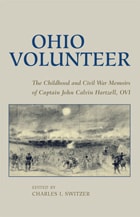
Ohio Volunteer
The Childhood and Civil War Memoirs of Captain John Calvin Hartzell, OVICharles I. Switzer
Ohio University Press, 2005
Edited and introduced by Charles Switzer, Ohio Volunteer: The Childhood and Civil War Memoirs of Captain John Calvin Hartzell, OVI documents military strategy, the life of the common soldier, the intense excitement and terror of battle, and the wretchedness of the wounded.
Hartzell’s family implored him to set down his life story, including his experiences in the Civil War from 1862 to 1866. Hartzell did so diligently, taking more than two years to complete his manuscript. The memoir reveals a remarkable memory for vivid details, the ability to see larger and more philosophical perspectives, and a humorous outlook that helped him bear the unbearable.
He also depicted the changing rural economy, the assimilation of the Pennsylvania Dutch, and the transformations wrought by coal mining and the iron industry. Hartzell felt individualism was threatened by the Industrial Revolution and the cruelties of the war. He found his faith in humanity affirmed—and the dramatic tension in his memoir resolved—when 136,000 Union soldiers reenlisted and assured victory for the North. The common soldier, he wrote, was “loyal to the core.”

Old Farm Country Cookbook
Recipes, Menus, and MemoriesJerry Apps
Wisconsin Historical Society Press, 2017
Inspired by the dishes made by his mother, Eleanor, and featuring recipes found in her well-worn recipe box, Jerry and his daughter, Susan, take us on a culinary tour of life on the farm during the Depression and World War II. Seasoned with personal stories, menus, and family photos, Old Farm Country Cookbook recalls a time when electricity had not yet found its way to the farm, when making sauerkraut was a family endeavor, and when homemade ice cream tasted better than anything you could buy at the store.
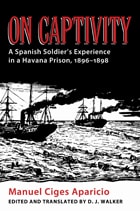
On Captivity
A Spanish Soldier's Experience in a Havana Prison, 1896-1898Manuel Ciges Aparicio
University of Alabama Press, 2012
A rare and unfiltered witness to Spain’s colonial collapse—Ciges Aparicio’s prison memoir exposes the political, human, and moral stakes of the Cuban War of Independence.
Ciges enlisted in the Spanish army in 1893 at the age of twenty. He served in Africa and then in Cuba, where he opposed Spanish General Valeriano Weyler’s policies in Cuba as well as the war itself. Ciges soon found himself imprisoned and facing execution for treason as punishment for an article critical of Weyler’s conducting of the war that was intercepted by Spanish authorities before it could be published in the pro-Cuban Parisian paper L’Intransigeant.
First published in book form in 1903, Ciges’s account includes detailed observations concerning prison organization, perceptions of political events and personalities of the time, as well as graphic descriptions of the daily life of the men confined in the infamous prison. Ciges is the only one of the so-called Generation of 1898—writers considered to have been deeply marked by el desastre (the loss of the colonies)—who was in Cuba during the war years. His witness to events there, colored by his stance as a freethinker and political skeptic, constitutes a significant historical document. Following his release from prison, Ciges returned to Spain where he resumed his career as an activist journalist and also earned acclaim as a translator and novelist. In time, his political allegiances shifted from socialism to liberal republicanism. He was acting as provincial governor of Avila when he was killed by unidentified assassins on August 4, 1936—eighteen days after the Falangist uprising against the Second Republic.
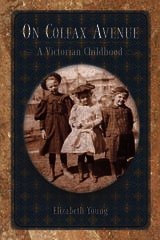
On Colfax Avenue
A Victorian ChildhoodElizabeth Young
University Press of Colorado, 2004
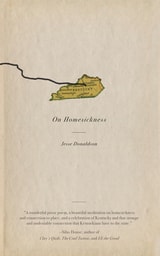
On Homesickness
A PleaJesse Donaldson
West Virginia University Press, 2017
One day, Jesse Donaldson wakes up in Portland, Oregon, and asks his wife to uproot their life together and move to his native Kentucky. As he searches for the reason behind this sudden urge, Donaldson examines both the place where he was born and the life he’s building.
The result is a hybrid—part memoir, part meditation on nostalgia, part catalog of Kentucky history and myth. Organized according to Kentucky geography, with one passage for each of the commonwealth’s 120 counties, On Homesickness examines whether we can ever return to the places we’ve called home.
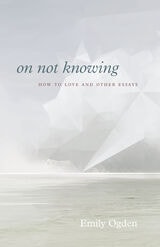
On Not Knowing
How to Love and Other EssaysEmily Ogden
University of Chicago Press, 2022
Moments of clarity are rare and fleeting; how can we become comfortable outside of them, in the more general condition of uncertainty within which we make our lives? Written by English professor Emily Ogden while her children were small, On Not Knowing forays into this rich, ambivalent space. Each of her sharply observed essays invites the reader to think with her about questions she can’t set aside: not knowing how to give birth, to listen, to hold it together, to love.
Unapologetically capacious in her range of reference and idiosyncratic in the canon she draws on, Ogden moves nimbly among the registers of experience, from the operation of a breast pump to the art of herding cattle; from one-night stands to the stories of Edgar Allan Poe; from kayaking near a whale to a psychoanalytic meditation on drowning. Committed to the accumulation of knowledge, Ogden nonetheless finds that knowingness for her can be a way of getting stuck, a way of not really living. Rather than the defensiveness of willful ignorance, On Not Knowing celebrates the defenselessness of not knowing yet—possibly of not knowing ever. Ultimately, this book shows how resisting the temptation of knowingness and embracing the position of not knowing becomes a form of love.
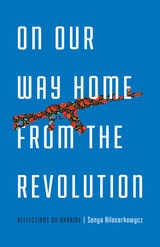
On Our Way Home from the Revolution
Reflections on UkraineSonya Bilocerkowycz
The Ohio State University Press, 2019
In 2014 Sonya Bilocerkowycz is a tourist at a deadly revolution. At first she is enamored with the Ukrainians’ idealism, which reminds her of her own patriotic family. But when the romantic revolution melts into a war with Russia, she becomes disillusioned, prompting a return home to the US and the diaspora community that raised her. As the daughter of a man who studies Ukrainian dissidents for a living, the granddaughter of war refugees, and the great-granddaughter of a gulag victim, Bilocerkowycz has inherited a legacy of political oppression. But what does it mean when she discovers a missing page from her family’s survival story—one that raises questions about her own guilt?
In these linked essays, Bilocerkowycz invites readers to meet a swirling cast of post-Soviet characters, including a Russian intelligence officer who finds Osama bin Laden a few weeks after 9/11; a Ukrainian poet whose nose gets broken by Russian separatists; and a long-lost relative who drives a bus into the heart of Chernobyl. On Our Way Home from the Revolution muddles our easy distinctions between innocence and culpability, agency and fate.
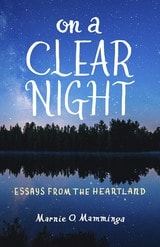
On a Clear Night
Essays from the HeartlandMarnie O. Mamminga
Wisconsin Historical Society Press, 2017
Combining elements of the personal and the universal, these essays chart the passage of time from childhood to adulthood, sickness to health, working life to retirement, parenthood to grandparenthood, and everything in between. These sharply observed vignettes highlight the importance of taking time to appreciate the ordinary occurrences that profoundly shape our lives and the places we call home.
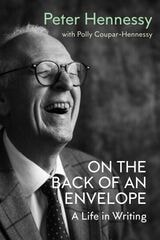
On the Back of an Envelope
A Life in WritingPeter Hennessy
Haus Publishing, 2025
As one of Britain’s foremost constitutional experts and contemporary historians, Peter Hennessy has spent his professional life unpicking the arcane world of Whitehall and Westminster. He began his career as a journalist for the Times, the Economist, and the Financial Times, developing a network of insider contacts who helped him shine a light on some of the dustiest corners of the British establishment. As a journalist, prize-winning contemporary historian, and political commentator, he has chronicled the workings of the British state with wit, affection, and a healthy sense of the absurd over a five-decade career. Now a crossbench peer, he has, in his own words, “moved in with his exhibits.” Hennessy is also a stalwart of BBC election night coverage and a regular commentator on BBC Radio 4, bringing a historical and constitutional perspective on current events.
In this new volume, he brings together selected journalism, unpublished lectures, and new writing alongside personal recollections and reflections on his time observing postwar Britain, how it is governed, and those who do the governing. He reflects on the making and unmaking of prime ministers from Attlee to Truss, life in the House of Lords, and the changing constitutional landscape in the wake of Brexit and amid uncertainty about the future of the Union. Interspersed with lectures, journalism, and new pieces, Hennessy also looks back at a fascinating career, reflecting on his own experiences as a young green graduate navigating the hard-nosed world of Fleet Street in the 1970s, bringing to life a cast of characters from a world now largely gone. He revisits his time as a public historian, academic, and crossbench peer with a levity reflected in his belief that history is “gossip with footnotes.”
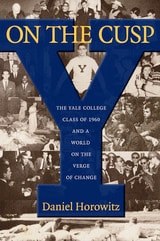
On the Cusp
The Yale College Class of 1960 and a World on the Verge of ChangeDaniel Horowitz
University of Massachusetts Press, 2015
How did the 1950s become “The Sixties”? This is the question at the heart of Daniel Horowitz's On the Cusp. Part personal memoir, part collective biography, and part cultural history, the book illuminates the dynamics of social and political change through the experiences of a small, and admittedly privileged, generational cohort.
A Jewish “townie” from New Haven when he entered Yale College in fall 1956, Horowitz reconstructs the undergraduate career of the class of 1960 and follows its story into the next decade. He begins by looking at curricular and extracurricular life on the all-male campus, then ranges beyond the confines of Yale to larger contexts, including the local drama of urban renewal, the lingering shadow of McCarthyism, and decolonization movements around the world. He ponders the role of the university in protecting the prerogatives of class while fostering social mobility, and examines the growing significance of race and gender in American politics and culture, spurred by a convergence of the personal and the political. Along the way he traces the political evolution of his classmates, left and right, as Cold War imperatives lose force and public attention shifts to the civil rights movement and the war in Vietnam.
Throughout Horowitz draws on a broad range of sources, including personal interviews, writings by classmates, reunion books, issues of the Yale Daily News, and other undergraduate publications, as well as his own letters and college papers. The end product is a work consistent with much of Horowitz's previously published scholarship on postwar America, further exposing the undercurrent of discontent and dissent that ran just beneath the surface of the so-called Cold War consensus.
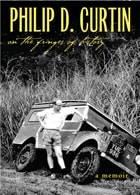
On the Fringes of History
A MemoirPhilip D. Curtin
Ohio University Press, 2005
In the 1950s, professional historians claiming to specialize in tropical Africa were no more than a handful. The teaching of world history was confined to high school courses, and even those were focused on European history, with a chapter added to account for the history of East and South Asia. The change over the ensuing decades was revolutionary.
Philip D. Curtin was a leader among a new generation of historians that emerged after the Second World War. Written with characteristic economy and telling detail, On the Fringes of History: A Memoir follows Curtin from his beginnings in central West Virginia in the 1920s, through a distinguished academic career in which Curtin founded African studies at the University of Wisconsin. He began the programs in comparative world history at Wisconsin and Johns Hopkins, producing many of the most influential historians and Africanists from the 1950s to today.
Always an independent thinker and controversial figure, Curtin revived the study of the Atlantic slave trade. His career stands as an example of the kind of dissatisfaction and struggles that brought about a sea change in higher education. On the Fringes of History traces the movement of African history and world history from the fringes of the history profession into the mainstream. This stunningly illustrated memoir illuminates both the career of a leading historian and the history of twentieth-century academia.
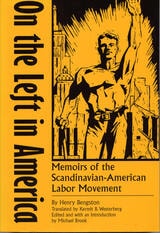
On the Left in America
Memoirs of the Scandinavian-American Labor MovementHenry Bengston. Translated by Kermit B. Westerberg. Edited and with an Introduction by Michael Brook
Southern Illinois University Press, 1999
Previously available only in an out-of-print Swedish edition published in 1955, Henry Bengston's firsthand account deals with what historian Dag Blanck calls the "other Swedish America."
Swedish immigrants in general were conservative, but Bengston and others—most notably Joe Hill—joined the working-class labor movement on the left, primarily as Debsian socialists, although their ranks included other socialists, communists, and anarchists. Involved in the radical labor movement on many fronts, Bengston was the editor of Svenska Socialisten from 1912 until he dropped out of the Scandinavian Socialist Federation in 1920. Even after 1920, however, his sympathies remained with the movement he had once strongly espoused.
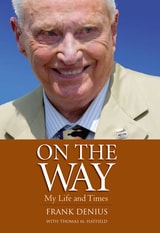
On the Way
My Life and TimesBy Frank Denius
University of Texas Press, 2016
Frank Denius was not yet twenty-one when he fought his way across Europe and was awarded four Silver Stars, a Presidential Unit Citation, and two Purple Hearts. On the Way describes Denius’s formative experiences during World War II in gripping detail and will cause any reader to wonder how he or she might have held up under similar pressure. The powerful opening chapters are followed by a detailed account of Denius’s life and career after the war, assembled into a first-person memoir from conversations between Denius and Thomas Hatfield, and published by the Briscoe Center for American History at the University of Texas at Austin.
Discharged from the army in October 1945, Denius enrolled at the University of Texas within a week. He is a lifelong supporter of the university: as part of the Texas Exes, as a donor to numerous academic programs, and as a fan of Longhorn football. Former UT football coach Mack Brown liked to say, “Frank has been to more practices than I have.”
Denius graduated from the University of Texas School of Law and joined one of Austin’s leading law firms in the late 1940s. Denius recounts how Texas operated in Lyndon Johnson’s prime, observes power plays in the Texas energy industry, and describes his role in building a regional university into a global leader.
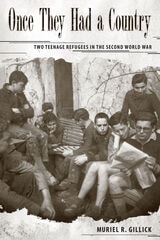
Once They Had a Country
Two Teenage Refugees in the Second World WarMuriel R. Gillick
University of Alabama Press, 2010
A powerful true story of survival, displacement, and hope in a world at war.
Muriel Gillick draws from a remarkable set of primary source materials, including letters, telegrams, and police records to relate the story of two teenage refugees during World War II. Once They Had a Country conveys well what it was like to establish a new life in a foreign country—over and over again and in constant fear for one’s life. The work tells of the extraordinary experiences of the author’s parents in Europe and demonstrates how citizens and the governments of Belgium, France, Switzerland, Brazil, America, China, and postwar Germany treated refugees. This story also reveals the origins of the Convention Relating to the Status of Refugees, the basis of contemporary international law affecting refugees in many countries today.
In addition to the dramatic human story it tells, this work brings the plight of refugees home to the reader—and with over 8 million refugees worldwide today, the subject of how individuals and nation states respond to these individuals is indeed timely.
Once a Professor
A Memoir of Teaching in Turbulent TimesJerry Apps
Wisconsin Historical Society Press, 2018
“I never wanted to be a professor,” writes Jerry Apps in the introduction to Once a Professor. Yet a series of unexpected events and unplanned experiences put him on an unlikely path—and led to a thirty-eight-year career at the University of Wisconsin.
In this continuation of the Apps life story begun in his childhood memoir Limping through Life, Wisconsin’s celebrated rural storyteller shares stories from his years at the University of Wisconsin–Madison from 1957 to 1995, when he left the university to lecture and write fulltime. During those years Apps experienced the turmoil of protests and riots at the UW in the 1960s, the struggles of the tenure process and faculty governance, and the ever-present pressure to secure funding for academic research and programs.
Through it all, the award-winning writer honed a personal philosophy of education—one that values critical thinking, nontraditional teaching approaches, and hands-on experiences outside of the classroom. Colorful characters, personal photos, and journal entries from the era enrich this account of an unexpected campus career.
One Day a Year
2001–2011Christa Wolf
Seagull Books, 2017
The book is both a personal record and a unique document of our times. With her characteristic precision and transparency, Wolf examines the interplay of the private, subjective, and major contemporary historical events. She writes about Germany after 9/11, about her work on her last great book City of Angels, and also about her exhausting confrontation with old age. One Day a Year is a compelling and personal glimpse into the life of one of the world’s greatest writers.
One Hour in Paris
A True Story of Rape and RecoveryKaryn L. Freedman
University of Chicago Press, 2014
At once deeply intimate and terrifyingly universal, One Hour in Paris weaves together Freedman’s personal experience with the latest philosophical, neuroscientific, and psychological insights on what it means to live in a body that has been traumatized. Using her background as a philosopher, she looks at the history of psychological trauma and draws on recent theories of posttraumatic stress disorder and neuroplasticity to show how recovery from horrific experiences is possible. Through frank discussions of sex and intimacy, she explores the consequences of sexual violence for love and relationships, and she illustrates the steep personal cost of sexual violence and the obstacles faced by individual survivors in its aftermath. Freedman’s book is an urgent call to face this fundamental social problem head-on, arguing that we cannot continue to ignore the fact that sexual violence against women is rooted in gender inequalities that exist worldwide—and must be addressed.
One Hour in Paris is essential reading for survivors of sexual violence as well as an invaluable resource for therapists, mental health professionals, and family members and friends of victims.

One Sunny Day
A Child's Memories of HiroshimaHideko Tamura Snider
Oregon State University Press, 2023
Hideko was ten years old when the atomic bomb devastated her home in Hiroshima. In this eloquent and moving narrative, Hideko recalls her life before the bomb, the explosion itself, and the influence of that trauma upon her subsequent life in Japan and the United States. Her years in America have given her unusual insights into the relationship between Japanese and American cultures and the impact of Hiroshima on our lives.
This new edition includes two expanded chapters and revisions throughout. A new epilogue brings the story up to date. This poignant story of courage and resilience remains deeply relevant today, offering a profoundly personal testament against the ongoing threat of nuclear warfare.
One of Us
A Family's Life with AutismMark Osteen
University of Missouri Press, 2010
In 1991, Mark Osteen and his wife, Leslie, were struggling to understand why their son, Cameron, was so different from other kids. At age one, Cam had little interest in toys and was surprisingly fixated on books. He didn’t make baby sounds; he ignored other children. As he grew older, he failed to grasp language, remaining unresponsive even when his parents called his name. When Cam started having screaming anxiety attacks, Mark and Leslie began to grasp that Cam was developmentally delayed. But when Leslie raised the possibility of an autism diagnosis, Mark balked. Autism is so rare, he thought. Might as well worry about being struck by lightning.
Since that time, awareness of autism has grown monumentally. Autism has received extensive coverage in the news media, and it has become a popular subject for film, television, and literature, but the disorder is frequently portrayed and perceived as a set of eccentricities that can be corrected with proper treatment. In reality, autism permanently wrecks many children’s chances for typical lives. Plenty of recent bestsellers have described the hardships of autism, but those memoirs usually focus on the recovery of people who overcome some or all of the challenges of the disorder. And while that plot is uplifting, it’s rare in real life, as few autistic children fully recover. The territory of severe autism—of the child who is debilitated by the condition, who will never be cured—has been largely neglected. One of Us: A Family’s Life with Autism tells that story.
In this book, Mark Osteen chronicles the experience of raising Cam, whose autism causes him aggression, insomnia, compulsions, and physical sickness. In a powerful, deeply personal narrative, Osteen recounts the struggles he and his wife endured in diagnosing, treating, and understanding Cam’s disability, following the family through the years of medical difficulties and emotional wrangling. One of Us thrusts the reader into the life of a child who exists in his own world and describes the immense hardships faced by those who love and care for him. Leslie and Mark's marriage is sorely tested by their son's condition, and the book follows their progress from denial to acceptance while they fight to save their own relationship.
By embracing the little victories of their life with Cam and by learning to love him as he is, Mark takes the reader down a road just as gratifying, and perhaps more moving, than one to recovery. One of Us is not a book about a child who overcomes autism. Instead, it’s the story of a different but equally rare sort of victory—the triumph of love over tremendous adversity.
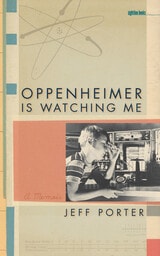
Oppenheimer Is Watching Me
A MemoirJeff Porter
University of Iowa Press, 2007
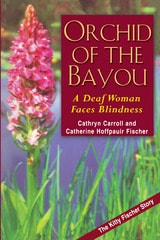
Orchid of the Bayou
A Deaf Woman Faces BlindessCathryn Carroll
Gallaudet University Press, 2001
In graduating from Gallaudet University, finding a job in Washington, D.C., and starting a family with her college sweetheart, Kitty Fischer tacitly abandoned the Louisiana Cajun culture that had exposed her to little more than prejudice and misery as a child. Upon discovering that she suffered from Usher syndrome (a genetic condition that causes both deafness and blindness), however, Fischer began an unlikely journey toward reclaiming her heritage. She and Cathryn Carroll tell the story of her heroic struggle and cultural odyssey in Orchid of the Bayou: A Deaf Woman Faces Blindness.
“By this time Mama knew I was ‘not right,’” Fischer says of her early childhood. “She knew the real words for ‘not right,’ too, though she never said those words. I was deaf and dumb.” Initially Fischer’s parents turned to folk healers to try and “cure” their daughter’s deafness, but an aunt’s fortunate discovery of the Louisiana School for the Deaf would rescue Fischer from misunderstanding and introduce her to sign language and Deaf culture. She weathered the school’'s experiments with oralism and soon rose to the top of her class, ultimately leaving Louisiana for the academic promise of Gallaudet.
While in college, Fischer met and married her future husband, Lance, a Jewish Deaf man from Brooklyn, New York, and each landed jobs close to their alma mater. After the birth of their first child, however, Fischer could no longer ignore her increasing tunnel vision. Doctors quickly confirmed that Fischer had Usher syndrome.
While Fischer struggled to come to terms with her condition, the high incidence of Usher syndrome among Cajun people led her to re-examine her cultural roots. “Could I still be me, Catherine Hoffpauir Fischer, had I not been born of a mix that codes for Usher syndrome?” she asks. “To some extent, the history of my people explains the constitution of my genes and the way my life has unfolded.” Today Fischer prospers, enjoying her time with family and friends and celebrating the Deaf, Cajun, Blind, and Jewish cultures that populate her life. Her lively story will resonate with anyone who recognizes the arduous journey toward claiming an identity.

Our House in the Clouds
Building a Second Life in the Andes of EcuadorBy Judy Blankenship
University of Texas Press, 2013
While many baby boomers are downsizing to a simpler retirement lifestyle, photographer and writer Judy Blankenship and her husband Michael Jenkins took a more challenging leap in deciding to build a house on the side of a mountain in southern Ecuador. They now live half the year in Cañar, an indigenous community they came to know in the early nineties when Blankenship taught photography there. They are the only extranjeros (outsiders) in this homely, chilly town at 10,100 feet, where every afternoon a spectacular mass of clouds rolls up from the river valley below and envelopes the town.
In this absorbing memoir, Blankenship tells the interwoven stories of building their house in the clouds and strengthening their ties to the community. Although she and Michael had spent considerable time in Cañar before deciding to move there, they still had much to learn about local customs as they navigated the process of building a house with traditional materials using a local architect and craftspeople. Likewise, fulfilling their obligations as neighbors in a community based on reciprocity presented its own challenges and rewards. Blankenship writes vividly of the rituals of births, baptisms, marriages, festival days, and deaths that counterpoint her and Michael’s solitary pursuits of reading, writing, listening to opera, playing chess, and cooking. Their story will appeal to anyone contemplating a second life, as well as those seeking a deeper understanding of daily life in the developing world.
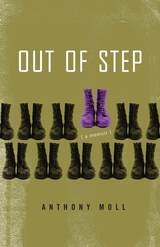
Out of Step
A MemoirAnthony Moll
The Ohio State University Press, 2018
What makes a pink-haired queer raise his hand to enlist in the military just as the nation is charging into war? In his memoir, Out of Step, Anthony Moll tells the story of a working-class bisexual boy running off to join the army in the midst of two wars and the “Don’t Ask, Don’t Tell” era. Set against the backdrop of hypermasculinity and sexual secrecy, Moll weaves a queer coming-of-age story.
Out of Step traces Moll’s development through his military service, recounting how the army both breaks and builds relationships, and what it was like to explore his queer identity while also coming to terms with his role in the nation’s ugly foreign policy. From a punk, nerdy, left-leaning, poor boy in Nevada leaving home for the first time to an adult returning to civilian life and forced to address a world more complicated than he was raised to believe, Moll’s journey isn’t a classic flag-waving memoir or war story—it’s a tale of finding one’s identity in the face of war and changing ideals.
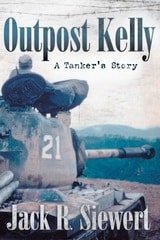
Outpost Kelly
A Tanker's StoryJack R. Siewert, with a foreword by Paul M Edwards
University of Alabama Press, 2006
Heavy rains turned the mountainous terrain around Outpost Kelly into shin-deep mud and muck. At the height of the fighting, Siewert was able to bring to bear the guns of only one of his five tanks against the enemy. Forced to abandon traditional tank warfare doctrine, he improvised. Allowing members of the 15th Infantry to retake Outpost Kelly, Siewert offers an excellent analysis of how theory and experience come together in a point-of-the-spear military situation.
Outpost Kelly also paints a fascinating picture of the type of fighting, often overlooked, that characterized the second and third years of the Korean War. With truce talks proceeding in Panmunjom, both sides fought to claim incremental pieces of real estate along the demarcation line between North and South.
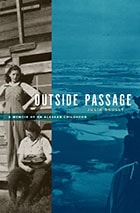
Outside Passage
A Memoir of an Alaskan ChildhoodJulia Scully
University of Alaska Press, 2010
Outside Passage is a lyrical and affecting memoir of those years, simultaneously an emotional account of a young girl’s first steps into adulthood and a unique portrait of a vanished frontier life.
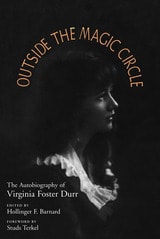
Outside the Magic Circle
The Autobiography of Virginia Foster DurrHollinger F. Barnard
University of Alabama Press, 1990
Winner of the Alabama Library Author Award
Outside the Magic Circle tells the remarkable story of Virginia Foster Durr, a southern white woman born into privilige who (along with her husband Clifford Durr, a lawyer best known for defending Rosa Parks), nonetheless devoted her life to Civil Rights activism.
Outside the Magic Circle is the powerful and deeply personal autobiography of Virginia Foster Durr, a Southern woman who defied the expectations of her privileged upbringing to become one of the most courageous voices for civil rights and social justice in 20th-century America. Born into a wealthy, white Alabama family, Durr was raised in a world steeped in segregation and conservative values. Yet through a journey marked by moral reckoning, intellectual awakening, and political activism, she stepped outside the “magic circle” of Southern gentility to confront the injustices that shaped her world.
With a foreword by renowned oral historian Studs Terkel, this memoir captures Durr’s transformation from reluctant conformist to outspoken advocate. Her story spans decades of American history—from the Great Depression and New Deal politics to the McCarthy era and the Civil Rights Movement. Alongside her husband, attorney Clifford Durr, Virginia became a key figure in progressive circles, working to abolish the poll tax, defend civil liberties, and support Black activists in the segregated South.
Told in Durr’s own voice, the narrative is rich with anecdotes, reflections, and encounters with historical figures such as Eleanor Roosevelt, Rosa Parks, and Martin Luther King Jr. It is both a personal reckoning and a political document, offering rare insight into the inner conflicts of white Southern liberals and the cost of dissent in a deeply divided society.
Outside the Magic Circle is more than a memoir—it is a testament to the power of conscience, the courage of transformation, and the enduring fight for justice. It remains a vital resource for readers interested in civil rights history, feminist thought, and the complexities of Southern identity.
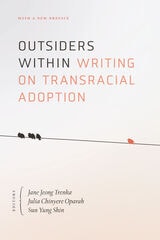
Outsiders Within
Writing on Transracial AdoptionJane Jeong Trenka
University of Minnesota Press, 2020
Confronting trauma behind the transnational adoption system—now back in print
Many adoptees are required to become people that they were never meant to be. While transracial adoption tends to be considered benevolent, it often exacts a heavy emotional, cultural, and economic toll on those who directly experience it. Outsiders Within is a landmark publication that carefully explores this most intimate aspect of globalization through essays, fiction, poetry, and art. Moving beyond personal narrative, transracially adopted writers from around the world tackle difficult questions about how to survive the racist and ethnocentric worlds they inhabit, what connects the countries relinquishing their children to the countries importing them, why poor families of color have their children removed rather than supported—about who, ultimately, they are. In their inquiry, the contributors unseat conventional understandings of adoption politics, reframing the controversy as a debate that encompasses human rights, peace, and reproductive justice.
Contributors: Heidi Lynn Adelsman; Ellen M. Barry; Laura Briggs, U of Massachusetts, Amherst; Catherine Ceniza Choy, U of California, Berkeley; Gregory Paul Choy, U of California, Berkeley; Rachel Quy Collier; J. A. Dare; Kim Diehl; Kimberly R. Fardy; Laura Gannarelli; Shannon Gibney; Mark Hagland; Perlita Harris; Tobias Hübinette, Stockholm U; Jae Ran Kim; Anh Đào Kolbe; Mihee-Nathalie Lemoine; Beth Kyong Lo; Ron M.; Patrick McDermott, Salem State College, Massachusetts; Tracey Moffatt; Ami Inja Nafzger (aka Jin Inja); Kim Park Nelson; John Raible; Dorothy Roberts, Northwestern U; Raquel Evita Saraswati; Kirsten Hoo-Mi Sloth; Soo Na; Shandra Spears; Heidi Kiiwetinepinesiik Stark; Kekek Jason Todd Stark; Sunny Jo; Sandra White Hawk; Indigo Williams Willing; Bryan Thao Worra; Jeni C. Wright.
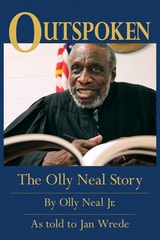
Outspoken
The Olly Neal StoryOlly Neal
Butler Center for Arkansas Studies, 2020
His road to success was not a smooth one, and Neal tells his unique story with humor, candor, and hard-earned wisdom, explaining his rocky journey from hardscrabble beginnings in rural Lee County to the role of prosecutor to the judicial bench. Along the way, many whites saw him as a threat to the established order and many blacks saw him as a traitor who was prosecuting and sitting in judgment of his own people. But Neal emphasized fairness and equal treatment at every opportunity, saying, “The way I got past all of this was by talking to my people about what I did and why, and by telling them how difficult it was for me. And I think that many folks understood me.” Looking back on these years and the people he met along the way, he offers insights into the traumas of the time and the toll they took on his mental and physical health, as well as the relationships that helped him face these challenges.
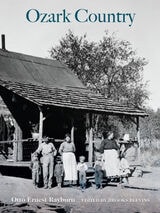
Ozark Country
Otto Ernest Rayburn
University of Arkansas Press, 2021
Published just days before America’s entry into World War II, Ozark Country is Otto Ernest Rayburn’s love letter to his adopted region. One of several chronicles of the Ozarks that garnered national attention during the Depression and war years, when many Americans craved stories about people and places seemingly untouched by the difficulties of the times, Rayburn’s colorful tour takes readers from the fictional village of Woodville into the backcountry of a region teeming with storytellers, ballad singers, superstitions, and home remedies.
Rayburn’s tales—fantastical, fun, and unapologetically romantic—portray a world that had already nearly disappeared by the time they were written. Yet Rayburn’s depiction of the Ozarks resonates with notions of the region that have persisted in the American consciousness ever since.