Results by title
125 books match the query 'Migration' and 2 start with o
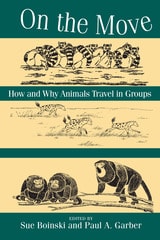
On the Move
How and Why Animals Travel in GroupsEdited by Sue Boinski and Paul A. Garber
University of Chicago Press, 2000
Getting from here to there may be simple for one individual. But as any parent, scout leader, or CEO knows, herding a whole troop in one direction is a lot more complicated. Who leads the group? Who decides where the group will travel, and using what information? How do they accomplish these tasks?
On the Move addresses these questions, examining the social, cognitive, and ecological processes that underlie patterns and strategies of group travel. Chapters discuss how factors such as group size, resource distribution and availability, the costs of travel, predation, social cohesion, and cognitive skills affect how individuals as well as social groups exploit their environment. Most chapters focus on field studies of a wide range of human and nonhuman primate groups, from squirrel monkeys to Turkana pastoralists, but chapters covering group travel in hyenas, birds, dolphins, and bees provide a broad taxonomic perspective and offer new insights into comparative questions, such as whether primates are unique in their ability to coordinate group-level activities.
On the Move addresses these questions, examining the social, cognitive, and ecological processes that underlie patterns and strategies of group travel. Chapters discuss how factors such as group size, resource distribution and availability, the costs of travel, predation, social cohesion, and cognitive skills affect how individuals as well as social groups exploit their environment. Most chapters focus on field studies of a wide range of human and nonhuman primate groups, from squirrel monkeys to Turkana pastoralists, but chapters covering group travel in hyenas, birds, dolphins, and bees provide a broad taxonomic perspective and offer new insights into comparative questions, such as whether primates are unique in their ability to coordinate group-level activities.
[more]

Organised Crime and Migration
Criminal Groups, Corruption and the Displacement Crisis in Central America and MexicoVictorie Knox
University of London Press, 2026
This book is the first to consider together three major, interconnected ways in which organized crime shapes migration in Mexico and Central America: as a driver of internal displacement and external migration, as a threat to migrants in transit, and as a facilitator of unauthorized migration through people-smuggling.
Organized criminal groups have been involved in the abuse of migrants and people-smuggling in Mexico for many years. A displacement crisis has emerged as people with different potential protection needs flee a complex mix of factors in Central America, from violence and threats from criminal gangs, persecution by state actors, gender violence, and hate crime to the impact of climate change, natural disasters, and entrenched inequality and poverty.
Drawing on original interview material with key informants speaking in their professional capacity and with migrants and refugees during their journey, the book analyzes organized crime’s role in provoking human displacement and the abuse of migrants, reflecting on state responsibility, the role of policy, corruption, and impunity in perpetuating abuse, and the implications for human rights. In doing so, it provides a new understanding of the likely consequences of implementing or externalizing migration policy in regions affected by endemic criminal violence and corruption globally.
[more]