Results by title
225 books match the query 'Modernism' and 7 start with o
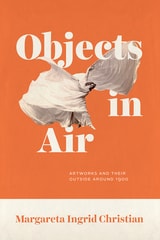
Objects in Air
Artworks and Their Outside around 1900Margareta Ingrid Christian
University of Chicago Press, 2021
Writers created an early theory of unbounded form that described what Christian calls an artwork’s ecstasis or its ability to stray outside its limits and engender its own space. Objects viewed in this perspective complicate the now-fashionable discourse of empathy aesthetics, the attention to self-projecting subjects, and the idea of the modernist self-contained artwork. For example, Christian invites us to historicize the immersive spatial installations and “environments” that have arisen since the 1960s and to consider their origins in turn-of-the-twentieth-century aesthetics. Throughout this beautifully written work, Christian offers ways for us to rethink entrenched narratives of aesthetics and modernism and to revisit alternatives.
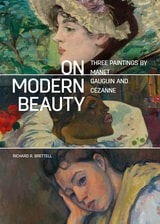
On Modern Beauty
Three Paintings by Manet, Gauguin, and CézanneRichard R. Brettell
J. Paul Getty Trust, The, 2019
Brettell shapes his manifesto around three masterworks from the collection of the J. Paul Getty Museum: Édouard Manet’s Jeanne (Spring), Paul Gauguin’s Arii Matamoe (The Royal End), and Paul Cézanne’s Young Italian Woman at a Table. The provocative discussion reveals how each of these exceptional paintings, though depicting very different subjects—a fashionable actress, a preserved head, and a weary working woman—enacts a revolutionary, yet enduring, icon of beauty.
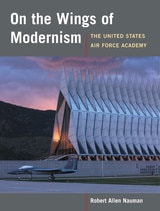
On the Wings of Modernism
The United States Air Force AcademyRobert Allen Nauman
University of Illinois Press, 2003
The United States Air Force Academy stands as one of the most extensive architectural projects of the cold war era. Key to a full understanding of American modernism, the project was also a volatile battleground involving competing ideas about aesthetics and politics. Arguing that the academy's production was squarely grounded in bureaucratic and political processes, Robert Allen Nauman demonstrates that selection of both the site and the design firm was the result of political maneuverings involving U.S. military leadership.
In the academy’s iconic design, myths and metaphors of flight and the American West were interwoven with those of modernism, both to justify the plan and to free it from any lingering socialist or European associations. Skidmore, Owings, and Merrill’s first public exhibition of plans and models for the project was designed by the former Bauhaus master Herbert Bayer, and it incorporated photographs of the Colorado Springs site by Ansel Adams and William Garnett. Using previously unexplored resources of the U.S. Air Force Academy, SOM, and the Air Force Academy Construction Agency, Nauman uncovered materials such as negatives of Adams’s original photographs of the sites. He also conducted extensive interviews with SOM’s project director for the academy, Walter Netsch, in tracing the complete history of the academy's construction, from its earliest conception to eventual completion.
Orientalism and Modernism
The Legacy of China in Pound and WilliamsZhaoming Qian
Duke University Press, 1995
Consulting rare and unpublished materials, Qian traces Pound’s and Williams’s remarkable dialogues with the great Chinese poets—Qu Yuan, Li Bo, Wang Wei, and Bo Juyi—between 1913 and 1923. His investigation reveals that these exchanges contributed more than topical and thematic ideas to the Americans’ work and suggests that their progressively modernist style is directly linked to a steadily growing contact and affinity for similar Chinese styles. He demonstrates, for example, how such influences as the ethics of pictorial representation, the style of ellipsis, allusion, and juxtaposition, and the Taoist/Zen–Buddhist notion of nonbeing/being made their way into Pound’s pre-Fenollosan Chinese adaptations, Cathay, Lustra, and the Early Cantos, as well as Williams’s Sour Grapes and Spring and All. Developing a new interpretation of important work by Pound and Williams, Orientalism and Modernism fills a significant gap in accounts of American Modernism, which can be seen here for the first time in its truly multicultural character.
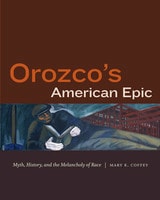
Orozco's American Epic
Myth, History, and the Melancholy of RaceMary K. Coffey
Duke University Press, 2020
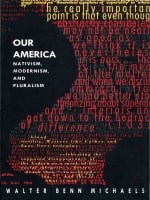
Our America
Nativism, Modernism, and PluralismWalter Benn Michaels
Duke University Press, 1997
“We have a great desire to be supremely American,” Calvin Coolidge wrote in 1924. That desire, Michaels tells us, is at the very heart of American modernism, giving form and substance to a cultural movement that would in turn redefine America’s cultural and collective identity—ultimately along racial lines. A provocative reinterpretation of American modernism, Our America also offers a new way of understanding current debates over the meaning of race, identity, multiculturalism, and pluralism.
Michaels contends that the aesthetic movement of modernism and the social movement of nativism came together in the 1920s in their commitment to resolve the meaning of identity—linguistic, national, cultural, and racial. Just as the Johnson Immigration Act of 1924, which excluded aliens, and the Indian Citizenship Act of the same year, which honored the truly native, reconceptualized national identity, so the major texts of American writers such as Cather, Faulkner, Hurston, and Williams reinvented identity as an object of pathos—something that can be lost or found, defended or betrayed. Our America is both a history and a critique of this invention, tracing its development from the white supremacism of the Progressive period through the cultural pluralism of the Twenties. Michaels’s sustained rereading of the texts of the period—the canonical, the popular, and the less familiar—exposes recurring concerns such as the reconception of the image of the Indian as a symbol of racial purity and national origins, the relation between World War I and race, contradictory appeals to the family as a model for the nation, and anxieties about reproduction that subliminally tie whiteness and national identity to incest, sterility, and impotence.
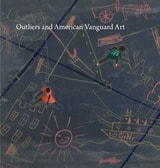
Outliers and American Vanguard Art
Lynne Cooke
University of Chicago Press, 2017
The art works in Outliers and American Vanguard Art come from three distinct periods when the intersections between mainstream and outlier artists were most dynamic and productive, ushering in exhibitions of art based on various degrees of co-existence, inclusion, and assimilation. Works by such diverse artists as Charles Sheeler, Christina Ramberg, and Matt Mullican are set in conversation with a range of works by such self-taught artists as Horace Pippin, Janet Sobel, and Henry Darger. Cooke also examines a recent increase of radically expressive work that challenges what it means to be an outlier today. She reveals how these distinctions have been freighted with a particularly American point of view as she investigates our assumptions about creativity, artistic practice, and the role of the artist in contemporary culture.
Outliers and American Vanguard Art is the most comprehensive show ever to examine outliers in dialogue with their established peers. It is sure to inspire vigorous conversation about how artists and the work they make are represented.