Results by title
193 books match the query 'Modernism (Literature)' and 10 start with o
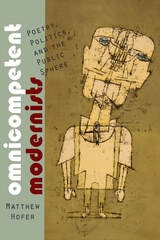
Omnicompetent Modernists
Poetry, Politics, and the Public SphereMatthew Hofer
University of Alabama Press, 2022
An innovative exploration of early twentieth-century avant-garde poetry’s relationship to the public sphere
“It is difficult / to get the news from poems / yet men die miserably every day / for lack / of what is found there,” as the poet William Carlos Williams memorably declared. In Omnicompetent Modernists: Poetry, Politics, and the Public Sphere, Matthew Hofer examines, through a multilayered literary critique of interwar modernist poetry, what it might mean to get the news, and more, from a poet.
Using pragmatist ideas about the public sphere as a tool, Hofer reveals how Langston Hughes, Ezra Pound, and Mina Loy sought to use literature to both express and enable thought. In Hughes, Pound, and Loy, Hofer attends to poets whose work vigorously imagined possible new relationships between language, thinking, and public society. Each poet had different goals and used different methods, but all found both inspiration and encouragement in popular political theory. Hughes advocated for a more just vision of color and class in the United States. Pound sought to condemn those whom he associated with public harm, linguistically, socially, economically, and politically. Loy championed the “psycho-democratic” representation of women, in both public and private life.
Although Hughes, Pound, and Loy are rarely considered together, what unites these three writers is how each reconceived the public realm, and revolutionized aesthetic form to articulate those visions. Hofer combines sharp intellectual historiography with rigorous literary criticism and the result is a study that reinvigorates both the poems and poets under consideration and speaks to the immense power of language in manipulating public opinion—with pertinent implications for the politics of the present.

On The Modernist Long Poem
Margaret Dickie
University of Iowa Press, 1986
Beyond Lionel Trilling's classic definition of Modernism as anticultural and subversive, Margaret Dickie posits American Modernist poetry as both conservative and affirmative—conservative because it was dominated by the composition of the long poem, affirmative because these poems aimed to restore public themes to poetry, to instruct and improve, to "affirm the gold thread in the pattern," as Ezra Pound claimed.
Each poet discussed in this new study—T. S. Eliot, Hart Crane, William Carlos Williams, and Ezra Pound—began his career as an experimenter in brief lyrics and then, paradoxically, developed an ambition to write a long public poem. The poems they wrote—The Waste Land, The Bridge, Paterson, and The Cantos—differed in length, in program, and in composition, but all were alike in their idealization of form, their commitment to the long poem, and the troubled and difficult process of their composition. Read together, they offer a new understanding of the Modernist sense of form shared by these quite different writers.
Tracing the development of each poem from the poet's initial announced plans through the lengthy writing and reconsideration of purpose, Dickie offers a new history not only of each poem but of the American Modernists and the ways they adapted the avant-garde tendencies of European Modernism to their own native needs.
Opposing Poetries
Part One: Issues and InstitutionsHank Lazer
Northwestern University Press, 1996
Volume One examines the shift in the governing assumptions of contemporary poetic practice. Lazer inspects the key critical works addressing poetries in the 1980s and 1990s, as well as the political and aesthetic impact of modern critics, poetry reading programs, and of the publishing industry and libraries on contemporary poetic practice.
Opposing Poetries
Part Two: ReadingsHank Lazer
Northwestern University Press, 1996
In Volume Two, Lazer presents a series of sustained readings of important experimental texts. Included are the poets Susan Howe, Lyn Hejinian, Bruce Andrews, and James Sherry. Lazer places these poets in the context of contemporary literary theory, and inspects both the successes and failures of said theory to interpret these works.
Ordinary Queerness in American Modernism
Jess Shollenberger
The Ohio State University Press, 2025
Orientalism and Modernism
The Legacy of China in Pound and WilliamsZhaoming Qian
Duke University Press, 1995
Consulting rare and unpublished materials, Qian traces Pound’s and Williams’s remarkable dialogues with the great Chinese poets—Qu Yuan, Li Bo, Wang Wei, and Bo Juyi—between 1913 and 1923. His investigation reveals that these exchanges contributed more than topical and thematic ideas to the Americans’ work and suggests that their progressively modernist style is directly linked to a steadily growing contact and affinity for similar Chinese styles. He demonstrates, for example, how such influences as the ethics of pictorial representation, the style of ellipsis, allusion, and juxtaposition, and the Taoist/Zen–Buddhist notion of nonbeing/being made their way into Pound’s pre-Fenollosan Chinese adaptations, Cathay, Lustra, and the Early Cantos, as well as Williams’s Sour Grapes and Spring and All. Developing a new interpretation of important work by Pound and Williams, Orientalism and Modernism fills a significant gap in accounts of American Modernism, which can be seen here for the first time in its truly multicultural character.
Ornament as Crisis
Architecture, Design, and Modernity in Hermann Broch's "The Sleepwalkers"Sarah McGaughey
Northwestern University Press, 2015
Ornament as Crisis explores the ways in which the novels of Hermann Broch’s Sleepwalkers (Schlafwandler) trilogy participate in and employ the history of architecture and architectural theory.
Beginning with the visual and architectural experiences of the figures in each novel, Sarah McGaughey analyzes the role of architecture in the trilogy as a whole, while discussing work by Broch’s contemporaries on architecture. She argues that The Sleepwalkers allows us to better understand how literature responds and contributes to social, theoretical, and spatial concepts of architecture. Ornament as Crisis guides readers through the spaces of Broch’s mdernist masterpiece and the architectural debates of his time.
Our America
Nativism, Modernism, and PluralismWalter Benn Michaels
Duke University Press, 1997
“We have a great desire to be supremely American,” Calvin Coolidge wrote in 1924. That desire, Michaels tells us, is at the very heart of American modernism, giving form and substance to a cultural movement that would in turn redefine America’s cultural and collective identity—ultimately along racial lines. A provocative reinterpretation of American modernism, Our America also offers a new way of understanding current debates over the meaning of race, identity, multiculturalism, and pluralism.
Michaels contends that the aesthetic movement of modernism and the social movement of nativism came together in the 1920s in their commitment to resolve the meaning of identity—linguistic, national, cultural, and racial. Just as the Johnson Immigration Act of 1924, which excluded aliens, and the Indian Citizenship Act of the same year, which honored the truly native, reconceptualized national identity, so the major texts of American writers such as Cather, Faulkner, Hurston, and Williams reinvented identity as an object of pathos—something that can be lost or found, defended or betrayed. Our America is both a history and a critique of this invention, tracing its development from the white supremacism of the Progressive period through the cultural pluralism of the Twenties. Michaels’s sustained rereading of the texts of the period—the canonical, the popular, and the less familiar—exposes recurring concerns such as the reconception of the image of the Indian as a symbol of racial purity and national origins, the relation between World War I and race, contradictory appeals to the family as a model for the nation, and anxieties about reproduction that subliminally tie whiteness and national identity to incest, sterility, and impotence.
Our Joyce
From Outcast to IconBy Joseph Kelly
University of Texas Press, 1997
James Joyce began his literary career as an Irishman writing to protest the deplorable conditions of his native country. Today, he is an icon in a field known as "Joyce studies." Our Joyce explores this amazing transformation of a literary reputation, offering a frank look into how and for whose benefit literary reputations are constructed.
Joseph Kelly looks at five defining moments in Joyce's reputation. Before 1914, when Joyce was most in control of his own reputation, he considered himself an Irish writer speaking to the Dublin middle classes. When T. S. Eliot and Ezra Pound began promoting Joyce in 1914, however, they initiated a cult of genius that transformed Joyce into a prototype of the "egoist," a writer talking only to other writers.
This view served the purposes of Morris Ernst in the 1930s, when he defended Ulysses against obscenity charges by arguing that geniuses were incapable of obscenity and that they wrote only for elite readers. That view of Joyce solidified in Richard Ellmann's award-winning 1950s biography, which portrayed Joyce as a self-centered genius who cared little for his readers and less for the world at war around him. The biography, in turn, led to Joyce's canonization by the academy, where a "Joyce industry" now flourishes within English departments.
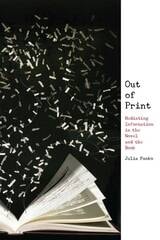
Out of Print
Mediating Information in the Novel and the BookJulia Panko
University of Massachusetts Press, 2020
This innovative study chronicles how the print book has fared as both novelists and the burgeoning profession of information science have grappled with unprecedented quantities of data across the twentieth and twenty-first centuries. As the novel's archival project took a critical turn from realism to an investigation of the structures, possibilities, and ideologies of information media, novelists have considered ideas about how data can best be collected and stored. Julia Panko pairs case studies from information history with close readings of modernist works such as James Joyce's Ulysses and Virginia Woolf's Orlando and contemporary novels from Jonathan Safran Foer, Stephen King, and Mark Z. Danielewski that emphasize their own informational qualities and experiment with the aesthetic potential of the print book.