Results by title
491 books match the query 'Moral and ethical aspects' and 7 start with o
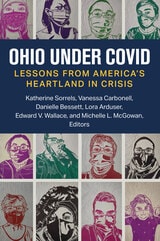
Ohio under COVID
Lessons from America's Heartland in CrisisKatherine Sorrels, Vanessa Carbonell, Danielle Bessett, Lora Arduser, Edward Wallace, and Michelle L. McGowan, Editors
University of Michigan Press, 2023
In early March of 2020, Americans watched with uncertain terror as the novel coronavirus pandemic unfolded. One week later, Ohio announced its first confirmed cases. Just one year later, the state had over a million cases and 18,000 Ohioans had died. What happened in that first pandemic year is not only a story of a public health disaster, but also a story of social disparities and moral dilemmas, of lives and livelihoods turned upside down, and of institutions and safety nets stretched to their limits.
Ohio under COVID tells the human story of COVID in Ohio, America’s bellwether state. Scholars and practitioners examine the pandemic response from multiple angles, and contributors from numerous walks of life offer moving first-person reflections. Two themes emerge again and again: how the pandemic revealed a deep tension between individual autonomy and the collective good, and how it exacerbated social inequalities in a state divided along social, economic, and political lines. Chapters address topics such as mask mandates, ableism, prisons, food insecurity, access to reproductive health care, and the need for more Black doctors. The book concludes with an interview with Dr. Amy Acton, the state’s top public health official at the time COVID hit Ohio. Ohio under COVID captures the devastating impact of the pandemic, both in the public discord it has unearthed and in the unfair burdens it has placed on the groups least equipped to bear them.
On Addiction
Insights from History, Ethnography, and Critical TheoryDarin Weinberg
Duke University Press, 2024

On European Ground
Alan Cohen
University of Chicago Press, 2001
Cohen's images achieve a solemn beauty even as they engage history at its most topical. Pictures of trenches and bunkers at the battlefields of Somme and Verdun explore the tension between the violence of the past and the inscrutability of its remnants. Photographs from the grounds of Dachau and Auschwitz solicit a provocative dialogue between the ordinariness of these sites today and their haunting memory. They teach us, as the New Art Examiner notes, "that the living perceptual connection to the Holocaust is vanishing." Images of the Berlin Wall show only the footprint of the barricade that once separated two hostile ideologies. They record the physical erosion and looming disappearance of the Wall while capturing its reappearance as a memorialized abstraction.
Accompanying the photographs in On European Ground are essays by Sander Gilman and Jonathan Bordo, as well as an interview with Cohen by critic Roberta Smith of the New York Times. The essays present both an introduction to and aesthetic analysis of Cohen's work, while the interview discusses the intractable problems of history and memory that his photographs so uniquely capture.
Oppenheimer
The Tragic IntellectCharles Thorpe
University of Chicago Press, 2007

Organ Transplantation Policy
James F. Blumstein and Frank A. Sloan, eds.
Duke University Press, 1989
A June 1988 symposium at Vanderbilt University gathered leaders in a wide variety of fields to synthesize the current state of knowledge concerning organ transplantation policy and to access policy options. Collected here are the revised papers presented at that symposium; also included is one influential earlier paper on the same topic. Together, they constitute a major contribution to the debate on organ transplantation policy and its moral, legal, financial, and political implications.

Our Enduring Values Revisited
Librarianship in an Ever-Changing WorldMichael Gorman
American Library Association, 2015
Our Enduring Values
Librarianship in the 21st CenturyMichael Gorman
American Library Association, 2000