Results by title
163 books match the query 'Nationalism & Patriotism' and 5 start with o

Oil and Nation
A History of Bolivia's Petroleum SectorStephen C. Cote
West Virginia University Press, 2016
The book advances chronologically from Bolivia’s earliest petroleum pioneers in the nineteenth century until the present, inserting oil into historical debates about Bolivian ethnic, racial, and environmental issues, and within development strategies by different administrations. While Bolivia is best known for its tin mining, Oil and Nation makes the case that nationalist reformers viewed hydrocarbons and the state oil company as a way to modernize the country away from the tin monoculture and its powerful backers and toward an oil-powered future.

Orange Parades
The Politics of Ritual, Tradition and ControlDominic Bryan
Pluto Press, 2000
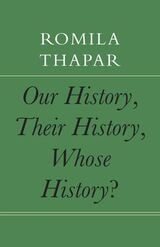
Our History, Their History, Whose History?
Romila Thapar
Seagull Books, 2023
In this timely book, historian Romila Thapar delves into the complex world of nationalism and its impact on the interpretations of the past and on the discipline of history itself. History, she expounds, is no mere collection of information and chronology, and its purpose extends well beyond storytelling.
Recognizing nationalism as a powerful force that gives rise to various narratives that provide ancestry to communities and shape the direction of societies, Thapar explores how, in India, two conflicting notions of nationalism have evolved and shaped the idea of the nation. Today, one such nationalistic theory claims the victimization of one religious community by another through centuries of “misrule.” Such a claim willfully ignores ample evidence to the contrary to suit a particular political and ideological purpose. Thapar counters such attempts at misrepresentation by citing several historical instances of the nuanced interface and intermingling of cultures, as well as by showing how today’s conflicts have their roots in the British colonial construction of India’s history. She also addresses the recent controversy surrounding the deletions of sections of Indian history textbooks published by NCERT, the Indian educational council, and suggests that the intention is more likely to be the promotion of a particular reading of history that conforms to the ideology of those in power.
Engaging and thought-provoking, Our History, Their History, Whose History? invites readers to question the authenticity of historical narratives touted by one group of nationalists, and it explores the clash between professional historians who study the past to understand our inherited present and fabricators who wield history for political gain.
Out of the Frame
The Struggle for Academic Freedom in IsraelIlan Pappe
Pluto Press, 2010
Even before he wrote his bestselling book The Ethnic Cleansing of Palestine, historian Ilan Pappe was a controversial figure in Israel. In Out of the Frame, he gives a full account of his break with mainstream Israeli scholarship and its consequences.
Here he traces his journey of discovery from the whispers of Palestinian classmates to his realisation that the 'enemy's' narrative of the events of 1948 was correct. After completing his thesis at Oxford University in the early 1980s, he returned to Palestine determined to protect the memory of the Nakbah. For the first time he gives the details of the formidable opposition he faced in Israel, including death threats fed by the media, denunciations by the Knesset and calls for him to be sacked from his post at Haifa university.
This revealing work, written with dignity and humour, highlights Israel's difficulty in facing up to its past and forging a peaceful, inclusive future in Palestine.
Overcoming Zionism
Creating a Single Democratic State in Israel/PalestineJoel Kovel
Pluto Press, 2007
Joel Kovel argues that the inner contradictions of Zionism have led Israel to a ‘state-sponsored racism’ fully as incorrigible as that of apartheid South Africa and deserving of the same resolution. Only a path toward a single-state secular democracy can provide the justice essential to healing the wounds of the Middle East.
Kovel is well-known writer on the Middle East conflict. This book draws on his detailed knowledge to show that Zionism and democracy are essentially incompatible. He offers a thoughtful account of the emergence and disintegration of Zionism that integrates psychological, political, cultural, economic, and ideological levels.
Ultimately, Kovel argues, a two-state solution is essentially hopeless as it concedes too much to the regressive forces of nationalism, wherein lie the roots of continued conflict.