Results by title
166 books match the query 'Native American' and 8 start with o

Ocean Power
Poems from the DesertOfelia Zepeda
University of Arizona Press, 1995
Poet Ofelia Zepeda centers these poems on her own experiences growing up in a Tohono O'odham family, where desert climate profoundly influenced daily life, and on her perceptions as a contemporary Tohono O'odham woman. One section of poems deals with contemporary life, personal history, and the meeting of old and new ways. Another section deals with winter and human responses to light and air. The final group of poems focuses on the nature of women, the ocean, and the way the past relationship of the O'odham with the ocean may still inform present day experience. These fine poems will give the outside reader a rich insight into the daily life of the Tohono O'odham people.
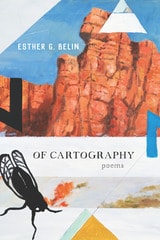
Of Cartography
PoemsEsther G. Belin
University of Arizona Press, 2017
In this long-anticipated collection, Belin daringly maps the poetics of womanhood, the body, institution, family, and love. Depicting the personal and the political, Of Cartography is an exploration of identity through language. With poems ranging from prose to typographic and linguistic illustrations, this distinctive collection pushes the boundaries of traditional poetic form.
Marking territory and position according to the Diné cardinal points, Of Cartography demands much from the reader, gives meaning to abstraction, and demonstrates the challenges of identity politics.
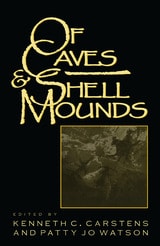
Of Caves and Shell Mounds
Edited by Kenneth C. Carstens and Patty Jo Watson
University of Alabama Press, 1996
Ancient human groups in the Eastern Woodlands of North America were long viewed as homogeneous and stable hunter-gatherers, changing little until the late prehistoric period when Mesoamerican influences were thought to have stimulated important economic and social developments. The authors in this volume offer new, contrary evidence to dispute this earlier assumption, and their studies demonstrate the vigor and complexity of prehistoric peoples in the North American Midwest and Midsouth. These peoples gathered at favored places along midcontinental streams to harvest mussels and other wild foods and to inter their dead in the shell mounds that had resulted from their riverside activities. They created a highly successful, pre-maize agricultural system beginning more than 4,000 years ago, established far-flung trade networks, and explored and mined the world's longest cave—the Mammoth Cave System in Kentucky.
Contributors include:
Kenneth C. Carstens, Cheryl Ann Munson, Guy Prentice, Kenneth B. Tankersley, Philip J. DiBlasi, Mary C. Kennedy, Jan Marie Hemberger, Gail E. Wagner, Christine K. Hensley, Valerie A. Haskins, Nicholas P. Herrmann, Mary Lucas Powell, Cheryl Claassen, David H. Dye, and Patty Jo Watson
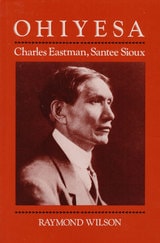
Ohiyesa
Charles Eastman, Santee SiouxRaymond Wilson
University of Illinois Press, 1983
Charles Eastman, called Ohiyesa in Santee, came of age amidst increasing tensions and violence between Native and European colonizers. Though raised to be a hunter-warrior, Eastman was persuaded by his Christian father to enter white society. Eastman graduated from Dartmouth and the Boston University School of Medicine. His career included service as the government physician at the Pine Ridge Agency, where he tended casualties at Wounded Knee; as an Inspector for the Bureau of Indian Affairs; as Indian secretary for the YMCA; and as one of the cofounders of the Boy Scouts of America.
Raymond Wilson examines these accomplishments while also delving into the writings that expressed Eastman’s determination to hold onto his Santee roots. Popular works like Indian Boyhood, The Soul of the Indian, and Indian Heroes and Chieftains reconfirmed his heritage and aimed at making white society aware of Indigenous peoples’ contribution to American civilization.
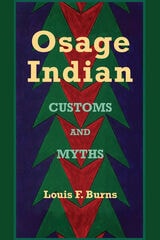
Osage Indian Customs and Myths
Louis F. Burns
University of Alabama Press, 2005
Siouan peoples who migrated from the Atlantic coastal region and settled in the central portion of the North American continent long before the arrival of Europeans are now known as Osage. Because the Osage did not possess a written language, their myths and cultural traditions were handed down orally through many generations. With time, only those elements deemed vital were preserved in the stories, and many of these became highly stylized. The resulting verbal recitations of the proper life of an Osage—from genesis myths to body decoration, from star songs to child-naming rituals, from war party strategies to medicinal herbs—constitute this comprehensive volume.
Osage myths differ greatly from the myths of Western Civilization, most obviously in the absence of individual names. Instead, “younger brother,” “the messenger,” “Little Old Men,” or a clan name may serve as the allegorical embodiment of the central player. Individual heroic feats are also missing because group life took precedence over individual experience in Osage culture.
Supplementing the work of noted ethnographer Francis La Flesche who devoted most of his professional life to recording detailed descriptions of Osage rituals, Louis Burns’s unique position as a modern Osage—aware of the white culture’s expectations but steeped in the traditions himself is able to write from an insider’s perspective.
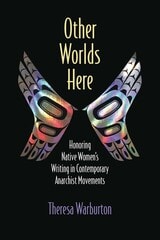
Other Worlds Here
Honoring Native Women’s Writing in Contemporary Anarchist MovementsTheresa Warburton
Northwestern University Press, 2021
All is not lost, however. Rather than centering a critical indictment of contemporary anarchist politics, Other Worlds Here maintains that a defining characteristic of New Anarchism is its ability to adapt and transform. Through close readings of texts by Native women authors, Warburton argues that anarchists must shift the paradigm that another world is possible to one that recognizes other worlds already here: stories, networks, and histories that lay out methods of building reciprocal relationships with the land and its people. Analyzing memoirs, poetry, and novels by writers including Deborah Miranda, Elissa Washuta, Heid E. Erdrich, Janet Rogers, and Leslie Marmon Silko, Other Worlds Here extends the study of Native women’s literatures beyond ethnographic analysis of Native experience to advance a widely applicable, contemporary political critique.
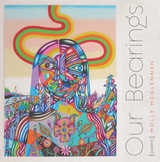
Our Bearings
PoemsMolly McGlennen; Foreword by Ben Burgess
University of Arizona Press, 2020
While working with both traditional and contemporary form, McGlennen’s unique use of space and rhythm creates poetry that is both captivating and accessible. Our Bearings does not attempt to speak for a population; rather it offers vibrant stories and moments that give voice to pieces of a large and complex tapestry of experiences. Through keen observation and a deep understanding of Native life in Minneapolis, McGlennen has created a timely collection that contributes beautifully to the important conversation about contemporary urban Native life in North America and globally.
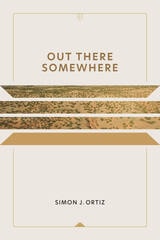
Out There Somewhere
Simon J. Ortiz
University of Arizona Press, 2002
Simon Ortiz, one of our finest living poets, has been a witness, participant, and observer of interactions between the Euro-American cultural world and that of his Native American people for many years. In this collection of haunting new work, he confronts moments and instances of his personal past—and finds redemption in the wellspring of his culture.
A writer known for deeply personal poetry, Ortiz has produced perhaps his most personal work to date. In a collage of journal entries, free-verse poems, and renderings of poems in the Acoma language, he draws on life experiences over the past ten years—recalling time spent in academic conferences and writers' colonies, jails and detox centers—to convey something of the personal and cultural history of dislocation. As an American Indian artist living at times on the margins of mainstream culture, Ortiz has much to tell about the trials of alcoholism, poverty, displacement. But in the telling he affirms the strength of Native culture even under the most adverse conditions and confirms the sustaining power of Native beliefs and connections: "With our hands, we know the sacred earth. / With our spirits, we know the sacred sky."
Like many of his fellow Native Americans, Ortiz has been "out there somewhere"—Portland and San Francisco, Freiburg, Germany, and Martinique—away from his original homeland, culture, and community. Yet, as these works show, he continues to be absolutely connected socially and culturally to Native identity: "We insist that we as human cultural beings must always have this connection," he writes, "because it is the way we maintain a Native sense of existence." Drawing on this storehouse of places, times, and events, Out There Somewhere is a rich fusion taking readers into the heart and soul of one of today's most exciting and original American poets.