Results by title
2817 books match the query 'Nature' and 82 start with o
Oak Origins
From Acorns to Species and the Tree of LifeAndrew L. Hipp
University of Chicago Press, 2024
An oak begins its life with the precarious journey of a pollen grain, then an acorn, then a seedling. A mature tree may shed millions of acorns, but only a handful will grow. One oak may then live 100 years, 250 years, or even 13,000 years. But the long life of an individual is only a part of these trees’ story.
With naturalist and leading researcher Andrew L. Hipp as our guide, Oak Origins takes us through a sweeping evolutionary history, stretching back to a population of trees that lived more than 50 million years ago. We travel to the ancient tropical Earth to see the ancestors of the oaks evolving side by side with the dinosaurs. We journey from the oaks’ childhood in the once-warm forests of the Arctic to the montane cloud forests of Mexico and the broad-leaved evergreen forests of Southeast Asia. We dive into current research on oak genomes to see how scientists study genes’ movement between species and how oaks evolve over generations—spanning tens of millions of years. Finally, we learn how oak evolutionary history shapes the forests we know today, and how it may even shape the forests of the future.
Oaks are familiar to almost everyone, and beloved. They are embedded in our mythology. They have fed us, housed us, provided wood for our ships and wine barrels and homes and halls, planked our roads, and kept us warm. Every oak also has the potential to feed thousands of birds, squirrels, and mice and host countless insects, mosses, fungi, and lichens. But as Oak Origins makes clear, the story of the oaks’ evolution is not just the story of one important tree. It is the story of the Tree of Life, connecting all organisms that have ever lived on Earth, from oaks’ last common ancestor to us.
Ocean Bestiary
Meeting Marine Life from Abalone to Orca to ZooplanktonWritten and illustrated by Richard J. King
University of Chicago Press, 2023
For millennia, we have taken to the waves. And yet, for humans, the ocean remains our planet’s most inaccessible region, the place about which we know the least. From A to Z, abalone to zooplankton, and through both text and original illustrations, Ocean Bestiary is a celebration of our ongoing quest to know the sea and its creatures.
Focusing on individual species or groups of animals, Richard J. King embarks upon a global tour of ocean wildlife, including beluga whales, flying fish, green turtles, mako sharks, noddies, right whales, sea cows (as well as sea lions, sea otters, and sea pickles), skipjack tuna, swordfish, tropicbirds, walrus, and yellow-bellied sea snakes. But more than this, King connects the natural history of ocean animals to the experiences of people out at sea and along the world’s coastlines. From firsthand accounts passed down by the earliest Polynesian navigators to observations from Wampanoag clamshell artists, African-American whalemen, Korean female divers (or haenyeo), and today’s pilots of deep-sea submersibles—and even to imaginary sea expeditions launched through poems, novels, and paintings—Ocean Bestiary weaves together a diverse array of human voices underrepresented in environmental history to tell the larger story of our relationship with the sea. Sometimes funny, sometimes alarming, but always compelling, King’s vignettes reveal both how our perceptions of the sea have changed for the better and how far we still have to go on our voyage.

Ocean Yearbook, Volume 1
Edited by Elisabeth Mann Borgese and Norton Ginsburg
University of Chicago Press, 1979
Ocean Yearbook, Volume 10
Edited by Elisabeth Mann Borgese, Norton Ginsburg, and Joseph R. Morgan
University of Chicago Press, 1993
Ocean Yearbook, Volume 11
Edited by Elisabeth Mann Borgese, Norton Ginsburg, and Joseph R. Morgan
University of Chicago Press, 1995
Volume 11 addresses the development of marine resources, along with recent transportation, communication, marine science, and technology developments. Twenty-four articles focus on such topics as sea-based nuclear issues, regional cooperation, transport of liquefied natural gas, along with an analysis of the UN conference on Straddling and Highly Migratory Fish Stocks.
Ocean Yearbook, Volume 12
Edited by Elisabeth Mann Borgese, Norton Ginsburg, and Joseph R. Morgan
University of Chicago Press, 1996
Volume 12 focuses on the sustainable development and use of the world's oceans and their resources. Major articles examine the managerial implications of sustainable development in different oceanic regions as well as how they relate to fisheries, coastal ecosystems and genetic and biochemical resources. Current problems associated with marine transportation are also addressed. In addition, the twelfth edition celebrates the entry into force of the United Nations Convention on the Law of the Sea and the recent conclusion of the agreement relating to the conservation and management of straddling and highly migratory fish stocks.
Ocean Yearbook, Volume 13
Edited by Elisabeth Mann Borgese, Aldo Chircop, Moira L. McConnell, and Joseph R
University of Chicago Press, 1998
Ocean Yearbook, Volume 14
Edited by Elisabeth Mann Borgese, Aldo Chircop, Moira L. McConnell, and Joseph R
University of Chicago Press, 1998
Ocean Yearbook, Volume 15
Edited by Elisabeth Mann Borgese, Aldo Chircop, and Moira L. McConnell
University of Chicago Press, 2002
Since its inception in 1978, the Ocean Yearbook has proven an invaluable research tool to marine biologists, oceanographers, ocean development specialists, students of international law, as well as analysts of foreign policy and international security.
Ocean Yearbook, Volume 2
Edited by Elisabeth Mann Borgese and Norton Ginsburg
University of Chicago Press, 1981
Ocean Yearbook, Volume 3
Edited by Elisabeth Mann Borgese and Norton Ginsburg
University of Chicago Press, 1982
Ocean Yearbook, Volume 4
Edited by Elisabeth Mann Borgese and Norton Ginsburg
University of Chicago Press, 1984
Ocean Yearbook, Volume 5
Edited by Elisabeth Mann Borgese and Norton Ginsburg
University of Chicago Press, 1985
Ocean Yearbook, Volume 6
Edited by Elisabeth Mann Borgese and Norton Ginsburg
University of Chicago Press, 1987
Ocean Yearbook, Volume 7
Edited by Elisabeth Mann Borgese, Norton Ginsburg, and Joseph R. Morgan
University of Chicago Press, 1989
Ocean Yearbook, Volume 8
Edited by Elisabeth Mann Borgese, Norton Ginsburg, and Joseph R. Morgan
University of Chicago Press, 1990
Ocean Yearbook, Volume 9
Edited by Elisabeth Mann Borgese, Norton Ginsburg, and Joseph R. Morgan
University of Chicago Press, 1992
Oceaning
Governing Marine Life with DronesAdam Fish
Duke University Press, 2024
Oceans under Glass
Tank Craft and the Sciences of the SeaSamantha Muka
University of Chicago Press, 2023
Atlantic coral is rapidly disappearing in the wild. To save the species, they will have to be reproduced quickly in captivity, and so for the last decade conservationists have been at work trying to preserve their lingering numbers and figure out how to rebuild once-thriving coral reefs from a few survivors. Captive environments, built in dedicated aquariums, offer some hope for these corals. This book examines these specialized tanks, charting the development of tank craft throughout the twentieth century to better understand how aquarium modeling has enhanced our knowledge of the marine environment.
Aquariums are essential to the way we understand the ocean. Used to investigate an array of scientific questions, from animal behavior to cancer research and climate change, they are a crucial factor in the fight to mitigate the climate disaster already threatening our seas. To understand the historical development of this scientific tool and the groups that have contributed to our knowledge about the ocean, Samantha Muka takes up specialty systems—including photographic aquariums, kriesel tanks (for jellyfish), and hatching systems—to examine the creation of ocean simulations and their effect on our interactions with underwater life. Lively and engaging, Oceans under Glass offers a fresh history about how the aquarium has been used in modern marine biology and how integral it is to knowing the marine world.
Oceans
An Illustrated ReferenceDorrik Stow
University of Chicago Press, 2005
Oceans: An Illustrated Reference tells the story of this last great frontier. With hundreds of beautiful full-color photographs and explanatory diagrams, charts, and maps, Oceans combines the visual splendor of ocean life with up-to-date scientific information to provide an invaluable and fascinating resource on this vital realm. Covering all major areas of oceanographic knowledge and research, Oceans is divided into two parts. The first, "Ocean Systems," examines the physical nature of the oceans, including plate tectonics, temperature and climate, waves and tides, natural resources and much more. The second, "Ocean Life,"explores biodiversity, evolution and adaptation, marine ecosystems and complex communities, and the preservation of fragile marine environments.
Oceans also offers readers a host of tools to better understand the magnificent world of the sea. A special section of bathymetric maps-made possible by satellite observation, deep-towed surveying craft, and remotely operated submarine vessels-provides a view of the depth and texture of ocean floors around the globe, giving us a glimpse of worlds rarely seen. And throughout the book, engagingly written special features delve into specific marine environments and phenomena such as the lost Tethys Ocean, from which the Himalayas were born. Cross-references and a detailed index help readers navigate this multifaceted volume, and a glossary provides clear definitions of scientific vocabulary.
Although the oceans are vast, their resources are finite. Oceans clearly presents the future challenge to us all-that of ensuring that our common ocean heritage is duly respected, wisely managed, and carefully harnessed for the benefit of the whole planet. Lavishly illustrated and filled with current research, Oceans is a step in that direction: a rich, magnificent, and illuminating volume for anyone who has ever heard the siren song of the sea.
Octopus, Squid, and Cuttlefish
A Visual, Scientific Guide to the Oceans’ Most Advanced InvertebratesRoger Hanlon, Mike Vecchione, and Louise Allcock
University of Chicago Press, 2018
Largely shell-less relatives of clams and snails, the marine mollusks in the class Cephalopoda—Greek for “head-foot”—are colorful creatures of many-armed dexterity, often inky self-defense, and highly evolved cognition. They are capable of learning, of retaining information—and of rapid decision-making to avoid predators and find prey. They have eyes and senses rivaling those of vertebrates like birds and fishes, they morph texture and body shape, and they change color faster than a chameleon. In short, they captivate us.
From the long-armed mimic octopus—able to imitate the appearance of swimming flounders and soles—to the aptly named flamboyant cuttlefish, whose undulating waves of color rival the graphic displays of any LCD screen, there are more than seven hundred species of cephalopod. Featuring a selection of species profiles, Octopus, Squid, and Cuttlefish reveals the evolution, anatomy, life history, behaviors, and relationships of these spellbinding animals. Their existence proves that intelligence can develop in very different ways: not only are cephalopods unusually large-brained invertebrates, they also carry two-thirds of their neurons in their arms.
A treasure trove of scientific fact and visual explanation, this worldwide illustrated guide to cephalopods offers a comprehensive review of these fascinating and mysterious underwater invertebrates—from the lone hunting of the octopus, to the social squid, and the prismatic skin signaling of the cuttlefish.
Of Cabbages and Kings County
Agriculture and the Formation of Modern BrooklynMarc Linder
University of Iowa Press, 1999
No one today thinks of Brooklyn, New York, as an agricultural center. Yet Kings County enjoyed over two centuries of farming prosperity. Even as late as 1880 it was one of the nation's leading vegetable producers, second only to neighboring Queens County.
In Of Cabbages and Kings County, Marc Linder and Lawrence Zacharias reconstruct the history of a lost agricultural community. Their study focuses on rural Kings County, the site of Brooklyn's tremendous expansion during the latter part of the nineteenth century. In particular, they question whether sprawl was a necessary condition of American industrialization: could the agricultural base that preceded and surrounded the city have survived the onrush of residential real estate speculation with a bit of foresight and public policies that the politically outnumbered farmers could not have secured on their own?
The first part of the book reviews the county's Dutch American agricultural tradition, in particular its conversion after 1850 from extensive farming (e.g., wheat, corn) to intensive farming of market garden crops. The authors examine the growing competition between local farmers and their southern counterparts for a share of the huge New York City market, comparing farming conditions and factors such as labor and transportation.
In the second part of the book, the authors turn their attention to the forces that eventually destroyed Kings County's farming—ranging from the political and ideological pressures to modernize the city's rural surroundings to unplanned, market-driven attempts to facilitate transportation for more affluent city dwellers to recreational outlets on Coney Island and, once transportation was at hand, to replace farms with residential housing for the city's congested population.
Drawing on a vast range of archival sources, the authors refocus the history of Brooklyn to uncover what was lost with the expansion of the city. For today, as urban planners, ecologists, and agricultural developers reevaluate urban sprawl and the need for greenbelts or agricultural-urban balance, the lost opportunities of the past loom larger.
Of Men and Marshes
Paul Errington
University of Iowa Press, 1957
This classic of twentieth-century nature writing, a landmark work that is still a joy to read, offers a stirring portrait of the Midwest’s endangered glacial marshland ecosystems by one of the most influential biologists of his day. A cautionary book whose advice has not been heeded, a must-read of American environmental literature, Of Men and Marshes should inspire a new generation of conservationists.
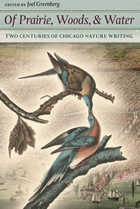
Of Prairie, Woods, and Water
Two Centuries of Chicago Nature WritingEdited by Joel Greenberg
University of Chicago Press, 2008
These writings tell the tale of a land in transition—one with abundant, unique, and incredibly lush flora and fauna, a natural history quite elusive today. Drawing on archives he uncovered while writing his acclaimed A Natural History of the Chicago Region, Greenberg hand-selected these first-person narratives, all written between 1721 and 1959. Not every author is familiar, but every contribution is distinctive. From a pioneer’s hilarious notes on life in the Kankakee marsh to Theodore Drieser’s poignant plea for conservation of the Tippecanoe River to infamous murderer Nathan Leopold’s charming description of a pet robin he kept in prison, the sources included are as diverse as the nature they describe.
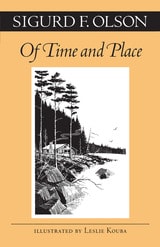
Of Time And Place
Sigurd F. Olson
University of Minnesota Press, 1998
Olson’s final work, available in paperback for the first time.
Of Time and Place is a legacy from one of the best-loved nature writers of our time. In this, his last book completed just before his death, Sigurd F. Olson guides readers through his wide-ranging memories of a lifetime dedicated to the preservation of the wilderness. Like his other best-selling books, Of Time and Place is filled with beauty, adventure, and wonder.
Olson recalls his many friendships of trail and woods and portage, his favorite campsites, the stories behind the artifacts and mementos hanging in his cabin at Listening Point. Whether he is remembering canoe trips with his friends, admiring the playful grace of the otter, or pondering the Earth’s great cycles of climatic change, these moving and evocative essays reaffirm Olson’s stature as one of the greatest nature writers of this century.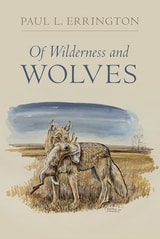
Of Wilderness and Wolves
Paul L. Errington
University of Iowa Press, 2015
Tracing his own relationship with wolves from his rural South Dakota upbringing through his formative years as a professional trapper to his landmark work as an internationally renowned wildlife biologist, Errington delves into our irrational fear of wolves. He forthrightly criticizes what he views as humanity’s prejudice against an animal that continues to serve as the very emblem of the wilderness we claim to love, but that too often falls prey to our greed and ignorance. A friend of Aldo Leopold, Errington was an important figure in the conservation efforts in the first half of the twentieth century. During his lifetime, wolves were considered vicious, wantonly destructive predators; by the mid-1900s, they had been almost completely eliminated from the lower forty-eight states. Their reintroduction to their historical range today remains controversial.
Lyrical yet unsentimental, Of Wilderness and Wolves provides a strong and still-timely dose of ecological realism for the abusive mismanagement of our natural resources. It is a testament to our shortsightedness and to Errington’s vision that this book, its publication so long delayed, still speaks directly to our environmental crises.

Official Guide to Texas State Parks and Historic Sites
New EditionBy Laurence Parent
University of Texas Press, 2018
Since it was first published in 1996, Official Guide to Texas State Parks and Historic Sites has become Texans’ one-stop source for information on great places to camp, fish, hike, backpack, swim, ride horseback, go rock climbing, view scenic landscapes, tour historical sites, and enjoy almost any other outdoor recreation.
Freshly redesigned, this revised edition includes eight new state parks and historical sites, completely updated information for every park, and beautiful new photographs for most of the parks. The book is organized by geographical regions to help you plan your trips around the state. For every park, Laurence Parent provides all of the essential information:
- The natural or historical attractions of the park
- Types of recreation offered
- Camping and lodging facilities
- Addresses and phone numbers
- Magnificent color photographs
So if you want to watch the sun set over Enchanted Rock, fish in the surf on the beach at Galveston, or listen for a ghostly bugle among the ruins of Fort Lancaster, let this book be your complete guide. Don’t take a trip in Texas without it.
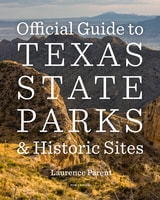
Official Guide to Texas State Parks and Historic Sites
New EditionLaurence Parent
University of Texas Press, 2024
The essential guide to Texas’s state parks and historic sites.
Updated with a new park, Palo Pinto Mountains State Park west of Forth Worth; new historic sites; and scores of beautiful new photographs, the Official Guide to Texas State Parks has all the essential information organized by geographical regions to help you plan your great Texas adventure. The only complete resource of its kind on Texas, Laurence Parent’s Official Guide to Texas State Parks is the trusted source, with more than sixty-five thousand copies sold over the past thirty years.
Praise for Previous Editions
“Texas state-park fans should be thrilled. . . . Official Guide to Texas State Parks is the ultimate book detailing Texas’s state parks.”—Dallas Morning News
“This book will make you want to hit the road to visit the natural splendor of Texas.”—Houston Chronicle
“It’s good enough for a coffee table or a campfire. The Official Guide to Texas State Parks gives you sleek photography, maps, narratives, and loads of information.”—Southern Living
“The newly updated Official Guide to Texas State Parks and Historic Sites . . . has beautiful color photographs and insights on camping, fishing, horseback riding, and other recreational opportunities around the state.”—Texas Journey
Oil Beach
How Toxic Infrastructure Threatens Life in the Ports of Los Angeles and BeyondChristina Dunbar-Hester
University of Chicago Press, 2023
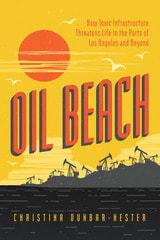
San Pedro Bay, which contains the contiguous Ports of Los Angeles and Long Beach, is a significant site for petroleum shipping and refining as well as one of the largest container shipping ports in the world—some forty percent of containerized imports to the United States pass through this so-called America’s Port. It is also ecologically rich. Built atop a land- and waterscape of vital importance to wildlife, the heavily industrialized Los Angeles Harbor contains estuarial wetlands, the LA River mouth, and a marine ecology where colder and warmer Pacific Ocean waters meet. In this compelling interdisciplinary investigation, award-winning author Christina Dunbar-Hester explores the complex relationships among commerce, empire, environment, and the nonhuman life forms of San Pedro Bay over the last fifty years—a period coinciding with the era of modern environmental regulation in the United States. The LA port complex is not simply a local site, Dunbar-Hester argues, but a node in a network that enables the continued expansion of capitalism, propelling trade as it drives the extraction of natural resources, labor violations, pollution, and other harms. Focusing specifically on cetaceans, bananas, sea birds, and otters whose lives are intertwined with the vitality of the port complex itself, Oil Beach reveals how logistics infrastructure threatens ecologies as it circulates goods and capital—and helps us to consider a future where the accumulation of life and the accumulation of capital are not in violent tension.
Oil Beach
How Toxic Infrastructure Threatens Life in the Ports of Los Angeles and BeyondChristina Dunbar-Hester
University of Chicago Press, 2023
Can the stories of bananas, whales, sea birds, and otters teach us to reconsider the seaport as a place of ecological violence, tied to oil, capital, and trade?
San Pedro Bay, which contains the contiguous Ports of Los Angeles and Long Beach, is a significant site for petroleum shipping and refining as well as one of the largest container shipping ports in the world—some forty percent of containerized imports to the United States pass through this so-called America’s Port. It is also ecologically rich. Built atop a land- and waterscape of vital importance to wildlife, the heavily industrialized Los Angeles Harbor contains estuarial wetlands, the LA River mouth, and a marine ecology where colder and warmer Pacific Ocean waters meet. In this compelling interdisciplinary investigation, award-winning author Christina Dunbar-Hester explores the complex relationships among commerce, empire, environment, and the nonhuman life forms of San Pedro Bay over the last fifty years—a period coinciding with the era of modern environmental regulation in the United States. The LA port complex is not simply a local site, Dunbar-Hester argues, but a node in a network that enables the continued expansion of capitalism, propelling trade as it drives the extraction of natural resources, labor violations, pollution, and other harms. Focusing specifically on cetaceans, bananas, sea birds, and otters whose lives are intertwined with the vitality of the port complex itself, Oil Beach reveals how logistics infrastructure threatens ecologies as it circulates goods and capital—and helps us to consider a future where the accumulation of life and the accumulation of capital are not in violent tension.
Oil Culture
Ross Barrett
University of Minnesota Press, 2014
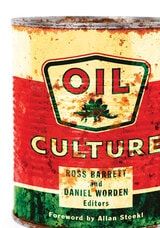
In the 150 years since the birth of the petroleum industry oil has saturated our culture, fueling our cars and wars, our economy and policies. But just as thoroughly, culture saturates oil. So what exactly is “oil culture”? This book pursues an answer through petrocapitalism’s history in literature, film, fine art, wartime propaganda, and museum displays. Investigating cultural discourses that have taken shape around oil, these essays compose the first sustained attempt to understand how petroleum has suffused the Western imagination.
The contributors to this volume examine the oil culture nexus, beginning with the whale oil culture it replaced and analyzing literature and films such as Giant, Sundown, Bernardo Bertolucci’s La Via del Petrolio, and Ben Okri’s “What the Tapster Saw”; corporate art, museum installations, and contemporary photography; and in apocalyptic visions of environmental disaster and science fiction. By considering oil as both a natural resource and a trope, the authors show how oil’s dominance is part of culture rather than an economic or physical necessity. Oil Culture sees beyond oil capitalism to alternative modes of energy production and consumption.
Contributors: Georgiana Banita, U of Bamberg; Frederick Buell, Queens College; Gerry Canavan, Marquette U; Melanie Doherty, Wesleyan College; Sarah Frohardt-Lane, Ripon College, Matthew T. Huber, Syracuse U; Dolly Jørgensen, Umeå U; Stephanie LeMenager, U of Oregon; Hanna Musiol, Northeastern U; Chad H. Parker, U of Louisiana at Lafayette; Ruth Salvaggio, U of North Carolina, Chapel Hill; Heidi Scott, Florida International U; Imre Szeman, U of Alberta; Michael Watts, U of California, Berkeley; Jennifer Wenzel, Columbia University; Sheena Wilson, U of Alberta; Rochelle Raineri Zuck, U of Minnesota Duluth; Catherine Zuromskis, U of New Mexico.

Oil Spills
Joanna Burger
Rutgers University Press, 1997
Oil and Nation
A History of Bolivia's Petroleum SectorStephen C. Cote
West Virginia University Press, 2016
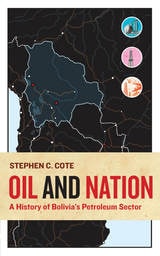
The book advances chronologically from Bolivia’s earliest petroleum pioneers in the nineteenth century until the present, inserting oil into historical debates about Bolivian ethnic, racial, and environmental issues, and within development strategies by different administrations. While Bolivia is best known for its tin mining, Oil and Nation makes the case that nationalist reformers viewed hydrocarbons and the state oil company as a way to modernize the country away from the tin monoculture and its powerful backers and toward an oil-powered future.
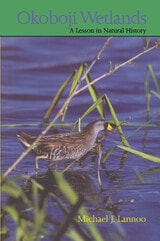
Okoboji Wetlands
A Lesson in Natural HistoryMichael J. Lannoo
University of Iowa Press, 1996
Lake Okoboji in northwest Iowa is the jewel of the Iowa Great Lakes. A region of wetlands formed by prairie potholes, the area is rich with lakes, sloughs, fens, creeks, prairies, and kettleholes. In this readable and beautifully illustrated volume, Michael Lannoo presents an extensive natural history of Okoboji and its cherished wetlands that examines that world of our grandparents, compares it to today's world, and extrapolates to the world of our grandchildren.
Old Farm
A HistoryJerry Apps
Wisconsin Historical Society Press, 2013
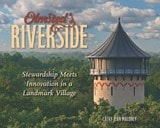
Olmsted's Riverside
Stewardship Meets Innovation in a Landmark VillageCathy Jean Maloney
Southern Illinois University Press, 2024
WINNER, Certificate of Excellence in “Scholarly Publications” from the Illinois State Historical Society’s 2025 Best of Illinois History Awards!
Honorable Mention, 2025 Society of Midland Authors Award in History!
The challenge to preserve Chicagoland’s unique haven
Just outside the bustling metropolis of Chicago lies the unlikely green oasis of Riverside, Illinois, a small village that has continued to directly influence American landscapes and suburbs since the 1870s. Once farmland, the location provided a blank canvas for preeminent designers Fredrick Law Olmsted and Calvert Vaux’s manifestation of a truly democratic society. Olmsted’s Riverside details the village’s historical significance, harmony with nature, and its nearly 150-year impact on American suburbs today.
Cathy Jean Maloney explores how Riverside’s layout and design presaged today’s urban planning goals of walkability, green space, public transportation access, sustainability, and resiliency. Houses in Riverside are set back from the road, sidewalks meander along gently curving roads, and public green spaces abound. Maloney shows how Riverside’s leaders and residents struggled with stewardship of Olmsted’s ideals by balancing competing interests in suburban development and Chicago sprawl from the 1870s to the 2020s. She details in chronological chapters how the village adapted to tragedies such as the Great Fire of 1871 and the Panic of 1873, as well as advancements in transportation, local civic life, urban policy, and environmental thought, all while staying true to the framework inherited from Olmsted and Vaux.
Olmsted’s Riverside provides engaging examples of how citizen involvement can protect a community’s ideals. This richly illustrated volume combines landscape architecture, regional history, and urban design to show how audacious civic planning and thoughtful conservation can provide a model for future American suburbs.
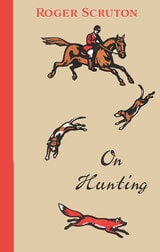
On Hunting
Roger Scruton
St. Augustine's Press, 2002
Among the most dramatic and ironic discoveries that On Hunting offers the typical American reader is that hunting is about a love and respect for animals, rather than a blood-thirsty hatred of them, and that the sport, far from being limited to an upper-class, old-monied aristocracy, is really one promoting an egalitarian meritocracy.
On Petrocultures
Globalization, Culture, and EnergyImre Szeman
West Virginia University Press, 2019
On Petrocultures brings together key essays by Imre Szeman, a leading scholar in the field of energy humanities and a critical voice in debates about globalization and neoliberalism. Szeman’s most important and influential essays, in dialogue with exciting new pieces written for the book, investigate ever-evolving circuits of power in the contemporary world, as manifested in struggles over space and belonging, redefinitions of work and individual autonomy, and the deep links between energy use and climate change.
These essays explore life lived in the twenty-first century by examining critically the vocabulary through which capitalism makes sense of itself, focusing on concepts like the nation, globalization, neoliberalism, creativity, and entrepreneurship. At the heart of the volume is the concept of “petrocultures,” which demands that we understand a fundamental fact of modern life: we are shaped by and through fossil fuels. Szeman argues that we cannot take steps to address global warming without fundamentally changing the social, cultural, and political norms and expectations developed in conjunction with the energy riches of the past century. On Petrocultures maps the significant challenge of our dependence on fossil fuels and probes ways we might begin to leave petrocultures behind.
On Water
Fluid PerspectivesEdited by Anna-Lisa Dieter
Diaphanes, 2027
Asks what we can learn from water's cycles, its adaptability, and its capacity for connection.
Water is ubiquitous: we drink it, bathe in it, and encounter it as rain, ice, rivers, and oceans. And yet it remains contradictory, both familiar and strange. In the context of climate change, growing cities, and global inequality, it poses a distinct challenge to established practices and ways of thinking. Contributors to this volume frame water as a dynamic element that fosters new scientific perspectives and inventive forms of social negotiation. On Water: Fluid Perspectives brings science, art, and society into conversation, exploring a single element and the many ways of thinking with it. This book accompanies the exhibition On Water—WasserWissen at Humboldt Labor in Berlin while extending its questions and perspectives beyond the show. Visual materials from the exhibition are interwoven with thoughtful essays from Berlin researchers that illuminate water as a compelling subject of inquiry.

On Your Own
How to Take Care of Yourself in Wild Country, a Manual for Field and Service MenSamuel A. Graham and Earl C. O’Roke
University of Minnesota Press, 1943
On Your Own was first published in 1943. Minnesota Archive Editions uses digital technology to make long-unavailable books once again accessible, and are published unaltered from the original University of Minnesota Press editions.
On the Banks of the Ganga
When Wastewater Meets a Sacred RiverKelly D. Alley
University of Michigan Press, 2002
Alley investigates ethno-semantic, discursive, and institutional data to flesh out the interplay between religious, scientific, and official discourses about the river Ganga. Using a new outward layering methodology, she points out that anthropological analysis must separate the historical and discursive strands of the debates concerning waste and sacred purity in order to reveal the cultural complexities that surround the Ganga. Ultimately, she addresses a deeply rooted cultural paradox: if the Ganga river is considered sacred by Hindus across India, then why do the people allow it to become polluted?
Examining areas of contemporary concern such as water usage and urban waste management in the most populated river basin in the world, this book will appeal to anthropologists and readers in religious, environmental, and Asian studies, as well as geography and law.
Kelly D. Alley is Associate Professor and Director of Anthropology at Auburn University. In addition to being a prolific writer, she has conducted research on public culture and environmental issues in northern India for over a decade. Alley is currently overseeing a project to ameliorate river pollution problems in India.
On the Brink
The Great Lakes in the 21st CenturyDave Dempsey
Michigan State University Press, 2004
As one of the world’s great natural treasures, the Great Lakes have also served in recent decades as an early warning system for many emerging environmental problems. In the early twenty-first century, as the Lakes face unprecedented challenges, we need to revisit both the wonder of the Lakes and the perils plaguing them, and to take action to protect this majestic ecosystem.
Dave Dempsey weaves the natural character and phenomena of the Great Lakes and stories of the schemes, calamities, and unusual human residents of the Basin with the history of their environmental exploitation and recovery. Contrasting the incomparable beauty and complexity of the Lakes, and the poetry, folklore, and citizen action they have inspired, with the disasters that short-sighted human folly has inflicted on the ecosystem, Dempsey makes this history both engaging and relevant to today’s debates and decisions.
Underlying the neglectful treatment of the Lakes are two irreconcilable and faulty human assumptions: that the Lakes are a system so big that human beings cannot do great harm to it, and that the Lakes are a resource that can be bent to the will of humankind. Dempsey finds evidence that, despite great changes in the laws governing the Lakes and public attitudes toward them in the last fifty years, government policy and institutions are still dominated by these dangerous attitudes.
A central theme of On the Brink is that citizens, who have displayed an increasing sense of commitment to the Lakes and a growing sense of place, must challenge their leaders to reform Great Lakes institutions. While everything from large-scale water exports to global climate change looms in the future of the Lakes, single-purpose solutions do not suffice—no more than a Band- aid would on a gaping wound. Dempsey shows that it is necessary to create a governing system that reflects the realities of life “on the ground” in communities and that taps into the passion and determination of citizens to protect these treasures.
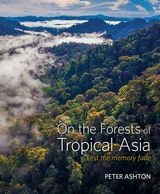
On the Forests of Tropical Asia
Lest the Memory FadePeter Ashton
Royal Botanic Gardens, Kew, 2014
On the Forests of Tropical Asia is the first book to describe the forests of the entire tropical Asian region, from Sind to New Guinea. It opens with chapters on physical geography and geological history and then moves on to address forest and tree structure and dynamics, floristics, and symbiotic organisms, as well as genetics, evolutionary history, species diversity, and human impact. A final chapter covers future policy and practice options for saving what remains. Hundreds of full-color illustrations serve as a lasting testimony to the diverse forests. Ashton combines existing research with his own experience and collaborations, creating a broad, comprehensive understanding of forest variation. By presenting a clear picture of where the forests stand today, he offers a framework for future research, policy, and conservation.
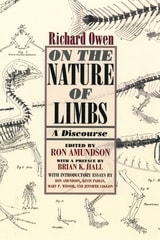
On the Nature of Limbs
A DiscourseRichard Owen
University of Chicago Press, 2007
Just as Darwin’s ideas continue to propel the modern study of adaptation, so too will Owen’s contributions fuel the new interest in homology, organic form, and evolutionary developmental biology. His theory of the archetype and his views on species origins were first offered to the general public in On the Nature of Limbs, published in 1849. It reemerges here in a facsimile edition with introductory essays by prominent historians, philosophers, and practitioners from the modern evo-devo community.

On the Water, Michigan
Your Comprehensive Guide to Water Recreation in the Great Lake StateEric Freedman
University of Michigan Press, 0
Once Out of Nature
Augustine on Time and the BodyAndrea Nightingale
University of Chicago Press, 2011
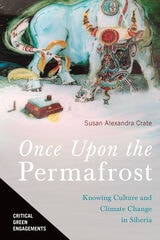
Once Upon the Permafrost
Knowing Culture and Climate Change in SiberiaSusan Alexandra Crate
University of Arizona Press, 2021
The author, anthropologist Susan Alexandra Crate, has spent three decades working with Sakha, the Turkic-speaking horse and cattle agropastoralists of northeastern Siberia, Russia. Crate reveals Sakha’s essential relationship with alaas, the foundational permafrost ecosystem of both their subsistence and cultural identity. Sakha know alaas via an Indigenous knowledge system imbued with spiritual qualities. This counters the scientific definition of alaas as geophysical phenomena of limited range. Climate change now threatens alaas due to thawing permafrost, which, entangled with the rural changes of economic globalization, youth out-migration, and language loss, make prescient the issues of ethnic sovereignty and cultural survival.
Through careful integration of contemporary narratives, on-site observations, and document analysis, Crate argues that local understandings of change and the vernacular knowledge systems they are founded on provide critical information for interdisciplinary collaboration and effective policy prescriptions. Furthermore, she makes her message relevant to a wider audience by clarifying linkages to the global permafrost system found in her comparative research in Mongolia, Arctic Canada, Kiribati, Peru, and Chesapeake Bay, Virginia. This reveals how permafrost provides one of the main structural foundations for Arctic ecosystems, which, in turn, work with the planet’s other ecosystems to maintain planetary balance.
Metaphorically speaking, we all live on permafrost.
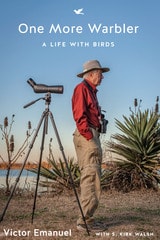
One More Warbler
A Life with BirdsBy Victor Emanuel, with S. Kirk Walsh
University of Texas Press, 2017
Victor Emanuel is widely considered one of America’s leading birders. He has observed more than six thousand species during travels that have taken him to every continent. He founded the largest company in the world specializing in birding tours and one of the most respected ones in ecotourism. Emanuel has received some of birding’s highest honors, including the Roger Tory Peterson Award from the American Birding Association and the Arthur A. Allen Award from the Cornell Laboratory of Ornithology. He also started the first birding camps for young people, which he considers one of his greatest achievements.
In One More Warbler, Emanuel recalls a lifetime of birding adventures—from his childhood sighting of a male Cardinal that ignited his passion for birds to a once-in-a-lifetime journey to Asia to observe all eight species of cranes of that continent. He tells fascinating stories of meeting his mentors who taught him about birds, nature, and conservation, and later, his close circle of friends—Ted Parker, Peter Matthiessen, George Plimpton, Roger Tory Peterson, and others—who he frequently birded and traveled with around the world. Emanuel writes about the sighting of an Eskimo Curlew, thought to be extinct, on Galveston Island; setting an all-time national record during the annual Audubon Christmas Bird Count; attempting to see the Imperial Woodpecker in northwestern Mexico; and birding on the far-flung island of Attu on the Aleutian chain. Over the years, Emanuel became a dedicated mentor himself, teaching hundreds of young people the joys and enrichment of birding. “Birds changed my life,” says Emanuel, and his stories make clear how a deep connection to the natural world can change everyone’s life.
One Planet, Many Worlds
The Climate ParallaxDipesh Chakrabarty
Brandeis University Press, 2023
Climate change represents a deep conundrum for humans. It is difficult for humans to give up the unequal and yet accelerating pursuit of a good life based on an insatiable appetite for energy sourced mainly from fossil fuel. But the same pursuit, scientists insist, damages the geobiological system that supports the existence of interrelated forms of life, including ours, on this planet. The planet, seen thus, is one. The global sway of financial and extractive capital connects humans technologically, but they remain divided along multiple axes of inequality. Their worlds are many and their politics still global rather than planetary. In the narrative presented here, Chakrabarty continues to explore the temporal and intellectual fault lines that mark the collapse of the global and the planetary in human history.
One Shot for Gold
Developing a Modern Mine in Northern CaliforniaEleanor Herz Swent
University of Nevada Press, 2021
An account of the creation of a modern, environmentally sensitive mine as told by the people who developed and worked it.
In 1978, a geologist working for the Homestake Mining Company discovered gold in a remote corner of California’s Napa County. This discovery led to the establishment of California’s most productive gold mine in the twentieth century. Named the McLaughlin Mine, it produced about 3.4 million ounces of gold between 1985 and 2002. The mine was also one of the first attempts at creating a new full-scale mine in California after the advent of environmental regulations and the first to use autoclaves to extract gold from ore.
One Shot for Gold traces the history of the McLaughlin Mine and how it transformed a community and an industry. This lively and detailed account is based largely on oral history interviews with a wide range of people associated with the mine, including Homestake executives, geologists, and engineers as well as local neighbors of the mine, officials from county governments, townspeople, and environmental activists. Their narratives— supported by thorough research into mining company documents, public records, newspaper accounts, and other materials—chronicle the mine from its very beginning to its eventual end and transformation into a designated nature reserve as part of the University of California Natural Reserve System.
A mine created at the end of the twentieth century was vastly different from the mines of the Gold Rush. New regulations and concerns about the environmental, economic, and social impacts of a large mine in this remote and largely rural region of the state-required decisions at many levels. One Shot for Gold offers an engaging and accessible account of a modern gold mine and how it managed to exist in balance with the environment and the human community around it.