Results by title
337 books match the query 'North America' and 5 start with o
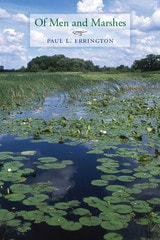
Of Men and Marshes
Paul Errington
University of Iowa Press, 1957
This classic of twentieth-century nature writing, a landmark work that is still a joy to read, offers a stirring portrait of the Midwest’s endangered glacial marshland ecosystems by one of the most influential biologists of his day. A cautionary book whose advice has not been heeded, a must-read of American environmental literature, Of Men and Marshes should inspire a new generation of conservationists.

On the Eve of Conquest
The Chevalier de Raymond's Critique of New France in 1754Joseph L. Peyser
Michigan State University Press, 1997
In 1754, Charles de Raymond, chevalier of the Royal and Military Order of Saint Louis and a captain in the Troupes de la Marine wrote a bold, candid, and revealing expose; on the French colonial posts and settlements of New France. On the Eve of the Conquest, more than an annotated translation, includes a discussion on the historical background of the start of the French and Indian War, as well as a concise biography of Raymond and Michel Le Courtois de Surlaville, the army colonel at the French court to whom the report was sent. The events surrounding Raymond's controversial year as commandant of the post (now Fort Wayne, Indiana) in 1749-50, his disputed recall by Governor General Jacques-Pierre de Taffanel de La Jonquier, and the subsequent friction between La Jonquiere's successor, Ange de Menneville Duqesne, and Raymond are presented in detail and illustrated by translations of their correspondence.
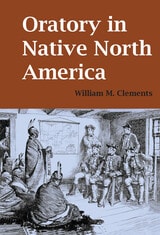
Oratory in Native North America
William M. Clements
University of Arizona Press, 2002
Here is a rich documentation of oratory dating from the earliest records: Benjamin Franklin's publication of treaty proceedings with the Six Nations of the Iroquois; the travel narratives of John Lawson, who visited Carolina Indians in the early 1700s; accounts of Jesuit missionary Pierre De Smet, who evangelized to Northern Plains Indians in the nineteenth century; and much more. The book also includes full texts of several orations. These texts are comprehensive documents that report not only the contents of the speeches but the entirety of the delivery: the textures, situations, and contexts that constitute oratorical events. While there are valid concerns about the reliability of early recorded oratory given the prejudices of those recording them, Clements points out that we must learn what we can from that record.
He extends the thread unwoven in his earlier study Native American Verbal Art to show that the long history of textualization of American Indian oral performance offers much that can reward the reader willing to scrutinize the entirety of the texts. By focusing on this one genre of verbal art, he shows us ways in which the sources are—and are not—valuable and what we must do to ascertain their value. Oratory in Native North America is a panoramic work that introduces readers to a vast history of Native speech while recognizing the limitations in premodern reporting. By guiding us through this labyrinth, Clements shows that with understanding we can gain significant insight not only into Native American culture but also into a rich storehouse of language and performance art.
Origins of Pre-Columbian Art
By Terence Grieder
University of Texas Press, 1982
Since Columbus first called the natives of the Americas “Indians,” the sources of their art and culture have been a puzzle. The strange mixture of objects of Asian appearance with those decidedly un-Asian has provided fuel for controversy between those who see the American cultures as products of diffusion and those who see them as independent inventions. Origins of Pre-Columbian Art cuts through this old dispute to provide a fresh look at ancient cultural history in the Americas and the Pacific basin.
Using evidence from archaeology, ethnology, and psychology, Terence Grieder suggests that contact between individuals across cultural borders is the root of both invention and diffusion. By tracing the spread of early symbolic techniques, materials, and designs from Europe and Asia to the lands of the Pacific and to the Americas, he displays the threads woven through humanity’s common cultural heritage.
While archaeology provides examples of ancient symbols, ethnology reveals widely separated modern peoples still using these symbols and giving them similar meanings. Mapping these patterns of use and meaning, the author describes three waves of migration from Asia to the Americas, each carrying its own cluster of ideas and the symbols that expressed them.
First Wave cultures focused on their environment and on the human body, inventing symbols that compared people and nature. Second Wave symbolism emphasized the center and the periphery: the village and the horizon; the tree or pole as world axis; and the world’s rim, where spirits exist. These cultures created masks to give form to those beings beyond the horizon. The heavens were finally incorporated into the system of symbols by Third Wave peoples, who named the celestial bodies as gods, treasured heaven-colored stones, and represented the world in pyramids.
Emphasizing the interpretation of art in its many forms, Grieder has found that such seemingly minor decorations as bark cloth clothing and tattoos have deep meaning. Ancient art, he argues, was the vehicle for ancient science, serving to express insights into biology, astronomy, and the natural world.
Other Worlds Here
Honoring Native Women’s Writing in Contemporary Anarchist MovementsTheresa Warburton
Northwestern University Press, 2021
All is not lost, however. Rather than centering a critical indictment of contemporary anarchist politics, Other Worlds Here maintains that a defining characteristic of New Anarchism is its ability to adapt and transform. Through close readings of texts by Native women authors, Warburton argues that anarchists must shift the paradigm that another world is possible to one that recognizes other worlds already here: stories, networks, and histories that lay out methods of building reciprocal relationships with the land and its people. Analyzing memoirs, poetry, and novels by writers including Deborah Miranda, Elissa Washuta, Heid E. Erdrich, Janet Rogers, and Leslie Marmon Silko, Other Worlds Here extends the study of Native women’s literatures beyond ethnographic analysis of Native experience to advance a widely applicable, contemporary political critique.