Results by title
117 books match the query 'Opera' and 18 start with o

Opera
Christine Byrne
University of Iowa Press, 2027
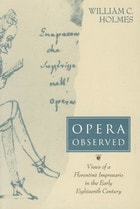
Opera Observed
Views of a Florentine Impresario in the Early Eighteenth CenturyWilliam C. Holmes
University of Chicago Press, 1993
A member of an illustrious Florentine family, Albizzi (1664-1745) served as one of the principal impresarios of the Pergola, Florence's earliest and greatest opera theater. He also carried on an active correspondence with impresarios in other cities, freely giving his advice on various economic and artistic concerns. Holmes uses the Albizzi family archives—the most abundant and varied material yet available about an eighteenth-century impresario and his theater—to deepen our knowledge of an extraordinary but little understood period in Italian opera.
This book will appeal to anyone curious about operatic history.
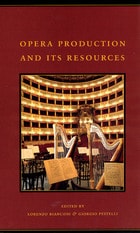
Opera Production and Its Resources
Edited by Lorenzo Bianconi and Giorgio Pestelli
University of Chicago Press, 1998
Opera Production and Its Resources traces the social, economic, and artistic history of the production of opera from its origins around 1600 to contemporary stagings. From the very beginning, opera has been a chronically deficit-producing enterprise. Yet it maintained unchallenged preeminence in the culture of all Italians for centuries. The first half explores the central role of theater impresarios in putting on these complex productions and in increasing the output of librettos and scores. The second half considers the roles of the three key figures in the creation of any opera: the librettist, the composer, and the singer.
Opera Scenes for Class and Stage
Mary Elaine Wallace and Robert Wallace
Southern Illinois University Press, 1979
Musically sound and fully annotated, this new reference work provides ready access to over 700 excerpts from 100 operas, by voice categories, and thus provides information on a wide variety of matters of interest to directors, teachers, and singers. A table of voice categories, coded excerpts (including length and reference to accessible scores), character descriptions (including estimations of degrees of difficulty of the music), summaries of the action of each excerpt, and indexes to titles, composers, and well-known arias and ensembles make this book an indispensable tool.
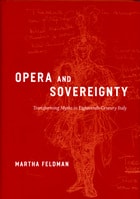
Opera and Sovereignty
Transforming Myths in Eighteenth-Century ItalyMartha Feldman
University of Chicago Press, 2007
Taking an anthropological approach to European music that’s as bold as it is unusual, Martha Feldman traces Italian opera’s shift from a mythical assertion of sovereignty, with its festive forms and rituals, to a dramatic vehicle that increasingly questioned absolute ideals. She situates these transformations against the backdrop of eighteenth-century Italian culture to show how opera seria both reflected and affected the struggles of rulers to maintain sovereignty in the face of a growing public sphere. In so doing, Feldman explains why the form had such great international success and how audience experiences of the period differed from ours today. Ambitiously interdisciplinary, Opera and Sovereignty will appeal not only to scholars of music and anthropology, but also to those interested in theater, dance, and the history of the Enlightenment.
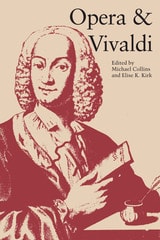
Opera and Vivaldi
Edited by Michael Collins and Elise K. Kirk
University of Texas Press, 1984
From the New York Times review of the Dallas Opera's performance of Orlando furioso and the international symposium on Baroque opera: ". . . it was a serious, thoughtful, consistent and imaginative realization of a beautiful, long-neglected work, one that fully deserved all the loving attention it received. As such, the production and its attendant symposium made a positive contribution to the cause of Baroque opera . . . . "
Baroque opera experienced a revival in the late twentieth century. Its popularity, however, has given rise to a number of perplexing and exciting questions regarding literary sources, librettos, theater design, set design, stage movement, and costumes—even the editing of the operas.
In 1980, the Dallas Opera produced the American premier of Vivaldi's Orlando furioso, which met with much acclaim. Concurrently an international symposium on the subject of Baroque opera was held at Southern Methodist University. Authorities from around the world met to discuss the operatic works of Vivaldi, Handel, and other Baroque composers as well as the characteristics of the genre. Michael Collins and Elise Kirk, deputy chair and chair of the symposium, edited the papers to produce this groundbreaking study, which will be of great interest to music scholars and opera lovers throughout the world.
Contributors to Opera and Vivaldi include Shirley Wynne, John Walter Hill, Andrew Porter, Eleanor Selfridge-Field, Howard Mayer Brown, William Holmes, Ellen Rosand, and the editors.
Opera and its Voices in Utah
Walter Rudolph
Utah State University Press, 2018
The Arrington Lecture series, established by one of the twentieth-century West's most distinguished historians, Leonard Arrington, has become a leading forum for prominent historians to address topics related to Mormon history. Utah State University hosts the Leonard J. Arrington Mormon History Lecture Series through the Merrill-Cazier Library Special Collections and Archives department.
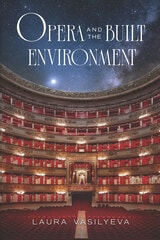
Opera and the Built Environment
Laura Vasilyeva
University of Chicago Press, 2025
In Opera and the Built Environment, music scholar Laura Vasilyeva considers the remarkable mass construction of opera houses around the world since the 1800s and the no-less-remarkable bids to standardize the architectural features of their interiors across this vast theatrical infrastructure. Now known as the teatro all’italiana, this style of architecture—made most famous by Milan’s Teatro alla Scala—is characterized by auditoria with tiers of stacked boxes and a dominant red hue.
With attention to the sensuous dimensions of their auditoria, from their surfaces to their atmospheres to their acoustics and thresholds, Vasilyeva reveals the calculated reasons these theaters took on the form they did. The result is a book that reveals unknown associations between the Italian opera house and matters of environmental destruction, empire, and belonging, showing us new and unexpected patterns in how opera connects to the world we know.
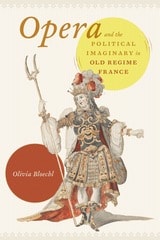
Opera and the Political Imaginary in Old Regime France
Olivia Bloechl
University of Chicago Press, 2018
In Opera and the Political Imaginary in Old Regime France, however, Olivia Bloechl reveals another layer of French opera’s political theater. The make-believe worlds on stage, she shows, involved not just fantasies of sovereign rule but also aspects of government. Plot conflicts over public conduct, morality, security, and law thus appear side-by-side with tableaus hailing glorious majesty. What’s more, opera’s creators dispersed sovereign-like dignity and powers well beyond the genre’s larger-than-life rulers and gods, to its lovers, magicians, and artists. This speaks to the genre’s distinctive combination of a theological political vocabulary with a concern for mundane human capacities, which is explored here for the first time.
By looking at the political relations among opera characters and choruses in recurring scenes of mourning, confession, punishment, and pardoning, we can glimpse a collective political experience underlying, and sometimes working against, ancienrégime absolutism. Through this lens, French opera of the period emerges as a deeply conservative, yet also more politically nuanced, genre than previously thought.
Opera for Everyone
The Industry's Experiments with American Opera in the Digital AgeMegan Steigerwald Ille
University of Michigan Press, 2024
Opera in Theory and Practice, Image and Myth
Edited by Lorenzo Bianconi and Giorgio Pestelli
University of Chicago Press, 2003
This sixth volume in the series centers on the sociological and critical aspects of opera in Italy, considering the art in the context of an Italian literary and cultural canon rarely revealed in English and American studies. In its six chapters, contributors survey critics' changing attitudes toward opera over several centuries, trace the evolution of formal conventions among librettists, explore the historical relationships between opera and Italian literature, and examine opera's place in Italian popular and national culture. In perhaps the volume's most striking contribution, German scholar Carl Dahlouse offers his most important statement on the dramaturgy of opera.
Opera on Stage
Edited by Lorenzo Bianconi and Giorgio Pestelli
University of Chicago Press, 2002
Opera on Stage, the second book of this multi-volume work to be published in English-in an expanded and updated version-focuses on staging and viewing Italian opera, from the court spectacles of the late sixteenth century to modern-day commercial productions. Mercedes Viale Ferrero describes the history of theater and stage design, detailing the evolution of the art well into the twentieth century. Gerardo Guccini does the same for stage and opera direction and the development of the director's role as an autonomous creative force. Kathleen Kuzmick Hansell discusses the interrelationships between theatrical ballet and Italian opera, from the age of Venetian opera to the early twentieth century. The visual emphasis of all three contributions is supplemented by over one hundred illustrations, and because much of this material-on the more "spectacular" visual aspects of Italian opera-has never before appeared in English, Opera on Stage will be welcomed by scholars and opera enthusiasts alike.
Opera on the Road
Traveling Opera Troupes in the United States, 1825-60Katherine K. Preston
University of Illinois Press, 1993
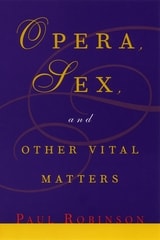
Opera, Sex and Other Vital Matters
Paul Robinson
University of Chicago Press, 2002
The essays on opera gathered here explore how masterpieces like Fidelio and The Magic Flute reflect the intellectual currents of their day. Be it the work of Verdi or Mozart, Wagner or Strauss, Robinson compels us to search for meaning not just in the lyrics of opera but also in the music. In melody, not libretto, we are more likely to discern key historical complexities and appreciate the way opera transcends language and time. The essays on sexuality, meanwhile, are ruminative, funny, and even moving. At one moment, Robinson measures whether homosexuality is the result of destiny or free choice. In another, he shares a touching exchange of letters with a gay student in the process of coming out. The final essays that encompass "other vital matters" find Robinson at his most incisive. Whether defending Freud as the most influential thinker of the twentieth century, attacking the dreaded use of semicolons, reflecting on his own mortality, or even meditating on the nature of cats, Sex, Opera, and Other Vital Matters is an eclectic work that will appeal to any reader interested in the continuing relevance of ideas to life.
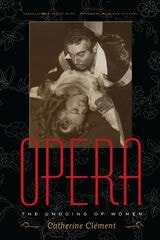
Opera
The Undoing of WomenCatherine Clement
University of Minnesota Press, 1999
An incisive and impassioned examination of women’s treatment in opera.
Catherine Clément analyzes the plots of over thirty prominent operas-Otello and Siegfried to Madame Butterfly and The Magic Flute-through the lenses of feminism and literary theory to unveil the negative messages about women in stories familiar to every opera listener.
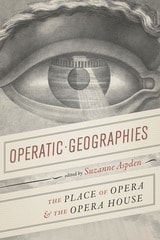
Operatic Geographies
The Place of Opera and the Opera HouseEdited by Suzanne Aspden
University of Chicago Press, 2019
Operatic Geographies invites us to reconsider the opera house’s spatial production. Looking at opera through the lens of cultural geography, this anthology rethinks the opera house’s landscape, not as a static backdrop, but as an expression of territoriality. The essays in this anthology consider moments across the history of the genre, and across a range of geographical contexts—from the urban to the suburban to the rural, and from the “Old” world to the “New.” One of the book’s most novel approaches is to consider interactions between opera and its environments—that is, both in the domain of the traditional opera house and in less visible, more peripheral spaces, from girls’ schools in late seventeenth-century England, to the temporary arrangements of touring operatic troupes in nineteenth-century Calcutta, to rural, open-air theaters in early twentieth-century France. The essays throughout Operatic Geographies powerfully illustrate how opera’s spatial production informs the historical development of its social, cultural, and political functions.
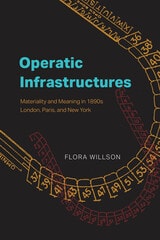
Operatic Infrastructures
Materiality and Meaning in 1890s London, Paris, and New YorkFlora Willson
University of Chicago Press, 2026
An exploration of the fundamental relationship between opera and urban modernity in three iconic cities: London, Paris, and New York.
At the end of the nineteenth century, London, Paris, and New York were quintessential modern metropolises and vital centers for opera. In Operatic Infrastructures, Flora Willson examines opera’s roots in the material worlds of these cities. Reaching beyond histories of opera as spectacle, she investigates the physical underpinnings of opera at the century’s end as an inter-urban, multimedia network.
Operatic Infrastructures considers emergent technologies such as the telephone and the subway, but it also retrieves the hidden, forgotten, and otherwise effaced traces of systems such as storage facilities and colonial trade routes. It takes seriously the mundane aspects of materiality, from the blandest clichés of newspaper columns to the fine print of insurance certificates. In doing so, the book reveals just how far these interfaces with modern urban life reached into opera’s own systems of meaning-making and performance in the 1890s—making it impossible to demarcate neatly between “opera” and its “context.” Without such operatic infrastructures, Willson shows, there would be no opera at all.
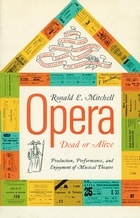
Opera—Dead or Alive
Production, Performance and Enjoyment of Musical TheatreRonald E. Mitchell
University of Wisconsin Press, 1972