Results by title
74 books match the query 'Oral history' and 6 start with o
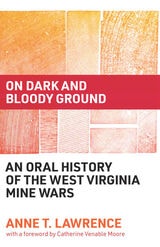
On Dark and Bloody Ground
An Oral History of the West Virginia Mine WarsAnne T. Lawrence
West Virginia University Press, 2021
In 1972 Anne Lawrence came to West Virginia at the invitation of the Miners for Democracy movement to conduct interviews with participants in, and observers of, the Battle of Blair Mountain and other Appalachian mine wars of the 1920s and ’30s. The set of oral histories she collected—the only document of its kind—circulated for many years as an informal typescript volume, acquiring an almost legendary status among those intrigued by the subject. Key selections from it appear here for the first time as a published book, supplemented with introductory material, maps, and photographs. The volume’s vivid, conversational mode invites readers into miners’ lived experiences and helps us understand why they took up arms to fight anti-union forces in some of the nation’s largest labor uprisings.
Published to coincide with the celebration of the Blair Mountain centennial in 2021, On Dark and Bloody Ground includes a preface by public historian Catherine Venable Moore and an afterword by Cecil E. Roberts of the United Mine Workers of America.
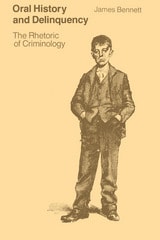
Oral History and Delinquency
The Rhetoric of CriminologyJames Bennett
University of Chicago Press, 1981
Oral History and Public Memories
Paula Hamilton
Temple University Press, 2008
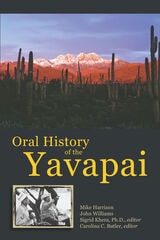
Oral History of the Yavapai
Mike Harrison and John Williams; Edited by Sigrid Khera and Carolina C. Butler
University of Arizona Press, 2015
Although Harrison and Williams have since passed away, their voices shine through the pages of this book and the history of their people remains to be passed along and shared. Thanks to the efforts of Scottsdale, Arizona, resident and Orme Dam activist Carolina Butler, this important document is being made available to the public for the first time.
Oral History of the Yavapai offers a wide range of information regarding the Yavapai people, from creation beliefs to interpretations of historical events and people. Harrison and Williams not only relate their perspectives on the relationship between the “White people” and the Native American peoples of the Southwest, but they also share stories about prayers, songs, dreams, sacred places, and belief systems of the Yavapai.
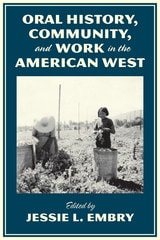
Oral History, Community, and Work in the American West
Edited by Jessie L. Embry
University of Arizona Press, 2013
In many cases occupations brought people together in myriad ways. The Latino workers who picked lemons together in Southern California report that it was baseball and Cinco de Mayo Queen contests that united them. Mormons in Fort Collins, Colorado, say that building a church together bonded them together. In separate essays, African Americans and women describe how they fostered a sense of community in Las Vegas. Native Americans detail the “Indian economy” in Northern California.
As these essays demonstrate, the history of the American West is the story of small towns and big cities, places both isolated and heavily populated. It includes groups whose history has often been neglected. Sometimes, western history has mirrored the history of the nation; at other times, it has diverged in unique ways. Oral history adds a dimension that has often been missing in writing a comprehensive history of the West. Here an array of oral historians—including folklorists, librarians, and public historians—record what they have learned from people who have, in their own ways, made history.
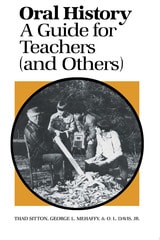
Oral History
A Guide for Teachers (and Others)By Thad Sitton, George L. Mehaffy, and O.L. Davis, Jr.
University of Texas Press, 1983
More than a mode of gathering information about the past, oral history has become an international movement. Historians, folklorists, and other educational and religious groups now recognize the importance of preserving the recollections of people about the past. The recorded memories of famous and common folk alike provide a vital complement to textbook history, bringing the past to life through the stories of those who lived it.
Oral History is designed to introduce teachers, students, and interested individuals to the techniques, problems, and pleasures of collecting oral history. The authors, themselves experienced educators, examine the uses of oral history in the classroom, looking at a wide range of projects that have been attempted and focusing on those that have succeeded best.
Besides suggesting many possible projects, they discuss the necessary hardware and its use: recording equipment and procedures, interview outlines and preliminary research, photography and note-taking in the field, transcription and storage of information, legal forms, and more. For the teacher, the authors offer helpful advice on training students to be sensitive interviewers in both formal and informal situations.
How can oral histories collected in the classroom be put to use? The authors discuss their uses within the curriculum; in projects such as oral history archives, publications such as the popular Foxfire books, and other media productions; and in researching current community problems. Useful appendixes survey a variety of reference tools for the oral historian and describe in detail how a Foxfire-concept magazine may be developed.