Results by title
173 books match the query 'Origins' and 25 start with o

On the Origins of Life and Its Infectious Nature
Life in a Cosmic ContextJosé Quintáns
University of Chicago Press, 2013

Origins
Reiner Schürmann
Diaphanes, 2016
Originally published in French in 1976, Origins was the winner of the coveted Prix Broquette-Gonin of the Académie Francaise. In close collaboration with the author, this meticulously crafted translation was created in the early 1990s, but Schürmann’s premature death in 1993 prevented its publication process and, as a result, one of the most important literary accounts of the conflicted process of coming to terms with the Holocaust and Germany’s Nazi past has been unavailable to English readers until now. Candid and frank, filled with fury and caustic sarcasm, Origins offers insight into a generation caught between disappointment and rage, alignment and rebellion, guilt and obsession with the past.
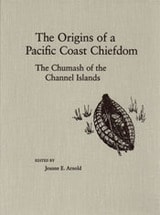
Origins Of A Pacific Coast Chiefdom
Jeanne E Arnold
University of Utah Press, 2001
When Europeans first visited California, they encountered one of the most culturally diverse regions of the New World. The coasts and ecologically richest areas were dotted with small polities which were supported not by horticulture but exclusively by hunting, fishing, and gathering, placing them among the more complex hunter-gatherer groups in the world.
The Origins of a Pacific Coast Chiefdom considers the Chumash, perhaps the most hierarchically organized of the California groups. It explores the final thousand years of coastal Chumash culture, which culminated in the complex society witnessed by the earliest Spanish explorers.
Chumash life was characterized by settled villages, massive production of prestige goods, sophisticated plank canoes, and extensive maritime exchange systems—features more characteristic of agricultural societies. Archaeological sites in the island Chumash area are exceptionally well preserved, permitting precise interpretations of both subtle and major changes in technologies, subsistence, prestige goods, and specialized shell and lithic industries. The data and interpretations presented here are the result of fifteen years of intensive investigation on the Channel Islands.
Origins Of Logical Empiricism
Ronald N. Giere
University of Minnesota Press, 1996

Origins Of Magnetospheric Physics
An Expanded EditionJames A. Van Allen
University of Iowa Press, 2004

Origins and Destinations
The Making of the Second GenerationRenee Luthra
Russell Sage Foundation, 2018
Using surveys of second generation immigrant adults in New York and Los Angeles, Origins and Destinations explains why second generation experiences differ across national origin groups and why immigrant offspring with the same national background often follow different trajectories. Inter-group disparities stem from contexts of both emigration and immigration. Origin countries differ in value orientations: immigrant parents transmit lessons learned in varying contexts of emigration to children raised in the U.S. A system of migration control sifts immigrants by legal status, generating a context of immigration that favors some groups over others. Both contexts matter: schooling is higher among immigrant children from more secular societies (South Korea) than among those from more religious countries (the Philippines). When immigrant groups enter the U.S. migration system through a welcoming door, as opposed to one that makes authorized status difficult to achieve, education propels immigrant children to better jobs.
Diversity is also evident among immigrant offspring whose parents stem from the same place. Immigrant children grow up with homeland connections, which can both hurt and harm: immigrant offspring get less schooling when a parent lives abroad, but more schooling if parents in the U.S. send money to relatives living abroad. Though all immigrants enter the U.S. as non-citizens, some instantly enjoy legal status, while others spend years in the shadows. Children born abroad, but raised in the U.S. are all everyday Americans, but only some have become de jure Americans, a difference yielding across-the-board positive effects, even among those who started out in the same country.
Disentangling the sources of diversity among today’s population of immigrant offspring, Origins and Destinations provides a compelling new framework for understanding the second generation that is transforming America.

Origins and Development of Medical Imaging
T. Doby and G. Alker
Southern Illinois University Press, 1997
For thousands of years, horror of the dead, superstition, and oppressive decrees prevented our ancestors from looking inside the human body; in ancient civilizations, diagnostics were based on imagination and theory, with only limited observation. So people developed suppositions about health and disease without knowing how the liver, heart, brain, and blood vessels looked or functioned. In tracing the history of medical imaging, Doby and Alker establish that it was not until the Renaissance and the detailed drawings of human anatomy by da Vinci and Vesalius that successful internal imaging of the human body was born.
At the turn of the nineteenth century, Roentgen’s discovery of the X-ray provided the first miraculous look into the living body. From that instant, medical imaging developed at an ever-increasing pace, evolving to more recent discoveries in nuclear medicine, CT scanning, and ultrasound and magnetic resonance imaging.
As Doby and Alker note, we can expect our efforts to be understood in the future only if we examine past events with an appreciation of the difficulties and challenges that faced our predecessors. Despite almost unbelievable advances in current medical technology, we must still rely on our own resources and common sense as human beings in understanding what technology can and cannot do for us.
A comprehensive set of appendixes pictorially depicting the history of imaging round out the volume.
Origins of African Nationalism
Continuity and Rupture in the Movements of Unity Emerging from the Struggle against Portuguese Colonial Domination, 1911–1961Mário Pinto de Andrade. Translated by Mario Pereira. Introduction by Jean-Michel Mabeko-Tali.
Tagus Press, 2022

Origins of Instability in Early Republican Mexico
Donald F. Stevens
Duke University Press, 1991
Donald F. Stevens’ revisionist account challenges traditional historiography to examine the nature and origins of Mexico’s political instability. Turning to quantitative methods as a way of providing a framework for examining existing hypotheses concerning Mexico’s instability, the author dissects the relationship between instability and economic cycles; contradicts the notion that Mexico’s social elite could have increased political stability by becoming more active; and argues that the principal political fissures were not liberal vs. conservative but were among radical, moderate, and conservative.
Ultimately, Stevens maintains, the origins of that country’s instability are to be found in the contradictions between liberalism and Mexico’s traditional class structure, and the problems of creating an independent republic from colonial, monarchical, and authoritarian traditions.
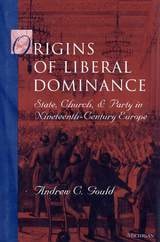
Origins of Liberal Dominance
State, Church, and Party in Nineteenth-Century EuropeAndrew C. Gould
University of Michigan Press, 1999

Origins of Modern Japanese Literature
Karatani Kojin
Duke University Press, 1993
In a sweeping reinterpretation of nineteenth-and twentieth-century Japanese literature, Karatani Kojin forces a reconsideration of the very assumptions underlying our concepts of modernity. In his analysis, such familiar terms as origin, modern, literature, and the state reveal themselves to be ideological constructs. Karatani weaves many separate strands into an argument that exposes what has been hidden in both Japanese and Western accounts of the development of modern culture. Among these strands are: the "discovery" of landscape in painting and literature and its relation to the inwardness of individual consciousness; the similar "discovery" in Japanese drama of the naked face as another kind of landscape produced by interiority; the challenge to the dominance of Chinese characters in writing; the emergence of confessional literature as an outgrowth of the repression of sexuality and the body; the conversion of the samurai class to Christianity; the mythologizing of tuberculosis, cancer, and illness in general as a producer of meaning; and the "discovery" of "the child" as an independent category of human being.
A work that will be important beyond the confines of literary studies, Karatani's analysis challenges basic Western presumptions of theoretical centrality and originality and disturbs the binary opposition of the "West" to its so-called "other." Origins of Modern Japanese Literature should be read by all those with an interest in the development of cultural concepts and in the interrelating factors that have determined modernity.
Origins of New Mexico Families
A Genealogy of the Spanish Colonial PeriodFray Angélico Chávez
Museum of New Mexico Press, 1992

Origins of Pre-Columbian Art
By Terence Grieder
University of Texas Press, 1982
Since Columbus first called the natives of the Americas “Indians,” the sources of their art and culture have been a puzzle. The strange mixture of objects of Asian appearance with those decidedly un-Asian has provided fuel for controversy between those who see the American cultures as products of diffusion and those who see them as independent inventions. Origins of Pre-Columbian Art cuts through this old dispute to provide a fresh look at ancient cultural history in the Americas and the Pacific basin.
Using evidence from archaeology, ethnology, and psychology, Terence Grieder suggests that contact between individuals across cultural borders is the root of both invention and diffusion. By tracing the spread of early symbolic techniques, materials, and designs from Europe and Asia to the lands of the Pacific and to the Americas, he displays the threads woven through humanity’s common cultural heritage.
While archaeology provides examples of ancient symbols, ethnology reveals widely separated modern peoples still using these symbols and giving them similar meanings. Mapping these patterns of use and meaning, the author describes three waves of migration from Asia to the Americas, each carrying its own cluster of ideas and the symbols that expressed them.
First Wave cultures focused on their environment and on the human body, inventing symbols that compared people and nature. Second Wave symbolism emphasized the center and the periphery: the village and the horizon; the tree or pole as world axis; and the world’s rim, where spirits exist. These cultures created masks to give form to those beings beyond the horizon. The heavens were finally incorporated into the system of symbols by Third Wave peoples, who named the celestial bodies as gods, treasured heaven-colored stones, and represented the world in pyramids.
Emphasizing the interpretation of art in its many forms, Grieder has found that such seemingly minor decorations as bark cloth clothing and tattoos have deep meaning. Ancient art, he argues, was the vehicle for ancient science, serving to express insights into biology, astronomy, and the natural world.

Origins of Psychopathology
The Phylogenetic and Cultural Basis of Mental IllnessFábrega Jr., Horacio
Rutgers University Press, 2002
In Origins of Psychopathology, Horacio Fárega Jr. employs principles of evolutionary biology to better understand the significance of mental illness. He explores whether what psychiatry has categorized as mental disorders could have existed during earlier phases of human evolution. Fábrega approaches the prominent features of mental disorders as adaptive responses to the environment and life’s circumstances, which in turn can only be understood in the context of our evolutionary past. Taking his cue from theoretical issues raised by research into primate behavior and early hominid evolution, he poses the question: What, if any, aspects of mental illness are rooted in our evolution? Does mental illness occur in primates and other animals, and if so, what does this tell us about mental illness in human evolution? How has mental illness played an adaptive role? How has the development of language and higher cognitive functions affected characteristics of psychopathology? Fábrega synthesizes insights from both the clinical and the evolutionary points of view. This facet of psychopathology, which involves its origins and manifestations viewed across the expanse of human evolution, has, until now, been largely neglected in psychiatric education, theory, and practice.

Origins of a Spontaneous Revolution
East Germany, 1989Karl-Dieter Opp, Peter Voss, and Christiane Gern
University of Michigan Press, 1995

Origins of the American Indians
European Concepts, 1492-1729By Lee E. Huddleston
University of Texas Press, 1967
The American Indian—origin, culture, and language—engaged the best minds of Europe from 1492 to 1729. Were the Indians the result of a co-creation? Were they descended from the Ten Lost Tribes of Israel? Could they have emigrated from Carthage, Phoenicia, or Troy? All these and many other theories were proposed.
How could scholars account for the multiplicity of languages among the Indians, the differences in levels of culture? And how did the Indian arrive in America—by using as a bridge a now-lost continent or, as was later suggested by some persons in the light of an expanding knowledge of geography, by using the Bering Strait as a migratory route?
Most of the theories regarding the American Indian were first advanced in the sixteenth century. In this distinctive book Lee E. Huddleston looks carefully into those theories and proposals. From many research sources he weaves an historical account that engages the reader from the very first.
The two most influential men in an early-developing controversy over Indian origins were Joseph de Acosta and Gregorio García. Approaching the subject with restraint and with a critical eye, Acosta, in 1590, suggested that the presence of diverse animals in America indicated a land connection with the Old World. On the other hand, García accepted several theories as equally possible and presented each in the strongest possible light in his Origen de los indios of 1607.
The critical position of Acosta and the credulous stand of García were both developed in Spanish writing in the seventeenth century. The Acostans settled on an Asiatic derivation for the Indians; the Garcians continued to accept most sources as possible. The Garcian position triumphed in Spain, as was shown by the republication of García’s Origen in 1729 with considerable additions consistent within the original framework.
Outside of Spain, Acosta was the more influential of the two. His writings were critical in the thinking of such men as Joannes de Laet (who bested Grotius in their polemic on Indian origins), Georg Horn, and Samuel Purchas. By the end of the seventeenth century the Acostans of Northern Europe had begun to apply physical characteristics to the determination of Indian origins, and by the early eighteenth century these new criteria were beginning to place the question of Indian origins on a more nearly scientific level.

Origins of the National Forests
Harold K. Steen, ed.
Duke University Press, 1992
The national forests are a major source of wood, water, minerals, forage, animal life and habitat, and wilderness. Yet questions of who controls and who benefits from the resources have posed problems and conflicts from the origins of the Forest Service to the present. Based on a 1991 Forest History Society conference, the essays collected here discuss a range of important topics surrounding our national forests, including the relationship between the federal and state systems that regulate the forests; the privately owned lands within the forests that are governed by federal statutes, state laws, and county ordinances; the ill-defined rights of those who lived on the land long before it was a national forest and were forced off the land; and the effect of early policymaking decisions made within the framework of the emerging Conservation Movement.
Contributors. Ron Arnold, Pamela A. Conners, Mary S. Culpin, Stanley Dempsey, Peter Gillis, Donn E. Headley, Robert L. Hendricks, Stephen Larrabee, Patricia Nelson Limerick, Dennis L. Lynch, Michael McCarthy, Char Miller, Joseph A. Miller, James Muhn, Kevin Palmer, Donald Pisani, John F. Reiger, William Rowley, Michael Ryan, William E. Shands, Harold K. Steen, Richard White, Gerald W. Williams
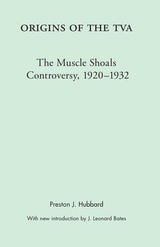
Origins of the TVA
The Muscle Shoals Controversy, 1920-1932Preston J. Hubbard
University of Alabama Press, 1961
How a North Alabama river fueled a national showdown over power, democracy, and the New Deal
Origins of the TVA: The Muscle Shoals Controversy, 1920–1932 is the definitive history of the bitter, decade-long struggle that gave rise to the Tennessee Valley Authority, one of the most consequential experiments in American public policy. Centered on Muscle Shoals, Alabama, this book traces how wartime investments in nitrates and hydropower became the focal point for national debates over public versus private power, regional planning, agricultural reform, and the proper role of the federal government.
In an era grappling with industrial transformation and sectional inequality, the story of Muscle Shoals illuminates why the TVA emerged as a landmark solution with global influence. Drawing on an extraordinary range of sources—more than twenty-five congressional hearings, the Congressional Record, private manuscripts, National Archives collections, and contemporary journalism—historian Preston J. Hubbard delivers a model of scholarly rigor and balance. Originally published in 1961 and still unmatched in scope, the book is widely praised for its restraint, clarity, and meticulous reconstruction of complex political, economic, and technological issues.
Hubbard demonstrates how a small group of lawmakers led by Senator George W. Norris ultimately shaped a durable vision of public power and regional development. This book will reward historians, political scientists, policy professionals, and students of Southern history, as well as readers interested in the origins of the New Deal, environmental policy, and the enduring debate over public resources and private enterprise.
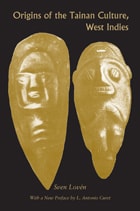
Origins of the Tainan Culture, West Indies
Sven Loven, with a new preface by L. Antonio Curet
University of Alabama Press, 2010
When originally published in German in 1924, this volume was hailed as the first modern, comprehensive archaeological overview of an emerging area of the world. Yes, the Caribbean islands had long been known and owned, occupied, or traded among by the economically advanced nations of the world. However, the original inhabitants—as well as their artifacts, languages, and culture—had been treated by explorers and entrepreneurs alike as either slaves or hindrances to progress, and were used or eliminated. There was no publication that treated seriously the region and the peoples until this work. In the following ten years, additional pertinent publications emerged, along with a request to translate the original into Spanish. Based on those recent publications, Loven decided to update and reissue the work in English, which he thought to be the future international language of scholarship. This work is a classic, with enduring interpretations, broad geographic range, and an eager audience.

Origins of the War with Mexico
The Polk-Stockton IntrigueBy Glenn W. Price
University of Texas Press, 1967
In the spring of 1846 James K. Polk announced that the Mexican Army had invaded United States territory and had “shed American blood upon the American soil.” This political rhetoric, as Glenn W. Price establishes in Origins of the War with Mexico: The Polk-Stockton Intrigue, is part of the myth of American innocence. It represents the “internal contradiction between professed values and patterns of action,” perpetuated by American historical writing that emphasizes national consequences of the acquisition of foreign territory and minimizes both its international significance and the importance of the diplomatic and military methods used.
A conflict with Mexico, leading to territorial expansion of the United States, was not unwanted. California was Polk’s prime objective from the beginning of his administration, and this Mexican province was to be acquired by conquest in a war initiated on the Texas-Mexican border. To this end Polk sent several agents to Texas, but the man at the center of the war intrigue was Commodore Robert F. Stockton, independently wealthy, prominent in politics, and the head of great business enterprises.
Sufficient evidence exists to substantiate in every important particular the steps in Polk’s path of intrigue: his attempts to bribe Mexican officials; his efforts to encourage revolutionary forces in the Mexican provinces; his use of the threat of force to frighten Mexico into selling California; his attempt to initiate a war by proxy through the government of Texas and Anson Jones.
If Polk was unwilling to assume responsibility for aggressive war, Stockton was not; he arrived in Galveston with a squadron of naval vessels in May of 1845, prepared to finance an army of three thousand men from his personal funds to avoid the overt involvement of the government of the United States. But, says Price, for all the internationally dangerous implications of such a maneuver, the two men who played the chief roles in the war intrigue of 1845 are representative in their written and spoken expression of faith in American righteousness of action and in the American tradition of the divine mission.
Based on extensive research into the written and spoken words of the people who were involved, directly and indirectly, in the events, this analysis (which will be considered revisionist) of the origins of the War with Mexico is the result of the kind of objective approach to national history for which the author makes a plea in his preface and conclusion and in his interpretive comments throughout the work. The historian, Price believes, “has the extraordinary advantage of being able to examine mankind from that distance and elevation and detachment which so often reveals, as it is designed to reveal, the gulf between pretension and performance.”
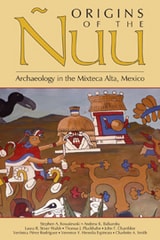
Origins of the Ñuu
Archaeology in the Mixteca Alta, MexicoStephen A. Kowalewski
University Press of Colorado, 2009
The ñuu - the kingdoms of the famous Mixtec codices - are traced back through the Postclassic and Classic periods to their beginnings in the first states of the Terminal Formative, revealing their origin, evolution, and persistence through two cycles of growth and collapse. Challenging assumptions that the Mixtec were peripheral to better-known peoples such as the Aztecs or Maya, the book asserts that the ñuu were a major demographic and economic power in their own right.
Older explanations of multiregional or macroregional systems often portrayed civilizations as rising in a cradle or hearth and spreading outward. New macroregional studies show that civilizations are products of more complex interactions between regions, in which peripheries are not simply shaped by cores but by their interactions with multiple societies at varying distances from major centers. Origins of the Ñuu is a significant contribution to this emerging area of archaeological research.

Other People's Colleges
The Origins of American Higher Education ReformEthan W. Ris
University of Chicago Press, 2022
For well over one hundred years, people have been attempting to make American colleges and universities more efficient and more accountable. Indeed, Ethan Ris argues in Other People’s Colleges, the reform impulse is baked into American higher education, the result of generations of elite reformers who have called for sweeping changes in the sector and raised existential questions about its sustainability. When that reform is beneficial, offering major rewards for minor changes, colleges and universities know how to assimilate it. When it is hostile, attacking autonomy or values, they know how to resist it. The result is a sector that has learned to accept top-down reform as part of its existence.
In the early twentieth century, the “academic engineers,” a cadre of elite, external reformers from foundations, businesses, and government, worked to reshape and reorganize the vast base of the higher education pyramid. Their reform efforts were largely directed at the lower tiers of higher education, but those efforts fell short, despite the wealth and power of their backers, leaving a legacy of successful resistance that affects every college and university in the United States. Today, another coalition of business leaders, philanthropists, and politicians is again demanding efficiency, accountability, and utility from American higher education. But, as Ris argues, top-down design is not destiny. Drawing on extensive and original archival research, Other People’s Colleges offers an account of higher education that sheds light on today’s reform agenda.

Other People's Colleges
The Origins of American Higher Education ReformEthan W. Ris
University of Chicago Press, 2022
This is an auto-narrated audiobook edition of this book.
An illuminating history of the reform agenda in higher education.
For well over one hundred years, people have been attempting to make American colleges and universities more efficient and more accountable. Indeed, Ethan Ris argues in Other People’s Colleges, the reform impulse is baked into American higher education, the result of generations of elite reformers who have called for sweeping changes in the sector and raised existential questions about its sustainability. When that reform is beneficial, offering major rewards for minor changes, colleges and universities know how to assimilate it. When it is hostile, attacking autonomy or values, they know how to resist it. The result is a sector that has learned to accept top-down reform as part of its existence.
In the early twentieth century, the “academic engineers,” a cadre of elite, external reformers from foundations, businesses, and government, worked to reshape and reorganize the vast base of the higher education pyramid. Their reform efforts were largely directed at the lower tiers of higher education, but those efforts fell short, despite the wealth and power of their backers, leaving a legacy of successful resistance that affects every college and university in the United States. Today, another coalition of business leaders, philanthropists, and politicians is again demanding efficiency, accountability, and utility from American higher education. But, as Ris argues, top-down design is not destiny. Drawing on extensive and original archival research, Other People’s Colleges offers an account of higher education that sheds light on today’s reform agenda.
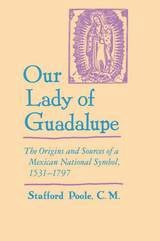
Our Lady of Guadalupe
The Origins and Sources of a Mexican National Symbol, 1531–1797Stafford Poole
University of Arizona Press, 1995
Our Lady of Guadalupe
The Origins and Sources of a Mexican National Symbol, 1531–1797Stafford Poole
University of Arizona Press, 2017