Results by title
74 books match the query 'Paleontology' and 3 start with o
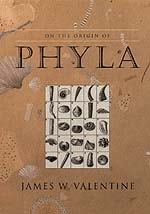
On the Origin of Phyla
James W. Valentine
University of Chicago Press, 2004
Owing its inspiration and title to On the Origin of Species, James W. Valentine's ambitious book synthesizes and applies the vast treasury of theory and research collected in the century and a half since Darwin's time. By investigating the origins of life's diversity, Valentine unlocks the mystery of the origin of phyla.
One of the twentieth century's most distinguished paleobiologists, Valentine here integrates data from molecular genetics, evolutionary developmental biology, embryology, comparative morphology, and paleontology into an analysis of interest to scholars from any of these fields. He begins by examining the sorts of evidence that can be gleaned from fossils, molecules, and morphology, then reviews and compares the basic morphology and development of animal phyla, emphasizing the important design elements found in the bodyplans of both living and extinct phyla. Finally, Valentine undertakes the monumental task of developing models to explain the origin and early diversification of animal phyla, as well as their later evolutionary patterns.
Truly a magnum opus, On the Origin of Phyla will take its place as one of the classic scientific texts of the twentieth century, affecting the work of paleontologists, morphologists, and developmental, molecular, and evolutionary biologists for decades to come.
"A magisterial compendium . . . . Valentine offers a judicious evaluation of an astonishing array of evidence."—Richard Fortey, New Scientist
"Truly a magnum opus, On the Origin of Phyla has already taken its place as one of the classic scientific texts of the twentieth century, affecting the work of paleontologists, morphologists, and developmental, molecular, and evolutionary biologists for decades to come."—Ethology, Ecology & Evolution
"Valentine is one of the Renaissance minds of our time. . . . Darwin wisely called his best-known work On the Origin of the Species; the origin of the phyla is an even stickier problem, and Valentine deserves credit for tackling it at such breadth . . . . A magnificient book."—Stefan Bengtson, Nature
[more]
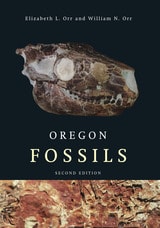
Oregon Fossils, Second Edition
Elizabeth L. Orr
Oregon State University Press, 2009
This revised and expanded edition of Oregon Fossils includes a record of all known fossils in Oregon going back 400 million years, along with collecting localities by county, age, rock formation, and published source. The book also provides a geologic overview of the state, from ocean beaches to the high desert, from the Blue Mountains to the Siskiyous.
Unique among fossil field guides, Oregon Fossils includes both specimen identification and interesting notes about their discovery, naming, and conservation. The narrative is sprinkled with biographical sketches of paleontologists who have contributed to the state’s fossil record, and the text is richly illustrated with photographs, line drawings, charts, and maps. A complete bibliography lists full citations to fossil material. The only single volume that provides Oregon’s fossil record and history, Oregon Fossils is a well-written, well-organized guide. It is an excellent reference for classroom and library use, for researchers, and for private collectors and hobbyists.
Unique among fossil field guides, Oregon Fossils includes both specimen identification and interesting notes about their discovery, naming, and conservation. The narrative is sprinkled with biographical sketches of paleontologists who have contributed to the state’s fossil record, and the text is richly illustrated with photographs, line drawings, charts, and maps. A complete bibliography lists full citations to fossil material. The only single volume that provides Oregon’s fossil record and history, Oregon Fossils is a well-written, well-organized guide. It is an excellent reference for classroom and library use, for researchers, and for private collectors and hobbyists.
[more]

Owls, Caves and Fossils
Predation, Preservation and Accumulation of Small Mammal Bones in Caves, with an Analysis of the Pleistocene Cave Faunas From Westbury-Sub-Mendip, Somerset, U.K.Peter Andrews
University of Chicago Press, 1990
Owls, Caves, and Fossils is the first comprehensive, fully illustrated account of small mammal taphonomy. The study of small mammal remains has previously been neglected in favor of such large mammals as elephants, bovids, and carnivores, and Andrews remedies this deficiency by analyzing the taphonomic processes significant in the preservation of small mammal fauna in caves.
[more]