Results by title
3258 books match the query 'Performing Arts' and 52 start with o
O'Neill's Shakespeare
Normand Berlin
University of Michigan Press, 1993
In O'Neill's Shakespeare , Normand Berlin explores the relationship of William Shakespeare and Eugene O'Neill through detailed, often surprising, intertextual readings of the two great playwrights' work. "Of course, it would have been impossible for O'Neill not to have been influenced by Shakespeare," acknowledges Berlin. But this is an influence of an unusual and extraordinary sort, "a family romance" that transcends their obvious differences—a romance that "takes in all O'Neill's life and art."
In the first book-length study of this crucial literary and dramatic relationship, Berlin probes far beyond the usual listing of allusions and references. This is the exploration of an "essential, basic, even natural" connection, in which Shakespeare is shown to have fundamentally shaped O'Neill's creative imagination. Following O'Neill's career chronologically, Berlin divides his study into two parts. The "first career" (culminating in Mourning Becomes Electra) is explored through recurring themes that evoke Shakespeare: the sea, black and white, and the family. O'Neill's "second career" (from Ah! Wilderness until the last plays) is examined through Shakespearean genre classifications: comedy, history, tragedy, and tragicomedy. Though always grounded in close textual readings, Berlin's analysis spirals outward to encompass O'Neill's artistic and psychological development and touches on the questions of tradition, transcendence, and human nature inevitably raised when such literary connections across history are drawn.
O'Neill's Shakespeare is more than a reminder that Shakespeare continues to haunt Western culture; it is a careful and fascinating analysis of a particular legacy in American drama. The book has insights to offer to specialists in Shakespeare and O'Neill, and to any reader interested in the transmission of ideas through Western culture. Berlin's study of the unconscious and conscious uses of Shakespeare by O'Neill provide a valuable new understanding of O'Neill's artistry. It is also an eloquent, thoughtful account that blends the transcendence of Shakespeare's influence with the particular ways in which every era must refashion Shakespeare so that "the past becomes the present."
Objects as Actors
Props and the Poetics of Performance in Greek TragedyMelissa Mueller
University of Chicago Press, 2015
As Mueller shows, props such as weapons, textiles, and even letters were often fully integrated into a play’s action. They could provoke surprising plot turns, elicit bold viewer reactions, and provide some of tragedy’s most thrilling moments. Whether the sword of Sophocles’s Ajax, the tapestry in Aeschylus’s Agamemnon, or the tablet of Euripides’s Hippolytus, props demanded attention as a means of uniting—or disrupting—time, space, and genre.
Insightful and original, Objects as Actors offers a fresh perspective on the central tragic texts—and encourages us to rethink ancient theater as a whole.
Observing Film Art
Themes from the Work of David BordwellCharlie Keil
Rutgers University Press, 2027
When David Bordwell died in 2024, he left behind a legacy of film scholarship and criticism whose influence is unmatched. Coauthor of a pair of textbooks adopted across the globe and the main force behind a blog read by thousands, Bordwell has influenced generations of film students, filmmakers, and film critics. Observing Film Art examines the breadth of Bordwell’s work through the perspectives of those who knew him best, collaborators, former students, and critics among them. This is the first collection devoted to the work of Bordwell, and it gives equal attention to each facet of his prodigious scholarship, structured to highlight his interest in theory, history, and analysis and criticism. The cornerstones of his approach to film study, including formalism, cognitivism, and historical poetics, are all examined in detail, as are key works, including The Classical Hollywood Cinema (coauthored with Kristin Thompson and Janet Staiger) and Narration in the Fiction Film.
Obstruction
Nick Salvato
Duke University Press, 2016
Occupying the Stage
The Theater of May '68Kate Bredeson
Northwestern University Press, 2018
The book shows how French theater artists during this period used a strategy of occupation-occupying buildings, streets, language, words, traditions, and artistic processes-as their central tactic of protest and transformation. It further proposes that the Theater of May '68 has left imprints on contemporary artists and activists, and that this theater offers a scaffolding on which to build a meaningful analysis of contemporary protest and performance in France, North America, and beyond.
At the book's heart is an inquiry into how artists of the period used theater as a way to engage in political work and, concurrently, questioned and overhauled traditional theater practices so their art would better reflect the way they wanted the world to be. Occupying the Stage embraces the utopic vision of May '68 while probing the period's many contradictions. It thus affirms the vital role theater can play in the ongoing work of social change.
Odd Man Out
A Memoir of the Holllywood TenEdward Dmytryk
Southern Illinois University Press, 1996
In 1947, the House Un-American Activities Committee rudely interrupted the successful career and life of Edward Dmytryk, citing him with contempt of Congress. As a result, Dmytryk was fired by RKO and spent three years in England before returning to the United States to serve a six-month jail sentence and undergo a second round of hearings, during which he recanted and provided evidence against several of his former colleagues.
In this personal and perceptive book, Dmytryk sharply chronicles the history of a particularly turbulent era in American political life while examining his own life before and after the events universally called the witch hunts. He details his brief membership in the Communist Party of America, explaining his initial commitment to what he perceived as communist ideals of civil liberties, economic justice, and antifacism, followed by his eventual disillusionment with the party as itbetrayed those ideals. He goes on to provide a fair assessment of what then happened to him and the effect it had on the rest of his life.
Dmytryk describes the activities, prejudices, and personal behaviors of all the parties enmeshed in the congressional hearings on communism in Hollywood. His reactions to other members of the Hollywood Ten and his recollection of conversations with them lend his book an immediacy that is not only informative but also absorbing. Most importantly, he does not uphold an ideology but rather presents the events as he perceived them, understood them, and responded to them. Dmytryk’s account is characterized by an openness born of a mature awareness of personal trial as history.
Odysseys of Recognition
Performing Intersubjectivity in Homer, Aristotle, Shakespeare, Goethe, and KleistWiggins, Ellwood
Bucknell University Press, 2019
Published by Bucknell University Press. Distributed worldwide by Rutgers University Press.
Of Borders And Thresholds
Theatre History, Practice, and TheoryMichal Andrzej Kobialka
University of Minnesota Press, 1999

Off Book
Devised Performance and Higher EducationEdited by Heather Fitzsimmons Frey, Nicola Hyland, and James McKinnon
Intellect Books, 2022
In the theater industry, “off book” refers to the date by which performers are to have memorized their lines and will no longer carry their play script—the “book”—on stage. But for the authors of this volume, the question is not when the book needs to be memorized, but why is there a need to be “on” book in the first place? Practitioners of devised performance choose to compose live performances from scratch rather than follow instructions in someone else’s script; educators of devised performance prefer to practice learning, too, as a generative and creative process that can never be confused with mere memorization. In its usual context, “off book” implies that theater is (literally) authorized by the book—the dramatic text—that represents its essential core or contains its meaning. Yet the “book” is not essential, and the chapters here highlight higher education theater practices that throw away the “book” altogether, creating space for actors and learners to do more than memorize. The conventional rules and hierarchies of theater creation, research, training, and education are not always relevant, or desirable, in these contexts. Instead, the questions and practices that go beyond the “book” matter.
Lively and engaging, Off Book will be a valuable and unique resource for university students, drama educators, theater historians, and practicing devised theater artists.
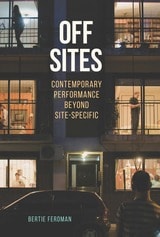
Off Sites
Contemporary Performance beyond Site-SpecificBertie Ferdman
Southern Illinois University Press, 2018
Contextualizing the techniques and methods of the incredibly rich and vital genre of site-specific performance, author Bertie Ferdman traces the evolution of that term. Originally used for experimental staging practices and then later also for engaged situational events, site-specific is no longer sufficient for the genre’s many contemporary variations.
Using the term off-site, Ferdman illustrates five distinct ways artists have challenged the disciplinary framework of site-specific theatre: blurring the traditional boundaries between the fictional and the real; changing how the audience and actor interact with each other and whether they are physically together or apart; fabricating sites from physically bound, conceptually constructed, or virtual spaces; staging live situations in real/nonreal and often mediated encounters; and challenging our preconceived notions of time and space. Tracing the genealogy of site-based work through the twentieth and twenty-first centuries, Ferdman outlines the theoretical groundwork for her study in the introduction. Individual chapters focus on distinct types of off-sites—the interdisciplinary discourse of disciplinary sites; the spaces of audience engagement with spectator sites; the dislocation of time for temporal sites; and the historiographical spaces of mapping for urban sites.
Ferdman examines site-based work being done in the Americas by contemporary companies and artists experimenting with new forms and practices for site-driven theatre. Key productions discussed include Private Moment by David Levine, Geyser Land by Mary Ellen Strom and Ann Carlson, Jim Findlay’s Dream of the Red Chamber, and Lola Arias’ Mi Vida Después.
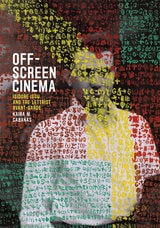
Off-Screen Cinema
Isidore Isou and the Lettrist Avant-GardeKaira M. Cabañas
University of Chicago Press, 2015
Off-Screen Cinema is the first monograph in English of the Lettrists. Offering a full portrait of the avant-garde scene of 1950s Paris, it focuses on the film works of key Lettrist figures like Gil J Wolman, Maurice Lemaître, François Dufrêne, and especially the movement's founder, Isidore Isou, a Romanian immigrant whose “discrepant editing” deliberately uncoupled image and sound. Through Cabañas's history, we see not only the full scope of the Lettrist project, but also its clear influence on Situationism, the French New Wave, the New Realists, as well as American filmmakers such as Stan Brakhage.
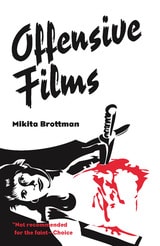
Offensive Films
Mikita Brottman
Vanderbilt University Press, 2005
While most critics have been quick to dismiss such films as mere shock-fests (if they even bother to talk about them at all), Brottman argues that these movies tell us quite a bit about who we are as a society, what makes us anxious, and what taboos we truly believe cannot be crossed. Part anthropology, part psychoanalysis, Offensive Films vivisects these movies in order to figure out just what about them is so offensive, obscene, or bizarre. In the end, Brottman proves that these films, shunned from the cinematic canon, work on us in sophisticated ways we often choose to remain unaware of.
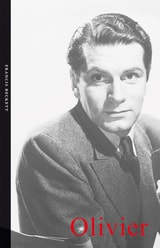
Olivier
Francis Beckett
Haus Publishing, 2006
On Broadway
Art and Commerce on the Great White WaySteven Adler
Southern Illinois University Press, 2004
At a critical, transitional moment in the history of Broadway—and, by extension, of American theatre itself—former Broadway stage manager Steven Adlerenlists insider perspectives from sixty-six practitioners and artists to chronicle the recent past and glimpse the near future of the Great White Way. From marquee names to behind-the-scenes power brokers, Adler has assembled a distinctly knowledgeable cast of theatre’s elite, including Stephen Sondheim, Arthur Laurents, Des McAnuff, Frank Rich, Robin Wagner, Rocco Landesman, Robert Longbottom, Todd Haimes, Bernard Gersten, and Alan Eisenberg.
On Broadway: Art and Commerce on the Great White Way spotlights the differing vantage points of performers, artists, writers, managers, producers, critics, lawyers, theatre owners, union leaders, city planners, and other influential players. Each details his or her firsthand account of the creative and economic forces that have wrought extraordinary changes in the way Broadway theatre is conceived, produced, marketed, and executed. Once the paramount site of American theatre, Broadway today is becoming a tourist-driven, family-friendly, middle-class entertainment oasis in Midtown, an enterprise inextricably bound to the larger mosaic of national and international professional theatre.
Accounting for this transformation and presaging Broadway’s identity for the twenty-first century, Adler and his interviewees assess the impact of the advent of corporate producers, the ascendance of not-for-profit theatres on Broadway, and the growing interdependence between regional and Broadway productions. Also critiqued are the important roles of the radical urban redevelopment staged in Times Square and the changing demographics and appetites of contemporary theatre audiences in New York and around the globe.
Actors and administrators, performers and producers, theatre students and theatregoers will all benefit from the perceptive insights in this authoritative account of theatre making for the new millennium.
On Disney
Sergei Eisenstein
Seagull Books, 2017
Seagull Books is embarking on a series of translations of key works by Eisenstein into English. On Disney, which was begun in 1940 but was never finished, was part of a series of essays Eistenstein wrote on masters of cinema; for Eisenstein, Walt Disney offered a way to think about how such impulses and animism and totemism survived in modern consciousness and art. This edition presents the original, unfinished essay along with material on Disney that Eisenstein worked on in subsequent years but never succeeded in integrating with the original.
On Drama
Boundaries of Genre, Borders of SelfMichael Goldman
University of Michigan Press, 2000
On Life Support
Eco-Dystopian Cinema in the Long 1970sMatthew I Thompson
University of Minnesota Press, 2026
Finding strategies for today’s environmental movement in classic science fiction films
What can science fiction film tell us about the course of the modern ecological movement? On Life Support traces how the environmental concerns of the 1970s were embedded in the eco-dystopian cinema of the era—and considers its implications for ecological thought and activism today.
Illuminating the patterns that shape our thinking about nonhuman nature, Matthew I. Thompson pairs iconic films such as Soylent Green and Silent Running with the transformational environmentalist texts that inspired them and kick-started the modern environmental movement, including Rachel Carson’s Silent Spring and Buckminster Fuller’s Operating Manual for Spaceship Earth. Thompson examines this confluence of literature and cinema to show how, as they translated environmentalism for Hollywood’s audiences, these movies distilled the movement’s concepts into a form that revealed their inherent contradictions.
A sensitive analysis of the tensions that complicate environmentalist praxis—especially between desire and fear in the activist impulse—On Life Support offers a timely critique of the politics of environmental containment and control, calling instead for a politics of interconnection and contamination. It is, after all, by inviting complexity and chaos that we begin to undermine the myth of human mastery, letting nature flourish on its own terms.
Retail e-book files for this title are screen-reader friendly with images accompanied by short alt text and/or extended descriptions.
On Living with Television
Amy Holdsworth
Duke University Press, 2021
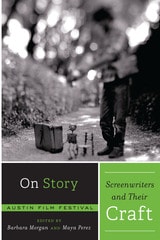
On Story - Screenwriters and Their Craft
Austin Film Festival
University of Texas Press, 2013
Austin Film Festival (AFF) is the first organization of its kind to focus on the writer’s creative contribution to film. Its annual Film Festival and Conference offers screenings, panels, workshops, and roundtable discussions that help new writers and filmmakers connect with mentors and gain advice and insight from masters, as well as refreshing veterans with new ideas. To extend the Festival’s reach, AFF produces On Story, a television series currently airing on PBS-affiliated stations and streaming online that presents footage of high-caliber artists talking candidly and provocatively about the art and craft of screenwriting and filmmaking, often using examples from their own films.
This book distills the advice of renowned, award-winning screenwriters who have appeared on On Story, including John Lee Hancock, Peter Hedges, Lawrence Kasdan, Whit Stillman, Robin Swicord, and Randall Wallace. In their own lively words and stories transcribed from interviews and panel discussions, they cover the entire development of a screenplay, from inspiration, story, process, structure, characters, and dialogue to rewriting and collaboration. Their advice is fresh, practical, and proven—these writers know how to tell a story on screen. Enjoy this collection of ideas and use it to jumpstart your own screenwriting career.
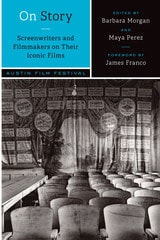
On Story—Screenwriters and Filmmakers on Their Iconic Films
Austin Film Festival, Edited by Barbara Morgan and Maya Perez
University of Texas Press, 2016
“On Story is film school in a box, a lifetime’s worth of filmmaking knowledge squeezed into half-hour packages.”
—Kenneth Turan, film critic for the Los Angeles Times
Austin Film Festival (AFF) is the first organization focused on the writer’s creative contribution to film. Its annual Film Festival and Conference offers screenings, panels, workshops, and roundtable discussions that help new writers and filmmakers connect with mentors and gain advice and insight from masters, as well as refreshing veterans with new ideas. To extend the festival’s reach, AFF produces On Story, a television series currently airing on PBS-affiliated stations and streaming online that presents footage of high-caliber artists talking candidly and provocatively about the art and craft of screenwriting and filmmaking, often using examples from their own films.
On Story—Screenwriters and Filmmakers on Their Iconic Films presents renowned, award-winning screenwriters and filmmakers discussing their careers and the stories behind the production of their iconic films such as L.A. Confidential, Thelma & Louise, Groundhog Day, Guardians of the Galaxy, The Silence of the Lambs, In the Name of the Father, Apollo 13, and more. In their own lively words transcribed from interviews and panel discussions, Ron Howard, Callie Khouri, Jonathan Demme, Ted Tally, Jenny Lumet, Harold Ramis, and others talk about creating stories that resonate with one’s life experiences or topical social issues, as well as how to create appealing characters and bring them to life. Their insights, production tales, and fresh, practical, and proven advice make this book ideal for film lovers, screenwriting students, and filmmakers and screenwriters seeking inspiration.
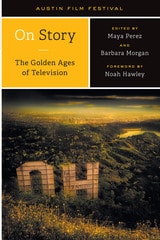
On Story—The Golden Ages of Television
Edited by Maya Perez and Barbara Morgan; foreword by Noah Hawley
University of Texas Press, 2018
“On Story is film school in a box, a lifetime’s worth of filmmaking knowledge squeezed into half-hour packages.”
—Kenneth Turan, film critic for the Los Angeles Times
Austin Film Festival (AFF) is the first organization to focus on writers’ creative contributions to film and television. Its annual Film Festival and Conference offers screenings, panels, workshops, and roundtable discussions that help new writers and filmmakers connect with mentors and gain advice and insight from masters, as well as reinvigorate veterans with new ideas. To extend the Festival’s reach, AFF produces On Story, a television series currently airing on PBS-affiliated stations and streaming online that presents high-caliber artists talking candidly and provocatively about the art and craft of screenwriting and filmmaking, often using examples from their own work.
On Story—The Golden Ages of Television explores the transformation of television’s narrative content over the past several decades through interviews with some of TV’s best creators and writers, including Garry Shandling (The Larry Sanders Show), Carl Reiner (The Dick Van Dyke Show), Issa Rae (Insecure), Vince Gilligan (Breaking Bad), Greg Daniels (The Office), Paula Pell (Saturday Night Live), Noah Hawley (Fargo), Liz Meriwether (New Girl), David Chase (The Sopranos), Alan Yang (Master of None), Marta Kauffman (Friends), Jenji Kohan (Orange Is the New Black), and many more. Their insights, behind-the-scenes looks at the creative process, production tales, responses to audiences’ reactions, and observations on how both TV narratives and the industry have changed make this book ideal for TV lovers, pop culture fans, students taking screenwriting courses, and filmmakers and writers seeking information and inspiration.
On The Wire
Linda Williams
Duke University Press, 2014
On the Sleeve of the Visual
Race as Face ValueAlessandra Raengo
Dartmouth College Press, 2013
On-Demand Culture
Digital Delivery and the Future of MoviesTryon, Chuck
Rutgers University Press, 2013
Chuck Tryon offers a compelling introduction to a world in which movies have become digital files. He navigates the complexities of digital delivery to show how new modes of access—online streaming services like YouTube or Netflix, digital downloads at iTunes, the popular Redbox DVD kiosks in grocery stores, and movie theaters offering digital projection of such 3-D movies as Avatar—are redefining how audiences obtain and consume motion picture entertainment. Tryon also tracks the reinvention of independent movies and film festivals by enterprising artists who have built their own fundraising and distribution models online.
Unique in its focus on the effects of digital technologies on movie distribution, On-Demand Culture offers a corrective to address the rapid changes in the film industry now that movies are available at the click of a button.
One Man’s Documentary
A Memoir of the Early Years of the National Film BoardGraham McInnes
University of Manitoba Press, 2004
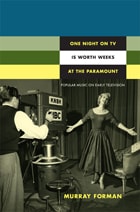
One Night on TV Is Worth Weeks at the Paramount
Popular Music on Early TelevisionMurray Forman
Duke University Press, 2012
Only Among Women
Philosophies of Community in the Russian and Soviet Imagination, 1860–1940Anne Eakin Moss
Northwestern University Press, 2020
Only at Comic-Con
Hollywood, Fans, and the Limits of ExclusivityErin Hanna
Rutgers University Press, 2020
Only the Names Have Been Changed
Dragnet, the Police Procedural, and Postwar CultureClaudia Calhoun
University of Texas Press, 2022
Winner of the 2022 Peter C. Rollins Book Prize, Northeast Popular Culture Association (NEPCA)
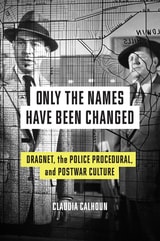
In the postwar era, the police procedural series Dragnet informed Americans on the workings of the criminal justice system and instructed them in their responsibilities as citizens.
Among shifting politics, tastes, and technology in television history, one genre has been remarkably persistent: the cop show. Claudia Calhoun returns to Dragnet, the pioneering police procedural and an early transmedia franchise, appearing on radio in 1949, on TV and in film in the 1950s, and in later revivals. More than a popular entertainment, Dragnet was a signifier of America’s postwar confidence in government institutions—and a publicity vehicle for the Los Angeles Police Department.
Only the Names Have Been Changed shows how Dragnet’s “realistic” storytelling resonated across postwar culture. Calhoun traces Dragnet’s “semi-documentary” predecessors, and shows how Jack Webb, Dragnet’s creator, worked directly with the LAPD as he produced a series that would likewise inspire public trust by presenting day-to-day procedural justice, rather than shootouts and wild capers. Yet this realism also set aside the seething racial tensions of Los Angeles as it was. Dragnet emerges as a foundational text, one that taught audiences to see police as everyday heroes not only on TV but also in daily life, a lesson that has come under scrutiny as Americans increasingly seek to redefine the relationship between policing and public safety.
Open Roads, Closed Borders
The Contemporary French-Language Road MovieEdited by Michael Gott and Thibaut Schilt
Intellect Books, 2013
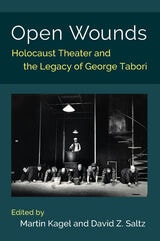
Open Wounds
Holocaust Theater and the Legacy of George TaboriEdited by Martin Kagel and David Z. Saltz
University of Michigan Press, 2022
This volume collects original essays on Hungarian-German playwright and screenwriter George Tabori (1914–2007) and his remarkable contributions to the stage. Tabori, a Jewish refugee and a truly transnational author, was best known for his work in New York theater that irreverently explored the Jewish experience, particularly the Holocaust. Although his illustrious career spanned a century, two continents, several languages, and a variety of literary genres, Tabori’s work has received scant attention in American letters, in spite of its significance for U.S. theater and Holocaust studies.
Until Tabori, most dramas about the Holocaust were either rooted in American domestic realism, striving to create a strong empathetic connection between the audience and Holocaust victims, or featured an unembellished documentary style. Tabori staked out a third position, beyond realism and documentation. The volume brings together the voices of international scholars to provide a comprehensive introduction to Tabori’s theater as well as in-depth analyses of his work, discussing all of his major plays. Individual essays address Tabori’s postdramatic theater in relation to sacrificial ritual, performance studies, and post-humanist approaches to the contemporary stage, as well as performance aspects of his productions, questions of ethics and aesthetics raised by his theater, and his plays’ relation to Holocaust representation in popular culture.
Opera Production II
A HandbookQuaintance Eaton
University of Minnesota Press, 1974
Opera Production II was first published in 1974. Minnesota Archive Editions uses digital technology to make long-unavailable books once again accessible, and are published unaltered from the original University of Minnesota Press editions.
For the world of opera this is an indispensable basic reference work which provides essential information about more than 350 operas. Producers, singers, directors, students, orchestras, and audiences will find useful, concise information in this handbook, a sequel to the author's earlier book Opera Production I: A Handbook, which contains similar information about more than 500 other operas. While the first volume concentrates on more familiar operas, this book is devoted principally to lesser known works, both old and new, including many as yet unperformed contemporary operas.
The details given about each opera are those needed to assess the production requirements for a given work: the number and importance of settings; size of orchestra, chorus, and ballet; number of singers, their relative importance and individual requirements; vocal and acting demands of performers, including vocal ranges in most cases; plot synopsis; and brief historical material to anchor the reader in the necessary knowledge of the period and source of the libretto. The information is compressed into capsule form so that anyone using the book can tell at a glance the suitability of a work to the particular facilities, talents, or tastes of an opera company or its public.
In addition to the reference material, there is a chapter "Production Problems in Handel's Opera" by Randolph Mickelson, a helpful feature since nine of Handel's operas are included and they are apt to pose special production problems.

Opera Production
A HandbookQuaintance Eaton
University of Minnesota Press, 1961
Opera Production was first published in 1961. Minnesota Archive Editions uses digital technology to make long-unavailable books once again accessible, and are published unaltered from the original University of Minnesota Press editions.
Designed particularly as a reference work for opera producers, students, performers, and writers, this book provides basic production information about more than 500 operas. Anyone planning to produce an opera will find here the essential information he needs in order to judge whether a given opera is appropriate to his resources for production.
Information for individual operas is given concerning the number and importance of settings; size of orchestra, chorus, and ballet; number of singers, their relative importance and individual requirements; sources for obtaining musical materials' previous performances in America; and the opera story, its period, and composer.
Extensive information about 150 full-length operas and 109 short operas is provided, with supplementary information about more than 260 other operas. The operas are alphabetized by title for easy reference. In order to condense the information as much as possible, codes and abbreviations are used, with keys and indexes at the back of the book.
This book will be invaluable to those working in either amateur or professional companies, in opera workshops, in school, college, or civic opera groups. Those whose interest in opera is confined to the other side of the footlights will find the book absorbing, too, just as a glimpse backstage would be.
Opera Scenes for Class and Stage
Mary Elaine Wallace and Robert Wallace
Southern Illinois University Press, 1979
Musically sound and fully annotated, this new reference work provides ready access to over 700 excerpts from 100 operas, by voice categories, and thus provides information on a wide variety of matters of interest to directors, teachers, and singers. A table of voice categories, coded excerpts (including length and reference to accessible scores), character descriptions (including estimations of degrees of difficulty of the music), summaries of the action of each excerpt, and indexes to titles, composers, and well-known arias and ensembles make this book an indispensable tool.
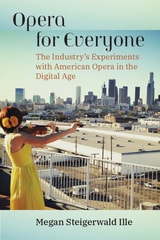
Opera for Everyone
The Industry's Experiments with American Opera in the Digital AgeMegan Steigerwald Ille
University of Michigan Press, 2024
Oral Poetry
An IntroductionPaul Zumthor
University of Minnesota Press, 1990
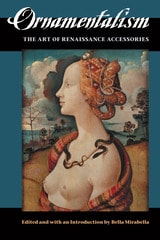
Ornamentalism
The Art of Renaissance AccessoriesEdited and with an Introduction by Bella Mirabella
University of Michigan Press, 2011
Lively, well-written, and richly illustrated with color plates, Ornamentalism will appeal to scholars of the material past and social practice, and those interested in fashion studies, manners and morals, gender and sexuality, theater and performance.
Orson Welles and the Unfinished RKO Projects
A Postmodern PerspectiveMarguerite H. Rippy
Southern Illinois University Press, 2009
Orson Welles and the Unfinished RKO Projects: A Postmodern Perspective traces the impact of legendary director Orson Welles on contemporary mass media entertainment and suggests that, ironically, we can see Welles’s performance genealogy most clearly in his unfinished RKO projects.
Author Marguerite H. Rippy provides the first in-depth examination of early film and radio projects shelved by RKO or by Welles himself. While previous studies of Welles largely fall into the categories of biography or modernist film studies, this book extends the understanding of Welles via postmodern narrative theory and performance analysis, weaving his work into the cultural and commercial background of its production. By identifying the RKO years as a critical moment in performance history, Rippy synthesizes scholarship that until now has been scattered among film studies, narrative theory, feminist critique, American studies, and biography.
Building a bridge between auteur and postmodern theories, Orson Welles and the Unfinished RKO Projects offers a fresh look at Welles in his full complexity. Rippy trains a postmodern lens on Welles’s early projects and reveals four emerging narrative modes that came to define his work: deconstructions of the first-person singular; adaptations of classic texts for mass media; explorations of the self via primitivism; and examinations of the line between reality and fiction. These four narrative styles would greatly influence the development of modern mass media entertainment.
Rippy finds Welles’s legacy alive and well in today’s mockumentaries and reality television. It was in early, unfinished projects where Welles first toyed with fact and fiction, and the pleasure of this interplay still resonates with contemporary culture. As Rippy suggests, the logical conclusion of Welles’s career-long exploration of “truthiness” lies in the laughs of fake news shows. Offering an exciting glimpse of a master early in his career, Orson Welles and the Unfinished RKO Projects documents Welles’s development as a storyteller who would shape culture for decades to come.
Othello and Interpretive Traditions
Edward Pechter
University of Iowa Press, 1999
Our Land is Made of Courage and Glory
Nationalist Performance of Nicaragua and GuatemelaE. J. Westlake
Southern Illinois University Press, 2005
Our Land Is Made of Courage and Glory: Nationalist Performance of Nicaragua and Guatemala adds to a growing and timely body of work on nationalist drama. Examining important twentieth-century plays that few people have written about in English, E. J. Westlake analyzes the phenomenon of nation as performance by focusing on the definition of a people, national metaphors, and the uses of national history.
Westlake discerns the common characteristics that constitute nationalist plays, a genre that seeks to legitimate the nature of a nation by defining its boundaries, race, language, citizens, and history. Particularly relevant in an era influenced by imperialism, migration, and globalization, the volume probes the concepts of nation and nationalism in the context of postcolonial literary and performance theory.
Our Land Is Made of Courage and Glory covers the political and theatrical history of Nicaragua and Guatemala. Westlake examines how the blending of races factors into nationalism with a look at the play El tren amarillo by Manuel Galich and uses Nobel laureate Miguel Ángel Asturias’s Soluna to show how nationalists appropriate Mayan culture to create a sense of the Guatemalan people and culture. She discusses the mapping of history as a linear progression in Alan Bolt’s Banana republic and as a cycle of patricide in Por los caminos van los campesinos by Pablo Cuadra. Westlake also suggests that Rolando Steiner’s La noche de Wiwilí, a play taken from an eyewitness account, acts as a site of official national memory, and she examines as well the canonizing of the folk ballet El Güegüence to further explore the notion of sites of memory versus lived memory.
Raising essential questions about the future of nationalism and nationalist performance, Our Land Is Made of Courage and Glory will be of interest to scholars and students in drama, Latin American theatre studies, political science, and history.

Our Movie Heritage
Tom McGreevey and Joanne L Yeck
Rutgers University Press, 1997
Our Movie Heritage should be read by anyone interested in motion picture history. Without film preservation, there can be no valid film history. Documents, autobiographies, oral histories, and secondary sources are of importance, but viewing the actual films preserved or restored to a state comparable to the way they were originally viewed is of inestimable importance.Rudy Behlmer, film historian and author of Memo from David O. Selznick
Our Movie Heritage is an enticing, up to the minute account of the complex National Film preservation effort, and should be read by anyone interested in our rich cinematic heritage.Mary Lea Bandy, chief curator, The Museum of Modern Art
Imagine an America without any images of itself no Judy Garland in the Wizard of Oz, no Orson Welles in Citizen Kane, and no Bogart and Bergman in Casablanca. Movies are an extraordinary personal and collective history of the American people. Unfortunately, over 90 percent of America's silent films are already lost to us, and more than half of the American feature films made before 1950 no longer exist. Whether it is a piece of cellulose nitrate exposed in 1910 or a strip of Eastman Color acetate stock produced in the 1970s all film self-destructs. Rapidly.
Our Movie Heritage is a highly readable and informative view of the world of film preservation, showing the work being done to save our national treasure trove of film history. Full of tales of discovery and rescue, the book is an urgent plea for preservation. Our Movie Heritage describes the race against time currently under way both in the public and private sectors in order to salvage what is left in vaults, theaters, and private collections. The book explains the basics of film preservation, covering the who, what, when, where, and how of the field, with top archivists and film restoration experts expressing their concerns and hopes for the future of movies. This beautifully produced book, with over one hundred pictures of top stars, directors, and film people, is itself a treasure that showcases the importance of this legacy.
Our Musicals, Ourselves
A Social History of the American Musical TheatreJohn Bush Jones
Brandeis University Press, 2004
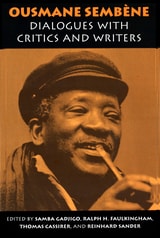
Ousmane Sembene
Dialogues with Critics and WritersThomas Cassirer
University of Massachusetts Press, 1993
This volume celebrates the work of Ousmane Sembène, the brilliant African filmmaker and writer. Since the 1950s, working in his native Senegal, Sembène has produced a series of films and novels that incisively depict the realities of contemporary African experience, particularly that of urban and industrial Africa. The book begins with critical essays on Sembène’s oeuvre by Frederick Ivor Case, Françoise Pfaff, Mbye Cham, and Claire Andrade-Warkins. There follows a series of presentations by distinguished black writers who discuss their craft and the ways in which language can function as a political act of cultural legitimation. These writers include Toni Cade Bambara, Earl Lovelace, Ngũgĩ wa Thiong’o, John Edgar Wideman, and Sembène.
The next section reproduces Sembène’s remarks on his film Camp de Thiaroye and an extended interview he recorded in Toronto in 1992. His comments are presented in both French and English. The volume concludes with annotated bibliographies of Sembène’s novels and of the films he has written and directed.
Out Takes
Essays on Queer Theory and FilmEllis Hanson, ed.
Duke University Press, 1999
The essays examine a wide array of films, including Calamity Jane, Rear Window, The Hunger, Heavenly Creatures, and Bound , and discuss such figures as Doris Day, Elizabeth Taylor, and Alfred Hitchcock. Divided into three sections, the first part reconsiders the construction of masculinity and male homoerotic desire—especially with respect to the role of women—in classic cinema of the 1940s and 1950s. The second section offers a deconstructive consideration of lesbian film spectatorship and lesbian representation. Part three looks at the historical trajectory of independent queer cinema, including works by H.D., Kenneth Anger, and Derek Jarman.
By exploring new approaches to the study of sexuality in film, Out Takes will be useful to scholars in gay and lesbian studies, queer theory, and cinema studies.
Contributors. Bonnie Burns, Steven Cohan, Alexander Doty, Lee Edelman, Michelle Elleray, Jim Ellis, Ellis Hanson, D. A. Miller, Eric Savoy, Matthew Tinkcom, Amy Villarejo, Jean Walton
Out of Sync & Out of Work
History and the Obsolescence of Labor in Contemporary CultureBurges, Joel
Rutgers University Press, 2018
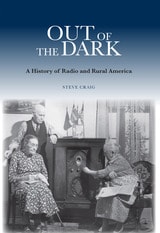
Out of the Dark
A History of Radio and Rural AmericaSteve Craig
University of Alabama Press, 2009
From the Grand Ole Opry to the National Barn Dance, how radio changed life in rural America
Out of the Dark: A History of Radio and Rural America shows how radio—especially clear channel network stations—brought news, markets, weather, religion, and entertainment into isolated farm homes between the 1920s and 1950s, narrowing rural–urban divides while also sustaining distinctly rural tastes (e.g., barn dance music). Craig argues that battery “farm radios,” high power stations, and national networking transformed daily life, work rhythms, consumer habits, and political participation, making radio the central domestic technology of the Depression era and beyond.
Craig blends regulatory and industry milestones, such as the Radio Act of 1927, with sociological studies, USDA extension records, FCC surveys, census tables, and rich case studies including WLS Chicago’s “National Barn Dance,” WSM Nashville’s “Grand Ole Opry,” and others. He mines audience research, diaries, program schedules, and tables that track the spread of radio. The book’s distinctive contributions include detailed charts (ownership by region; clear channel assignments) and vivid narratives of stations, formats, and personalities that connected farm families to national culture while preserving local identity.
The book is ideal for scholars and students of US social, rural, and media history; communication policy and political communication; country and bluegrass music history; agricultural extension; and American studies. It will also engage librarians, curators, and public historians seeking context for rural collections; journalists and podcasters tracing the roots of today’s information ecosystems; and general readers interested in how radio re made community life long before the internet.
Outback
Westerns in Australian CinemaBrian McFarlane
Intellect Books, 2026
Focusing on the influence of the cinematic Western in Australian cinema history, Outback explores how the American genre has been adapted to the changing Australian social, political, and cultural contexts of its production, including the shifting emphases in the representation of the Indigenous population.
Brian McFarlane emphasizes the ways film can, without didacticism, provide evidence of changing politics and culture. McFarlane explores Australian history with the genre by analyzing such films as Charles Tait’s 1906 The Story of the Kelly Gang and Justin Kurzel’s 2020 adaptation of Peter Carey’s The True History of the Kelly Gang. He further explores other key matters, including the changing attitudes to and representation of Indigenous peoples and of women's roles in Australian Westerns.
Outside Theater
Alliances That Shape MexicoStuart A. Day
University of Arizona Press, 2017
Taking a cue from influential French philosopher Jacques Rancière, who in The Emancipated Spectator rejects the idea of the passive, ignorant, duped spectators in need of instruction to become active, Stuart A. Day’s goal in Outside Theater is to highlight written words and performances that exemplify effective strategies, past and present, to reveal and promote civic engagement, to provoke disruptions, or to highlight fissures—and opportunities—in oppressive social structures.
Through the study of one or two primary models per chapter, as well as multiple examples in the introduction and conclusion, Day presents Mexican plays from 1905 to 2015, including the 2010 Mexico City performance of Zoot Suit by Chicano playwright Luis Valdez. Using these plays, Day explores the concept of “outside theater,” where people or groups translate the tools of the theatrical trade to a different stage, outside the walls of the theater, and play the part of fictional or real life Celestinas—matchmakers who unite seemingly disparate entities to promote social awareness and social action by working the borders between life and art.
Each work in this innovative analysis reveals productive social connections that, with the help of crucial artistic alliances, contradict the perception that art is somehow secondary to or disconnected from the public sphere of influence and the struggles of everyday life. With this book, Day shows that Mexican theater can and does bolster civil society and thus the country’s fragile democracy.
Over and Over
Performance, Time, and Resonance in Serial Television DramaElliott Logan
Rutgers University Press, 2026
How does serial drama earn, keep, and reward our attention for so long—over episodes, seasons, months, and years? While we know that characters are the focus of story and viewer interest in television fiction, scholars have for decades overlooked the way those characters are performed on-screen and the lure of performance as a key formal and thematic aspect of long-form television storytelling. In Over and Over, Elliott Logan offers close readings of performance in some of the most celebrated television dramas of the century, casting new light on the attractions and significance of the medium’s seriality. The book shows how the patterning and expressive resonance of performers on-screen binds together otherwise unconnected episodes of shows like The Sopranos and Mad Men. In doing so, it highlights the provisionality of identity and meaning as crucial to their interest in the sustenance of human relationships over long periods of time. In accounting for the resonance of performance over time in serial drama, this book shows, we find the terms of our own attachment to its compelling depictions of human life
Overweight Sensation
The Life and Comedy of Allan ShermanMark Cohen
Brandeis University Press, 2013