Results by title
210 books match the query 'Philosophy, Theory & Social Aspects' and 11 start with o

On Future Of Educational Institutions
Friedrich Nietzsche
St. Augustine's Press, 2004
On the Future of Our Educational Institutions, the work that was to have been Nietzsche's second book until he canceled the contract and used portions in his Untimely Meditations, is a substantial call for radical educational reform presented in the form of a prolonged narrative dialogue. It is presented here in the first English translation ever from the standard critical edition (a little-known translation was made for the Complete Works of 1909, long out of print). Here Nietzsche, through the characters of this prolonged narrative dialogue, starts from a consideration of German educational institutions and rises to a consideration of what is needed for true, or classical, education. Though Nietzsche engages his contemporary world more in this work than in perhaps any other, this engagement is neither arbitrary nor limiting. Starting where one is and has grown up happens to be the necessary grounding of the organic unity that belongs to true culture: "Every so-called classical education has only one healthy and natural starting point, the artistic, serious, and rigorous habituation in the use of the mother tongue. . . . Here where gradually the distinguishing feeling for form and for barbarism awakes, the wing bestirs itself for the first time that carries to the right and sole home of education, to Greek antiquity. Of course we would not come very far with the help of that wing all alone in the attempt to bring ourselves close to that castle of the Hellenic, infinitely distant and enclosed within diamond ramparts: rather anew we need the same leaders, the same teachers, our German classics, in order ourselves to become swept away under the wingbeat of their ancient endeavors to the land of longing, to Greece."
In this dialogue, Nietzsche considers what it would mean to put education, culture, first in priority above all else, above religion, above economics, even above the state. The dialogue's call for educational reform goes so far as to require that the state be completely subordinated to the demands and needs of culture. The state must not be "a border guard, regulator, or overseer for his culture; rather the robust, muscular comrade, ready for battle, and companion on the way, who gives the admired, nobler, and, as it were, unearthly friend safe conduct through the harsh realities and for that earns his thankfulness."
Not only does the dialogue demand that the state subordinate itself to education, but it goes on to suggest that widespread educational institutions are for the sake of only a small number of beneficiaries. This radical and uncompromising devotion to the education of a very few sketches Nietzsche's thoughts on education perhaps more completely than any other work.
In addition, this dialogue offers numerous other objects of interest. The dialogue form shows off Nietzsche's literary art and offers an occasion to think carefully about the special tasks involved in reading philosophic texts well. The circumstances of this text's writing and its nearly being published offer insights both into Nietzsche's development and into the production of his works, especially regarding the Untimely Meditations. The letters and notes in the appendices help to flesh out the thinking that surrounds this text as well as to suggest the form of the never-written sixth lecture. Also Nietzsche's engagement with the immediate tradition of his contemporary milieu, not only with Goethe, Schiller, and Lessing but also with lesser figures such as Koetzebue, Grillparzer, and Gutzkow, should be of interest to intellectual historians and students of European culture.
Nietzsche read On the Future of Our Educational Institutions publicly in the form of five lectures. He then tried to rush it into publication, and it very nearly became Nietzsche's second book. Only at the last moment did he withdraw the book from the public. Now it is available in English.

On Jewish Learning
Franz Rosenzweig; Edited by N. N. Glatzer
University of Wisconsin Press, 2002
On Learning, Volume 2
Philosophies, Concepts and PracticesEdited by David Scott
University College London, 2024
The contributors to this volume focus on two meta-concepts: knowledge and learning, on the relationship between the two, and the way these can be framed in epistemic, social, political, and economic terms. Knowledge and learning, as meta-concepts, are positioned in various networks or constellations of meaning, principally: their antecedents, their relations to other relevant concepts, and the way the concepts are used in the lifeworld.
The various authors in this book explore several important concepts that are relevant to the idea of learning: Meta-concepts such as epistemology, inferential role semantics, phenomenology, rationality, thinking, hermeneutics, critical realism, and pragmatism. Meso-concepts such as probability, woman, training, assessment, education, system, race, friendship, Bildung, curriculum, ecology and pedagogy. Like David Scott’s first volume of On Learning, this collection also focuses on philosophy, concepts, and practices as a response to empiricist and positivist conceptions of knowledge. It challenges reductionist ideas of learning that have filtered through to the management of our schools, colleges, and universities; confronts over-simplified messages about learning, knowledge, curriculum, and assessment; and fosters the denial that values are central to understanding how we live and how we should live, the normative dimension to social policy and social theory.
On Learning, Volume 3
Knowledge, Curriculum and EthicsDavid Scott
University College London, 2025
What does it mean to learn? In On Learning, Volume 3: Knowledge, Curriculum and Ethics, David Scott probes the intricate relationship between knowledge and learning, questioning reductionist and empiricist perspectives that dominate contemporary education. This volume, like the first two in the series, critically analyzes the philosophical and ethical dimensions of learning, pushing beyond simplified notions of curriculum and assessment. Scott ties in a range of key concepts, including epistemology and critical realism, to offer a profound rethinking of what it means to know and engage with the world.
At the heart of this book is a call to recognize that learning is not merely a mechanical process or a set of measurable outcomes but a deeply human and ethical endeavor. On Learning, Volume 3 urges readers to reconsider the structures that shape education today and invites us to rethink how we understand knowledge and learning, and the values that underpin them.
On Learning
A General Theory of Objects and Object-RelationsDavid Scott
University College London, 2021
What is learning? This book is a philosophical work that develops a general theory of ontological objects and object-relations, examining concepts as acquired dispositions. David Scott answers a series of questions about concepts in general and the concept of learning in particular. This volume offers a counterargument to empiricist conceptions of learning, rejecting the propagation of simple messages about learning, knowledge, curriculum, and assessment. Instead, Scott argues that values are central to understanding how we live, permeating our descriptions of the world, the attempts we make at creating better futures, and our relations with other people.

On the Communicative Turn in Philosophy
Exploring Intersubjectivity, Community and the Ethics of DialogueClaude Mangion
Intellect Books, 2025
Philosophy has long grappled with questions of meaning and human connection, yet communication itself remains an underexplored concept in the field. Claude Mangion shifts the focus by examining how communication has shaped debates on intersubjectivity and ethics.
By tracing its role across key philosophical discussions, this book offers a new outlook on how dialogue informs our understanding of self and society. Accessible and rigorously argued, it bridges the gap between philosophy and communication theory, making it a useful reference for students and scholars alike. This work provides a compelling argument for thinking about communication as a philosophical practice, whether you’re exploring community, the ethics of dialogue, or the foundations of intersubjectivity.
On the Digital Humanities
Essays and ProvocationsStephen Ramsay
University of Minnesota Press, 2023
A witty and incisive exploration of the philosophical conundrums that animate the digital humanities
Since its inception, the digital humanities has been repeatedly attacked as a threat to the humanities: warnings from literary and cultural theorists of technology overtaking English departments and the mechanization of teaching have peppered popular media. Stephen Ramsay’s On the Digital Humanities, a collection of essays spanning the personal to the polemic, is a spirited defense of the field of digital humanities.
A founding figure in what was once known as “humanities computing,” Ramsay has a well-known and contentious relationship with what is now called the digital humanities (DH). Here Ramsay collects and updates his most influential and notorious essays and speeches from the past fifteen years, considering DH from an array of practical and theoretical perspectives. The essays pursue a broad variety of themes, including the nature of data and its place in more conventional notions of text and interpretation, the relationship between the constraints of computation and the more open-ended nature of the humanities, the positioning of practical skills and infrastructures in both research and pedagogical contexts, the status of DH as a program for political and social action, and personal reflections on the author’s journey into the field as both a theorist and a technologist.
These wide-ranging essays all center around one idea: that DH not forsake its connection to the humanities. While “digital humanities” may sound like an entirely new form of engagement with the artifacts of human culture, Ramsay argues that the field well reveals what is most essential to humanistic inquiry.

Once a Professor
A Memoir of Teaching in Turbulent TimesJerry Apps
Wisconsin Historical Society Press, 2018
“I never wanted to be a professor,” writes Jerry Apps in the introduction to Once a Professor. Yet a series of unexpected events and unplanned experiences put him on an unlikely path—and led to a thirty-eight-year career at the University of Wisconsin.
In this continuation of the Apps life story begun in his childhood memoir Limping through Life, Wisconsin’s celebrated rural storyteller shares stories from his years at the University of Wisconsin–Madison from 1957 to 1995, when he left the university to lecture and write fulltime. During those years Apps experienced the turmoil of protests and riots at the UW in the 1960s, the struggles of the tenure process and faculty governance, and the ever-present pressure to secure funding for academic research and programs.
Through it all, the award-winning writer honed a personal philosophy of education—one that values critical thinking, nontraditional teaching approaches, and hands-on experiences outside of the classroom. Colorful characters, personal photos, and journal entries from the era enrich this account of an unexpected campus career.
Open Your Hand
Teaching as a Jew, Teaching as an AmericanIlana M. Blumberg
Rutgers University Press, 2019
Opening Ceremony
Inviting Inclusion into University GovernanceKathryn J. Gindlesparger
University of Minnesota Press, 2023
Explores how university governance is restricted by ceremony and what it must do to survive
University shared governance is a microcosm of regulation and thrives particularly on ceremony to communicate its relevance. While many investigations of university governance examine representation, Opening Ceremony offers that, instead, stakeholders’ belief in institutional values can invite revision of stagnant governance practices. Governance tells us what the rules are, but they also tell us how to feel: opening up the ceremonial communication of this system invites new participants to rewrite how universities respond to felt needs.
Kathryn J. Gindlesparger considers how to break the seal of ceremony to invite voices not traditionally heard in governance and, in doing so, protect the ideals of the institution and rebuild trust in higher education.
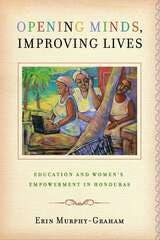
Opening Minds, Improving Lives
Education and Women's Empowerment in HondurasErin Murphy-Graham
Vanderbilt University Press, 2012
Empowering women through education has become a top priority of international development efforts. Erin MurphyGraham draws on more than a decade of qualitative research to examine the experiences of Juanita and eighteen other women who participated in the SAT program. Their narratives suggest the simple yet subtle ways education can spark the empowerment process, as well as the role of men and boys in promoting gender equality.
Drawing on indepth interviews and classroom observation in Honduras and Uganda, MurphyGraham shows the potential of the SAT program to empower women through expanded access and improved quality of secondary education in Latin America and Africa. An appendix provides samples of the classroom lessons.