Results by title
572 books match the query 'Photography' and 11 start with o

Object Lessons
Zofia Rydet’s Sociological RecordEdited by Krzysztof Pijarski
Museum of Modern Art in Warsaw, 2017
Object Lessons, a new volume of essays inspired by an exhibition at the Museum of Modern Art in Warsaw, helps to dispel the myths that have formed around the project in recent years and introduces the photographer to a new global audience. The essays here contextualize and interpret “Sociological Record” from different perspectives, opening up the work to further inquiry as both an object of interpretation and a subject of theoretical interest. Rydet herself remained unresolved over the question of how to define her work, leaving the viewer to ponder whether her magnum opus is a piece of art or science. What does remain undisputed is that “Sociological Record” is a striking testimony of its time.
A fascinating celebration of Rydet’s work that is sure to spur on fresh debate about art as a social practice and a tool of knowledge, Object Lessons reminds us of photography’s incredible power to provide a visual way of thinking and a provocative method for archiving the world.
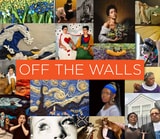
Off the Walls
Inspired Re-Creations of Iconic ArtworksSarah Waldorf
J. Paul Getty Trust, The, 2020
Van Gogh’s Starry Night made out of spaghetti? Cat with a Pearl Earring? Frida Kahlo self-portraits with pets and toilet paper? While the world reeled from the rapid spread of the novel coronavirus (COVID-19), thousands of people around the globe, inspired by challenges from Getty and other museums, raided toy chests, repurposed pantry items, and enlisted family, roommates, and animals to re-create famous works of art at home. Astonishing in their creativity, wit, and ingenuity, these creations remind us of the power of art to unite us and bring joy during troubled times. Off the Walls: Inspired Re-Creations of Iconic Artworks celebrates these imaginative re-creations, bringing highlights from this challenge together in one whimsical, irresistible volume. Getty Publications will donate all profits from the sale of this book to a charity supporting art and artists.
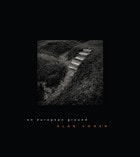
On European Ground
Alan Cohen
University of Chicago Press, 2001
Cohen's images achieve a solemn beauty even as they engage history at its most topical. Pictures of trenches and bunkers at the battlefields of Somme and Verdun explore the tension between the violence of the past and the inscrutability of its remnants. Photographs from the grounds of Dachau and Auschwitz solicit a provocative dialogue between the ordinariness of these sites today and their haunting memory. They teach us, as the New Art Examiner notes, "that the living perceptual connection to the Holocaust is vanishing." Images of the Berlin Wall show only the footprint of the barricade that once separated two hostile ideologies. They record the physical erosion and looming disappearance of the Wall while capturing its reappearance as a memorialized abstraction.
Accompanying the photographs in On European Ground are essays by Sander Gilman and Jonathan Bordo, as well as an interview with Cohen by critic Roberta Smith of the New York Times. The essays present both an introduction to and aesthetic analysis of Cohen's work, while the interview discusses the intractable problems of history and memory that his photographs so uniquely capture.

On Fire
Larry Schwarm
Duke University Press, 2003
The Center for Documentary Studies/Honickman
First Book Prize in Photography
A startling, mesmerizing series of photographs of prairie fires, On Fire transports us from moments of almost apocalyptic splendor to the stillness of near abstraction. For over a decade Kansas-based photographer Larry Schwarm has been making extraordinary color photographs of the dramatic prairie fires that sweep across the vast grasslands of his native state each spring. Based on this stunning and extensive body of work, Schwarm was chosen from over 500 submissions as the inaugural winner of the CDS/Honickman Foundation First Book Prize in Photography. With publication of On Fire, Duke University Press, in association with the Center for Documentary Studies and The Honickman Foundation, launches this major biennial book prize for American photographers.
Fire is an essential element of the ecosystem. Every spring, the expanses of tallgrass prairie in the Flint Hills of east-central Kansas undergo controlled burning. For photographer Larry Schwarm, documenting these fires has become a passion. He captures the essence of the fires and their distinct personalities—ranging from calm and lyrical to angry and raging. His photos allow us to see the redemptive power of fire and to remove ourselves from its tragic elements. Through Schwarm’s lens, the horizon takes on new meaning as we view the sublime, mystical, and sensual character of the burning landscape. Schwarm connects the enormous power and devastation of fire to what can only be identified as another kind of creation—the creation of beauty.
Published by Duke University Press in association with Lyndhurst Books of the Center for Documentary Studies
To view images from the book, please visit http://cds.aas.duke.edu/books/fire.html
The Center for Documentary Studies/Honickman First Book Prize in Photography is open to American photographers who use their cameras for creative exploration, whether it be of places, people, or communities; of the natural or social world; of beauty at large or the lack of it; of objective or subjective realities. Information and guidelines about the prize are available at http://cds.aas.duke.edu/grants
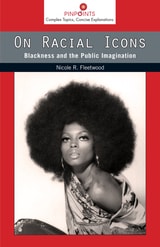
On Racial Icons
Blackness and the Public ImaginationFleetwood, Nicole R
Rutgers University Press, 2015
Nicole R. Fleetwood’s answers to these questions will change the way you think about the next photograph that you see depicting a racial event, black celebrity, or public figure. In On Racial Icons, Fleetwood focuses a sustained look on photography in documenting black public life, exploring the ways in which iconic images function as celebrations of national and racial progress at times or as a gauge of collective racial wounds in moments of crisis.
Offering an overview of photography’s ability to capture shifting race relations, Fleetwood spotlights in each chapter a different set of iconic images in key sectors of public life. She considers flash points of racialized violence in photographs of Trayvon Martin and Emmett Till; the political, aesthetic, and cultural shifts marked by the rise of pop stars such as Diana Ross; and the power and precarity of such black sports icons as Serena Williams and LeBron James; and she does not miss Barack Obama and his family along the way. On Racial Icons is an eye-opener in every sense of the phrase.
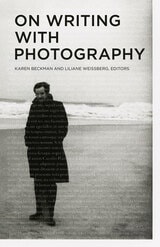
On Writing with Photography
Karen Beckman
University of Minnesota Press, 2013
From James Agee to W. G. Sebald, there has been an explosion of modern documentary narratives and fiction combining text and photography in complex and fascinating ways. However, these contemporary experiments are part of a tradition that stretches back to the early years of photography. Writers have been integrating photographs into their work for as long as photographs have existed, producing rich, multilayered creations; and photographers have always made images that incorporate, respond to, or function as writing. On Writing with Photography explores what happens to texts—and images—when they are brought together.
From the mid-nineteenth century to the present, this collection addresses a wide range of genres and media, including graphic novels, children’s books, photo-essays, films, diaries, newspapers, and art installations. Examining the works of Herman Melville, Don DeLillo, Claude McKay, Man Ray, Dare Wright, Guy Debord, Zhang Ailing, and Roland Barthes, among others, the essays trace the relationship between photographs and “reality” and describe the imaginary worlds constructed by both, discussing how this production can turn into testimony of personal and collective history, memory and trauma, gender and sexuality, and ethnicity.
Together, these essays help explain how writers and photographers—past and present—have served as powerful creative resources for each other.
Contributors: Stuart Burrows, Brown U; Roderick Coover, Temple U; Adrian Daub, Stanford U; Marcy J. Dinius, DePaul U; Marianne Hirsch, Columbia U; Daniel H. Magilow, U of Tennessee, Knoxville; Janine Mileaf; Tyrus Miller, U of California, Santa Cruz; Leah Rosenberg, U of Florida; Xiaojue Wang, U of Pennsylvania.
One Small Farm
Photographs of a Wisconsin Way of LifeCraig Schreiner
Wisconsin Historical Society Press, 2013
“People’s lives are written on the fields of old farms. The rows of the fields are like lines on a page, blank and white in winter, filled in with each year’s story of happiness, disappointment, drought, rain, sun, scarcity, plenty. The chapters accumulate, and people enter and leave the narrative. Only the farm goes on.”—From the Introduction
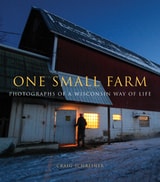
In One Small Farm, Craig Schreiner’s evocative color photographs capture one family as they maintain the rhythms and routines of small farm life near Pine Bluff, Wisconsin. “Milk in the morning and milk at night. Feed the cows and calves. Plant crops. Grind feed. Chop and bale hay. Cut wood. Clean the barn. Spread manure on the fields. Plow snow and split wood in winter. In spring, pick rocks from the fields. Cultivate corn. Pick corn. Harvest oats and barley. Help calves be born. Milk in the morning and milk at night.”
There’s much more to life on the farm than just chores, of course, and Schreiner captures the rhythms and richness of everyday life on the farm in all seasons, evoking both the challenges and the joys and providing viewers a window into a world that is quickly fading. In documenting the Lamberty family’s daily work and life, these thoughtful photos explore larger questions concerning the future of small farm agriculture, Wisconsin cultural traditions, and the rural way of life.
Opening Zion
A Scrapbook of the National Park's First Official TouristsJohn Clark
University of Utah Press, 2010
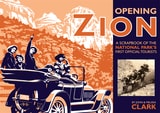
When Melissa Clark purchased a box of old scrapbooks online, she knew only that she had bought something relating to the University of Utah and Zion Park. What came in the mail was much more than she had expected. Instead of random mementos, two albums arrived full of photographs and newspaper clippings dating to 1920 that document a trip made by six young women from the University of Utah into the newly formed Zion National Park. Part of a promotional campaign developed by the Los Angeles and Salt Lake Railroad to advertise its national park shuttle service, the women entered Zion Canyon as its first offical tourists. When Melissa bought those timeworn scrapbooks she found a forgotten treasure: the opening of Zion.
With text by John Clark, the scrapbooks are now the basis of a one-of-a-kind publication. Part fashion spread, part adventure guide, and all Utah cultural treasure, Opening Zion is a stunning visual record of the park. Remarkably detailed black-and-white photographs show the young adventurers scrambling over rocky outcrops, pondering the dizzying height of Zion's sheer walls, and singing camp songs by the campfire. We are introduced anew to the "gigantic grandeur" of Zion National Park. As one of the women wrote, "One can think only beautiful thoughts amid such splendor."
Operational Images
From the Visual to the InvisualJussi Parikka
University of Minnesota Press, 2023
An in-depth look into the transformation of visual culture and digital aesthetics
First introduced by the German filmmaker Harun Farocki, the term operational images defines the expanding field of machine vision. In this study, media theorist Jussi Parikka develops Farocki’s initial concept by considering the extent to which operational images have pervaded today’s visual culture, outlining how data technologies continue to develop and disrupt our understanding of images beyond representation.
Charting the ways that operational images have been employed throughout a variety of fields and historical epochs, Parikka details their many roles as technologies of analysis, capture, measurement, diagramming, laboring, (machine) learning, identification, tracking, and destruction. He demonstrates how, though inextricable from issues of power and control, operational images extend their reach far beyond militaristic and colonial violence and into the realms of artificial intelligence, data, and numerous aspects of art, media, and everyday visual culture.
Serving as an extensive guide to a key concept in contemporary art, design, and media theory, Operational Images explores the implications of machine vision and the limits of human agency. Through a wealth of case studies highlighting the areas where imagery and data intersect, this book gives us unprecedented insight into the ever-evolving world of posthuman visuality.
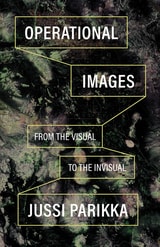
Cover alt text: Satellite photo on which white title words appear in yellow boxes. Yellow lines connect the boxes.
Outside Influence
Photography in Colorado, 1945–1995Rupert Jenkins
University Press of Colorado, 2025
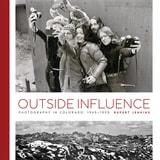
Outside Influence: Photography in Colorado, 1945–1995 is the first detailed account of the state’s history of post–World War II expressive photography. The title “Outside Influence” alludes to the historic presence of the natural landscape as subject and to the transformative impact of out-of-state artists and educators. Their arrival in Colorado beginning in the 1960s galvanized interpretive photography by introducing innovative concepts, nontraditional materials, and emergent digital technologies to students, peers, and their audience-at-large.
Throughout the book’s nine chapters, Rupert Jenkins contextualizes Colorado photography’s postwar development with a social, political, and cultural abstract that encompasses national events and trends, the emerging presence of women and photographers of color, and institutional leadership. Drawing from more than 120 personal interviews, he identifies the medium’s principal in-state creators, mentors, and advocates from the modernist era of film processing to the emergence of interdisciplinary digital practice. Jenkins answers fundamental questions about the people and work of this era: Who generated this significant body of innovative, noncommercial photographic work? Where did they come from? Who inspired them, and who in turn did they inspire?
As Eric Paddock, curator of photography at the Denver Art Museum, discusses in his foreword, by looking at the schools, workshops, galleries, and museums that supported these artists, Jenkins stresses the importance of collaboration and community to any successful venture. Crucially, in examining the lives and careers of photographers like Robert Adams, Walter Chappell, Albert Chong, Cherie Hiser, Barbara Houghton, Winter Prather, Mark Sink, Melanie Walker, Myron Wood, and numerous others, Outside Influence seeks to affirm the medium’s legacy within Colorado’s fine arts canon.
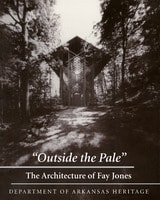
Outside the Pale
The Architecture of Fay JonesUniversity of Arkansas Press, 1999
Honored with the 1990 American Institute of Architects Gold Medal for a lifetime of outstanding achievement, Fay Jones is an Arkansas original. In receiving the medal from Prince Charles of Great Britain, Jones was hailed as a “powerful and special genius who embodies nearly all the qualities we admire in an architect” and as an artist who used his vision to craft “mysterious and magical places” not only in Arkansas but all over the world.
This book accompanied a special museum exhibit of Jones’s life and work at the Old State House in Little Rock. It traces Jones’s development from his early years as a student of Frank Lloyd Wright and Bruce Goff, to the culmination of his ability in such arresting structures as Pinecote Pavilion in Picayune, Mississippi; Thorncrown Chapel in Eureka Springs, Arkansas; and Chapman University Chapel in Orange, California. Through the black-and-white photographs of the homes, chapels, and other buildings that Jones has created and the accompanying captions and interviews of the architect, the reader is allowed a view into this man’s remarkable talent.
Designing structures that fuse architecture and landscape, the organic and the man-made, Jones has created special places which touch their viewers with the power and subtlety of poetry. Herein we learn why.
From the Foreword by Robert Adams Ivy Jr.:
“Fay Jones’s architecture begins in order and ends in mystery. . . . His role can perhaps best be understood as mediator, a human consciousness that has arisen from the Arkansas soil and scoured the cosmos, then spoken through the voices of stone and wood, steel and glass. Art, philosophy, craft, and human aspiration coalesce in his masterworks, transformed from acts of will into harmonies: Jones lets space sing.”