Results by title
557 books match the query 'Poems' and 18 start with o
O Paradise
PoemsWilliam Trowbridge
University of Arkansas Press, 1995
As Howard Nemerov has said in praise of William Trowbridge’s first poetry collection: “he is very much up on the peculiarities of our little world … He is both funny and serious, seriously funny; probably the best, if not the only, way of dealing with the complex predicament.”
Continuing in this third collection of poems to work in the realm of the serio-comic, Trowbridge explores other borderlands—between the tangible world and the intuitive one, between actuality and memory, between consciousness and unconsciousness, between self as flesh and blood and self as ghost.
This is fast-faced, nervy poetry whose witty, vernacular language moves surprisingly toward transcendence.
Ocean Power
Poems from the DesertOfelia Zepeda
University of Arizona Press, 1995
Poet Ofelia Zepeda centers these poems on her own experiences growing up in a Tohono O'odham family, where desert climate profoundly influenced daily life, and on her perceptions as a contemporary Tohono O'odham woman. One section of poems deals with contemporary life, personal history, and the meeting of old and new ways. Another section deals with winter and human responses to light and air. The final group of poems focuses on the nature of women, the ocean, and the way the past relationship of the O'odham with the ocean may still inform present day experience. These fine poems will give the outside reader a rich insight into the daily life of the Tohono O'odham people.
Ocean, as Much as Rain
Stories, Lyrical Prose, and Poems from TibetTsering Woeser. Edited and Translated by Fiona Sze-Lorrain with Dechen Pemba.
Duke University Press, 2026
Of Cartography
PoemsEsther G. Belin
University of Arizona Press, 2017
In this long-anticipated collection, Belin daringly maps the poetics of womanhood, the body, institution, family, and love. Depicting the personal and the political, Of Cartography is an exploration of identity through language. With poems ranging from prose to typographic and linguistic illustrations, this distinctive collection pushes the boundaries of traditional poetic form.
Marking territory and position according to the Diné cardinal points, Of Cartography demands much from the reader, gives meaning to abstraction, and demonstrates the challenges of identity politics.
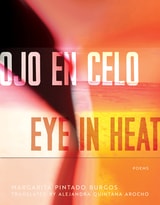
Ojo en Celo / Eye in Heat
PoemsMargarita Pintado Burgos; Translated by Alejandra Quintana Arocho
University of Arizona Press, 2024
Aflame with desire, the eye conjures, dreams, invents itself, sees what it wants. The eye sees what it is able to see.
Ojo en celo / Eye in Heat brings into sharp relief the limits of our gaze. It shows us what it is to escape the mirror and move beyond mirages. Margarita Pintado Burgos invites us to ponder the impasse while showing us ways to see better, to break the habit of lying, and to confront images along with language.
With devastating clarity, Pintado Burgos’s poems, presented in both Spanish and English, give voice to the world within and beyond sight: the plants, the trees, the birds, the ocean waves, the fruit forgotten in the kitchen, the house’s furniture. Light takes on new dimensions to expose, manipulate, destroy, and nourish. Alejandra Quintana Arocho’s sensitive English translation renders the stark force of these poems without smoothing over the language of the original.
This collection is for anyone who has felt the weight of beauty that remains hidden. It is for those who have left behind a mother, a father, a country. It is for those who know that there is no way out of the poem, for those who have had to live off a house of words and need that house to be as real as possible. Pintado Burgos writes as a woman, exile, daughter, sister, lover, and artist empowered by the restorative potential of the creative phenomenon.
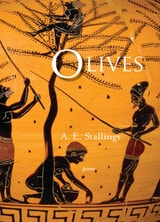
Olives
PoemsA.E. Stallings
Northwestern University Press, 2012
Finalist, 2012 NBCC Award in the Poetry category
Recipient, 2011 MacArthur Fellowship and Guggenheim Fellowship
A. E. Stallings has established herself as one of the best American poets of her generation. In addition to a lively dialogue with both the contemporary and ancient culture of her adopted homeland, Greece, this new collection features poems that, in her inimitable voice, address the joys and anxieties of marriage and motherhood. This collection builds on previous accomplishments with some longer poems and sequences of greater philosophical scope, such as “On Visiting a Borrowed Country House in Arcadia.” Stallings possesses the rare ability to craft precise poems that pulsate with deeply felt emotion. Like the olives of the title, the book embraces the bitter but savory fruits of the ancient tree, and the tears and sweetness we harvest in our temporary lives. These poems show Stallings in complete command of her talent, able to suggest the world in a word.
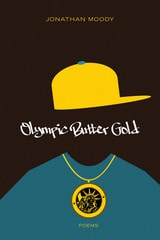
Olympic Butter Gold
PoemsJonathan Moody
Northwestern University Press, 2015
Jonathan Moody grew up during the Golden Ages of hip-hop and listened to rap that was as adventurous and diverse as his military upbringing. When rap’s Golden Ages expired, the music’s innovativeness and variety diminished. Moody’s second book, Olympic Butter Gold, winner of the 2014 Cave Canem Northwestern University Press Poetry Prize, responds to Chuck D’s claim that "if there was a HIP-HOP or Rap Olympics, I really don’t think the United States would get Gold, Silver or Brass." From the poem "Opening Ceremony," in the voice of a heroin addict struggling to use Lady Liberty’s torch to cook "The American Dream," to "Dear 2Pac," an autobiographical account of teaching Tupac Shakur’s poetry to engage high school students indifferent to literature, Moody shares a worldview that is simultaneously apocalyptic and promising.
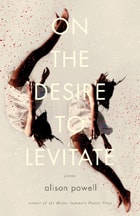
On the Desire to Levitate
PoemsAlison Powell
Ohio University Press, 2014
On the Desire to Levitate is the first collection of poems by Alison Powell. This striking collection includes vivid, unflinching meditations on aging, mythology, poetry, and family. In tight, elegant lines that alternate between homage and elegy, these poems explore known subjects with a rebellious eye: a defeated Hercules and a bitter Eurydice, a sympathetic Lucifer, and generations of adolescent girls as mythical adventurers moving within a beloved but confining Midwest. Yet in Powell’s skillful hands, hardship never overtakes: as judge Charles Hood writes, “There’s often a delicious humor in this work, and always a deep and lasting integrity.”
Once When Green
PoemsMark Irwin
University of Massachusetts Press, 2025
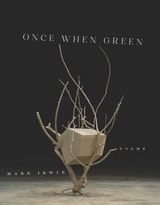
“We breathe, and then / vanish,” proclaims a speaker in Once When Green, a new collection by accomplished poet Mark Irwin. While deeply personal, the book engages the earth, “gulls, / gray, quarreling air, their ha-ha-ha-ing at our trace / of garbage and carbon,” and addresses mortality as well as the consequences of global warming—how it impacts humans, animals, and the plant life that sustains us all. Poems here accent the lateness of our attempt to control pollution, while interrogating the natural world through myth and the voicings of different creatures, beings displaced or relegated to other spaces, including apes, birds, and an arcade bear that reflects: “I once thought that was freedom— / but how in a receding wilderness no longer mine?”
Sighting those areas where metropolis and wilderness collide, Irwin conveys the tension between the natural and digital world as a speaker laments: “I am so lonely for a river’s one rushing / minute with scuttling crayfish, nymphs, and eddies blurring clouds, not its / imagined thousand pixels changing colors toward forms / on a screen.” These poems remind us how forms of the spirit cannot be bound by technology and capitalism, imploring “how to become explorers, cartographers / again.”
One Unblinking Eye
PoemsNorman Williams
Ohio University Press, 2003
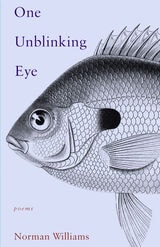
The poems in One Unblinking Eye cast a steady and serious gaze at life outside the beltways. Whether testifying at a prayer meeting in Indiana, tramping the backwoods of northern New England, or working on an oil derrick in the Gulf, the inhabitants of these poems live on the margins of society. “They are the left-behind, odd-manneredones/Who speak in starts,” Norman Williams writes of the last residents of a West Virginia mining town. Describing the woods of central Maine, he speaks of “lives … scraped from sides/Of deer and garden plots; where double-wides,/On concrete pads abut a hard-pan road.”
It is the art of these poems to convince the reader that these lives matter. There is desperation here, and madness, but there is an equal measure of determination and faith. In one poem, Mr. Williams writes of a fisherman haunted by his daughter’s death, who “casts his line/In hopes a flash and strike will draw him back.” These words describe the poet’s method as well. The work in this collection is built on a supple metrical foundation; it is filled with glancing rhymes and wordplay; and it is touched off by striking images. It is, in other words, composed with care, and it richly rewards a careful reading.
Norman Williams writes in Burlington, Vermont, where he works as an attorney. His first book, The Unlovely Child, was published by Alfred A. Knopf to enthusiastic reviews. Anthony Hecht wrote that “the voice of these poems is marvelously modulated, low-key in its acceptances, modest in its exultations, steady and unintoxicated in its long vision. It is my fixed conviction that with his first book he has fashioned a landmark in our literature, and sounded a uniquely American note with beautiful certainty.”
With his second book, more than fifteen years in the making, Norman Williams reafirms the truth of that assessment.

Or, Gone
PoemsDeborah Flanagan
Tupelo Press, 2015
Our Bearings
PoemsMolly McGlennen; Foreword by Ben Burgess
University of Arizona Press, 2020
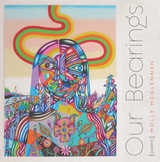
While working with both traditional and contemporary form, McGlennen’s unique use of space and rhythm creates poetry that is both captivating and accessible. Our Bearings does not attempt to speak for a population; rather it offers vibrant stories and moments that give voice to pieces of a large and complex tapestry of experiences. Through keen observation and a deep understanding of Native life in Minneapolis, McGlennen has created a timely collection that contributes beautifully to the important conversation about contemporary urban Native life in North America and globally.
Our Cancers
PoemsDan O'Brien
Acre Books, 2021
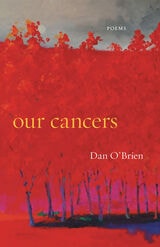
On the fourteenth anniversary of 9/11—an event that caused their downtown apartment to become “suffused with the World Trade Center’s carcinogenic dust”—Dan O’Brien’s wife discovers a lump in her breast. Surgery and chemotherapy soon follow, and on the day of his wife’s final infusion, O’Brien learns of his own diagnosis. He has colon cancer and will need to undergo his own intensive treatment over the next nine months.
Our Cancers is a compelling account of illness and commitment, of parenthood and partnership. This spare and powerful sequence creates an intimate mythology that seeks meaning in illness while also celebrating the resilience of sufferers, caregivers, and survivors.
As O’Brien explains in an introduction, “The consecutiveness of our personal disasters, with a daughter not yet two years old at the start of it, was shattering and nearly silencing. At hospital bedsides, in hospital beds myself, and at home through the cyclical assaults of our therapies, these poems came to me in fragments, as if my unconscious were attempting to reassemble our lives, our identities and memories . . . as if I were in some sense learning how to speak again.”
Our Earliest Tattoos
PoemsPeter Twal
University of Arkansas Press, 2018
Outlaw Style
PoemsR. T. Smith
University of Arkansas Press, 2007
Owl Question
PoemsFaith Shearin
Utah State University Press, 2004

of blue & bone
PoemsMichal 'MJ' Jones
Northwestern University Press, 2027
Winner of the 2026 Cave Canem Angela Jackson Prize
The second collection from acclaimed poet Michal “MJ” Jones, of blue & bone reckons with the Hart family murder-suicide. On March 26, 2018, white wives Jen and Sarah Hart drove themselves and their six adopted Black children—Markis, Hannah, Devonte, Jeremiah, Abigail, and Ciera Rose—off a cliff in Mendocino County, California. Before this tragedy and while the families of origin battled to keep their children, the Harts evaded culpability for over a decade of child abuse, protected under the guise of innocence and privilege. A collection of documentary poetics, of blue & bone engages persona, ode, and lyrical poetry to reflect on the question How could this have happened? Jones carefully studies the nuances and intersections of race, queerness, and class crucial to this question, employing delicate and powerful language to explore a devastating tragedy and attempt to make sense out of monstrous devastation. Vulnerable and raw, this collection cuts deeply through blue and bone.
once upon a twin
poemsRaymond Luczak
Gallaudet University Press, 2021