Results by title
142 books match the query 'Political Advocacy' and 4 start with o
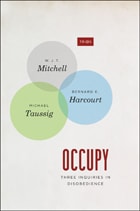
Occupy
Three Inquiries in DisobedienceW. J. T. Mitchell, Bernard E. Harcourt, and Michael Taussig
University of Chicago Press, 2013
Mic check! Mic check! Lacking amplification in Zuccotti Park, Occupy Wall Street protestors addressed one another by repeating and echoing speeches throughout the crowd. In Occupy, W. J. T. Mitchell, Bernard E. Harcourt, and Michael Taussig take the protestors’ lead and perform their own resonant call-and-response, playing off of each other in three essays that engage the extraordinary Occupy movement that has swept across the world, examining everything from self-immolations in the Middle East to the G8 crackdown in Chicago to the many protest signs still visible worldwide.
“You break through the screen like Alice in Wonderland,” Taussig writes in the opening essay, “and now you can’t leave or do without it.” Following Taussig’s artful blend of participatory ethnography and poetic meditation on Zuccotti Park, political and legal scholar Harcourt examines the crucial difference between civil and political disobedience. He shows how by effecting the latter—by rejecting the very discourse and strategy of politics—Occupy Wall Street protestors enacted a radical new form of protest. Finally, media critic and theorist Mitchell surveys the global circulation of Occupy images across mass and social media and looks at contemporary works by artists such as Antony Gormley and how they engage the body politic, ultimately examining the use of empty space itself as a revolutionary monument.
Occupy stands not as a primer on or an authoritative account of 2011’s revolutions, but as a snapshot, a second draft of history, beyond journalism and the polemics of the moment—an occupation itself.
[more]
Open Marxism 4
Against a Closing WorldAna Cecilia Dinerstein
Pluto Press, 2019
The publication of the first three volumes of Open Marxism in the 1990s has had a transformative impact on how we think about Marxism in the twenty-first century. 'Open Marxism' aims to think of Marxism as a theory of struggle, not as an objective analysis of capitalist domination, arguing that money, capital and the state are forms of struggle from above and therefore open to resistance and rebellion. As critical thought is squeezed out of universities and geographical shifts shape the terrain of theoretical discussion, the editors argue now is the time for a new volume that reflects the work that has been carried out during the past decade. Emphasising the contemporary relevance of 'open Marxism' in our moment of political and economic uncertainty, the collection shines a light on its significance for activists and academics today.
[more]
Open Marxism 4
Against a Closing WorldAna Cecilia Dinerstein
Pluto Press, 2019
The publication of the first three volumes of Open Marxism in the 1990s has had a transformative impact on how we think about Marxism in the twenty-first century. 'Open Marxism' aims to think of Marxism as a theory of struggle, not as an objective analysis of capitalist domination, arguing that money, capital and the state are forms of struggle from above and therefore open to resistance and rebellion. As critical thought is squeezed out of universities and geographical shifts shape the terrain of theoretical discussion, the editors argue now is the time for a new volume that reflects the work that has been carried out during the past decade. Emphasising the contemporary relevance of 'open Marxism' in our moment of political and economic uncertainty, the collection shines a light on its significance for activists and academics today.
[more]
Over the Wire and on TV
CBS and UPI in Campaign '80Michael J. Robinson
Russell Sage Foundation, 1983
First the press became the media, and now the media have become the Imperial Media—or have they? In this timely and comprehensive analysis, Michael Robinson and Margaret Sheehan examine how the news media behaved (or misbehaved) in covering the 1980 presidential campaign. Using the media's own traditional standards as a guide, Robinson and Sheehan measure the level of objectivity, fairness, seriousness, and criticism displayed by CBS News and United Press International between January and December of 1980. Drawing on statistical analyses of almost 6,000 news stories and dozens of interviews with writers and reporters, the authors reach convincing and sometimes surprising conclusions. They demonstrate, for example, that both CBS and UPI strictly avoided subjective assessments of the candidates and their positions on the issues. Both gave the major parties remarkably equal access. But the media seem to give more negative coverage to front-runners, treating serious challengers less harshly. Perhaps the most surprising finding is that networks were not more superficial than print; CBS attended to the issues at least as often as UPI. Robinson and Sheehan find television coverage more subjective, more volatile, and substantially more negative than traditional print. But CBS behaved neither imperially nor irresponsibly in Campaign '80. The networks did, however, emulate the more highly charged journalism of the eastern elite print press. By blending the quantitative techniques of social science and the tools of Washington-based journalism, Robinson and Sheehan have produced a book that will be essential reading for students and practitioners of politics, public opinion research, journalism, and communications. Lively and readable, it should also appeal to anyone interested in the role of the news media in contemporary politics.
[more]