Results by title
213 books match the query 'Political parties' and 3 start with o

Obama's Washington
Political Leadership in a Partisan EraEdited by Clodagh Harrington
University of London Press, 2014
This volume examines the array of challenges facing the Obama administration and the president himself. Topics range from how best to manage a ruptured economy to controlling the budget, the green agenda, foreign policy, and the recalibration of U.S. relations with Britain. It also includes sections on presidential leadership, elections,healthcare, and food poverty. The common theme throughout is the issue of governing in a fractured, unruly political environment, and the accompanying difficulties. Contributing scholars, based at academic institutions in the United States and the UK, offer a range of informed perspectives throughout this engaging work. Packed with detail yet highly accessible, this volume will appeal to those interested in American politics, history, and the political process.
[more]
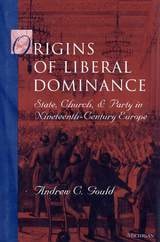
Origins of Liberal Dominance
State, Church, and Party in Nineteenth-Century EuropeAndrew C. Gould
University of Michigan Press, 1999
How did liberal movements reshape the modern world? Origins of Liberal Dominance offers a revealing account of how states, churches, and parties joined together in France, Belgium, Switzerland, and Germany to produce fundamentally new forms of organization that have shaped contemporary politics.
Modern political life emerged when liberal movements sought to establish elections, constitutions, free markets, and religious liberty. Yet liberalism even at its height faced strong and often successful opposition from conservatives. What explains why liberals overcame their opponents in some countries but not in others? This book compares successful and unsuccessful attempts to build liberal political parties and establish liberal regimes in France, Belgium, Switzerland, and Germany from 1815 to World War I.
Andrew Gould argues that relations between states and churches set powerful conditions on any attempt at liberalization. Liberal movements that enhanced religious authority while reforming the state won clerical support and successfully built liberal institutions of government. Furthermore, liberal movements that organized peasant backing around religious issues founded or sustained mass movements to support liberal regimes.
Origins of Liberal Dominance offers striking new insights into the emergence of modern states and regimes. It will be of interest to political scientists, sociologists, comparative historians, and those interested in comparative politics, regime change and state-building, democratization, religion and politics, and European politics.
Andrew C. Gould is Assistant Professor of Government and Kellogg Institute Fellow, University of Notre Dame.
[more]
Our Common Bonds
Using What Americans Share to Help Bridge the Partisan DivideMatthew Levendusky
University of Chicago Press, 2023
A compelling exploration of concrete strategies to reduce partisan animosity by building on what Democrats and Republicans have in common.
One of the defining features of twenty-first-century American politics is the rise of affective polarization: Americans increasingly not only disagree with those from the other party but distrust and dislike them as well. This has toxic downstream consequences for both politics and social relationships. Is there any solution?
Our Common Bonds shows that—although there is no silver bullet that will eradicate partisan animosity—there are concrete interventions that can reduce it. Matthew Levendusky argues that partisan animosity stems in part from partisans’ misperceptions of one another. Democrats and Republicans think they have nothing in common, but this is not true. Drawing on survey and experimental evidence, the book shows that it is possible to help partisans reframe the lens through which they evaluate the out-party by priming commonalities—specifically, shared identities outside of politics, cross-party friendships, and common issue positions and values identified through civil cross-party dialogue. Doing so lessons partisan animosity, and it can even reduce ideological polarization. The book discusses what these findings mean for real-world efforts to bridge the partisan divide.
[more]