Results by title
73 books match the query 'Popular works' and 2 start with o
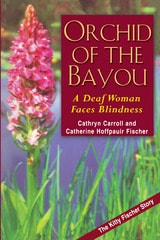
Orchid of the Bayou
A Deaf Woman Faces BlindessCathryn Carroll
Gallaudet University Press, 2001
In graduating from Gallaudet University, finding a job in Washington, D.C., and starting a family with her college sweetheart, Kitty Fischer tacitly abandoned the Louisiana Cajun culture that had exposed her to little more than prejudice and misery as a child. Upon discovering that she suffered from Usher syndrome (a genetic condition that causes both deafness and blindness), however, Fischer began an unlikely journey toward reclaiming her heritage. She and Cathryn Carroll tell the story of her heroic struggle and cultural odyssey in Orchid of the Bayou: A Deaf Woman Faces Blindness.
“By this time Mama knew I was ‘not right,’” Fischer says of her early childhood. “She knew the real words for ‘not right,’ too, though she never said those words. I was deaf and dumb.” Initially Fischer’s parents turned to folk healers to try and “cure” their daughter’s deafness, but an aunt’s fortunate discovery of the Louisiana School for the Deaf would rescue Fischer from misunderstanding and introduce her to sign language and Deaf culture. She weathered the school’'s experiments with oralism and soon rose to the top of her class, ultimately leaving Louisiana for the academic promise of Gallaudet.
While in college, Fischer met and married her future husband, Lance, a Jewish Deaf man from Brooklyn, New York, and each landed jobs close to their alma mater. After the birth of their first child, however, Fischer could no longer ignore her increasing tunnel vision. Doctors quickly confirmed that Fischer had Usher syndrome.
While Fischer struggled to come to terms with her condition, the high incidence of Usher syndrome among Cajun people led her to re-examine her cultural roots. “Could I still be me, Catherine Hoffpauir Fischer, had I not been born of a mix that codes for Usher syndrome?” she asks. “To some extent, the history of my people explains the constitution of my genes and the way my life has unfolded.” Today Fischer prospers, enjoying her time with family and friends and celebrating the Deaf, Cajun, Blind, and Jewish cultures that populate her life. Her lively story will resonate with anyone who recognizes the arduous journey toward claiming an identity.
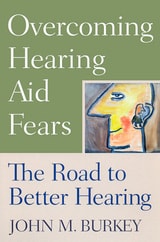
Overcoming Hearing Aid Fears
The Road to Better HearingBurkey, John M.
Rutgers University Press, 2003
There are dozens of misconceptions about hearing aids:
- “They make you look old.”
- “They cause ear infections.”
- “They increase hearing loss.”
- “I can’t afford one.”
In Overcoming Hearing Aid Fears, audiologist John M. Burkey addresses common fears, concerns, and misconceptions about hearing aids to help readers decide whether these devices will prove useful. Using an informal, anecdotal style informed by years of clinical practice, Burkey provides practical information about hearing aid styles, options, and costs. His expertise and experience in caring for more than 50,000 patients will help people with hearing loss address their personal concerns. The book also helps friends and family understand why a loved one might resist getting a hearing aid, and offers tips on counseling. Audiologists will find this text an important educational tool in advising their own patients.
Approximately 10 percent of Americans (and nearly one-third of people age seventy and older) have some degree of hearing loss that, if left untreated, causes frustration, isolation, and depression. A hearing aid is a simple tool to improve careers, relationships, and self-esteem, and to provide independence and security. Overcoming Hearing Aid Fears can help readers take that first step to a better life.