119 books match the query 'Power (Social sciences)' and 4 start with o
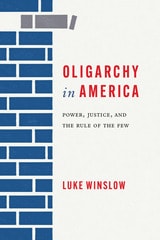
cover of Oligarchy in America: Power, Justice, and the Rule of the Few

Oligarchy in America

Power, Justice, and the Rule of the Few

Luke Winslow

University of Alabama Press, 2024

Roderick P. Hart Outstanding Book Award for the National Communication Association's Political Communication Division 

A fascinating survey of the history of political and economic ideas in the US that have led to an increasingly entrenched ultra-rich class of oligarchs.

To an American, oligarchy is something that happens somewhere else. In Oligarchy in America, Luke Winslow reveals oligarchy’s deep intellectual roots and alarming growth in America. The book provides conceptual tools the lack of which have prevented Americans from recognizing oligarchy at home.

Winslow argues that generic labels like “billionaires” for a class of ultra-rich masks the pervasive structures that entrench their power. He introduces instead the concept of democratic oligarchy—an institutional arrangement in which the ultra-rich form a class consciously creating and leveraging state power to accumulate wealth.

Like a master class in political ideas, Winslow traces the intellectual lineage of oligarchy in the US. His lively and compulsively readable survey examines key rhetorical sources such as Herbert Spencer, Andrew Carnegie, Friedrich Hayek, Lewis Powell, Milton Friedman, Charles Koch, Donald Trump, Tucker Carlson, and others.

Oligarchy in America maps the connective web of oligarchic ideas uniting these disparate figures. By offering a lucid framework through which to view oligarchic ideas ambient in American culture, Winslow makes a vital contribution to readers and scholars of communication and rhetorical studies, public address, economics, and political science.
[more]
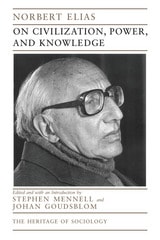
cover of On Civilization, Power, and Knowledge: Selected Writings

On Civilization, Power, and Knowledge

Selected Writings

Norbert Elias

University of Chicago Press, 1997

Nobert Elias (1897-1990) is among the great sociologists of the twentieth century. Born in Germany, Elias earned a doctorate in philosophy and then turned to sociology, working with Max Weber's younger brother, Alfred Weber, and with Karl Mannheim. He later fled the Nazi regime in 1935 and spent most of his life in Britain. He is best known for his book, The Civilizing Process, wherein he traces the subtle changes in manners among the European upper classes since the Middle Ages, and shows how those seemingly innocuous changes in etiquette reflected profound transformations of power relations in society. He later applied these insights to a wide range of subjects, from art and culture to the control of violence, the sociology of sports, the development of knowledge and the sciences, and the methodology of sociology.

This volume is a carefully chosen collection of Elias's most important writings and includes many of his most brilliant ideas. The development of Elias's thinking during the course of his long career is traced along with a discussion of how his work relates to other major sociologists and how the various selections are interconnected. The result is a consistent and stimulating look at one of sociology's founding thinkers.
[more]
cover of On Decoloniality: Concepts, Analytics, Praxis

On Decoloniality

Concepts, Analytics, Praxis

Walter D. Mignolo and Catherine E. Walsh

Duke University Press, 2018
In On Decoloniality Walter D. Mignolo and Catherine E. Walsh explore the hidden forces of the colonial matrix of power, its origination, transformation, and current presence, while asking the crucial questions of decoloniality's how, what, why, with whom, and what for. Interweaving theory-praxis with local histories and perspectives of struggle, they illustrate the conceptual and analytic dynamism of decolonial ways of living and thinking, as well as the creative force of resistance and re-existence. This book speaks to the urgency of these times, encourages delinkings from the colonial matrix of power and its "universals" of Western modernity and global capitalism, and engages with arguments and struggles for dignity and life against death, destruction, and civilizational despair.
[more]
cover of Ontopower: War, Powers, and the State of Perception

Ontopower

War, Powers, and the State of Perception

Brian Massumi

Duke University Press, 2015

Color coded terror alerts, invasion, drone war, rampant surveillance: all manifestations of the type of new power Brian Massumi theorizes in Ontopower. Through an in-depth examination of the War on Terror and the culture of crisis, Massumi identifies the emergence of preemption, which he characterizes as the operative logic of our time. Security threats, regardless of the existence of credible intelligence, are now felt into reality. Whereas nations once waited for a clear and present danger to emerge before using force, a threat's felt reality now demands launching a preemptive strike. Power refocuses on what may emerge, as that potential presents itself to feeling. This affective logic of potential washes back from the war front to become the dominant mode of power on the home front as well. This is ontopower—the mode of power embodying the logic of preemption across the full spectrum of force, from the “hard” (military intervention) to the "soft" (surveillance). With Ontopower, Massumi provides an original theory of power that explains not only current practices of war but the culture of insecurity permeating our contemporary neoliberal condition.
 
[more]