Results by title
76 books match the query 'Principles' and 2 start with o
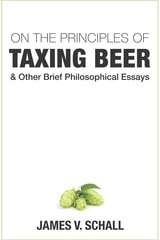
On the Principles of Taxing Beer
and Other Brief Philosophical EssaysJames V. Schall
St. Augustine's Press, 2015
What is real and what is noble, as well as what is deranged and wrong, can often be stated briefly. Nietzsche was famous for his succinct aphorisms and epigrams. Aquinas in one of his responses could manage to state clearly what he held to be true. Ultimately, all of our thought needs to be so refined and concentrated that we can see the point. So these are “brief” essays and they are largely of a philosophical “hue.” They touch on things worth thinking about. Indeed, often they consider things we really need to think about if our lives are to make sense.
The advantage of a collection of essays is that it is free to talk about many things. It can speak of them in a learned way or in an amused and humorous way. As Chesterton said, there is no necessary conflict between what is true and what is funny. Oftentimes, the greatest things we learn are through laughter, even laughter at ourselves and our own foibles and faults.
So these essays are “brief.” And they are largely of philosophical import. At first sight, taxing beer may seem to have no serious principle, except perhaps for the brewer and the consumer. But wherever there is reality, we can find something to learn.
Each of these essays begins with the proposition “on”—this is a classical form of essay in the English language. Belloc, one the essay’s greatest masters, wrote a book simply entitled “ON”—and several other books with that introductory “ON” to begin it. The word has the advantage of focusing our attention on some idea, place, book, person, or reality that we happen to come across and notice, then notice again, then wonder about.
These essays are relatively short, often lightsome, hopefully always with a consideration that illumines the world through the mind of the reader. These essays are written in the spirit that the things we encounter provoke us, our minds. We need to come to terms, to understand what we come across in our pathways through this world. Often the best way to know what we observe or confront is to write about it, preferably briefly and with some philosophical insight. This is what we do here.
[more]
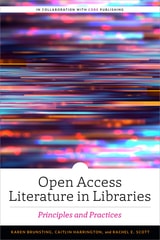
Open Access Literature in Libraries
Principles and PracticesKaren Brunsting, Caitlin Harrington, and Rachel E. Scott
American Library Association, 2022
Open Access has evolved into the most complex challenge of the scholarly publishing landscape and something libraries grapple with on a regular basis. But although librarians hold increasingly positive perceptions about OA, including its richness of unique content and immediacy of access, many lack the understanding, training, documentation, and knowledge of best practices that would allow them to engage with it confidently. This book helps to fill that gap, using a holistic approach that walks readers through the steps of integrating OA resources into library collections and supporting OA initiatives irrespective of budget, institution type, collection size, and staffing. Explaining definitions and models of OA, types of OA support, the tensions between free-to-read and libre OA, and other key topics, from this book readers will learn
- the origins and growth of OA, how to define it, and some of the ways in which librarians have made connections to OA;
- where OA diverges from the historic role of library collection development policies and ways to bring OA into alignment with an institution's collection development principles and practices;
- real-world examples of how libraries have supported or integrated OA into their collections, including strategies for selecting and activating OA titles and collections for inclusion, offering open educational resources (OER) to students, samples of collection management workflows, and ideas for aligning collections with institutional repositories or other Green OA initiatives;
- guidance on financially supporting OA content, initiatives, and platforms;
- how OA publishing does and does not harmonize with diversity, equity, and inclusion initiatives; and
- tips for using ongoing assessment and evaluation to continuously support the library’s path to an open future.
[more]