Results by title
117 books match the query 'Production and direction' and 6 start with o
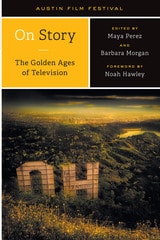
On Story—The Golden Ages of Television
Edited by Maya Perez and Barbara Morgan; foreword by Noah Hawley
University of Texas Press, 2018
“On Story is film school in a box, a lifetime’s worth of filmmaking knowledge squeezed into half-hour packages.”
—Kenneth Turan, film critic for the Los Angeles Times
Austin Film Festival (AFF) is the first organization to focus on writers’ creative contributions to film and television. Its annual Film Festival and Conference offers screenings, panels, workshops, and roundtable discussions that help new writers and filmmakers connect with mentors and gain advice and insight from masters, as well as reinvigorate veterans with new ideas. To extend the Festival’s reach, AFF produces On Story, a television series currently airing on PBS-affiliated stations and streaming online that presents high-caliber artists talking candidly and provocatively about the art and craft of screenwriting and filmmaking, often using examples from their own work.
On Story—The Golden Ages of Television explores the transformation of television’s narrative content over the past several decades through interviews with some of TV’s best creators and writers, including Garry Shandling (The Larry Sanders Show), Carl Reiner (The Dick Van Dyke Show), Issa Rae (Insecure), Vince Gilligan (Breaking Bad), Greg Daniels (The Office), Paula Pell (Saturday Night Live), Noah Hawley (Fargo), Liz Meriwether (New Girl), David Chase (The Sopranos), Alan Yang (Master of None), Marta Kauffman (Friends), Jenji Kohan (Orange Is the New Black), and many more. Their insights, behind-the-scenes looks at the creative process, production tales, responses to audiences’ reactions, and observations on how both TV narratives and the industry have changed make this book ideal for TV lovers, pop culture fans, students taking screenwriting courses, and filmmakers and writers seeking information and inspiration.
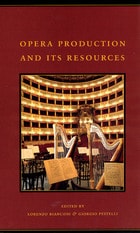
Opera Production and Its Resources
Edited by Lorenzo Bianconi and Giorgio Pestelli
University of Chicago Press, 1998
Opera Production and Its Resources traces the social, economic, and artistic history of the production of opera from its origins around 1600 to contemporary stagings. From the very beginning, opera has been a chronically deficit-producing enterprise. Yet it maintained unchallenged preeminence in the culture of all Italians for centuries. The first half explores the central role of theater impresarios in putting on these complex productions and in increasing the output of librettos and scores. The second half considers the roles of the three key figures in the creation of any opera: the librettist, the composer, and the singer.
Opera Scenes for Class and Stage
Mary Elaine Wallace and Robert Wallace
Southern Illinois University Press, 1979
Musically sound and fully annotated, this new reference work provides ready access to over 700 excerpts from 100 operas, by voice categories, and thus provides information on a wide variety of matters of interest to directors, teachers, and singers. A table of voice categories, coded excerpts (including length and reference to accessible scores), character descriptions (including estimations of degrees of difficulty of the music), summaries of the action of each excerpt, and indexes to titles, composers, and well-known arias and ensembles make this book an indispensable tool.
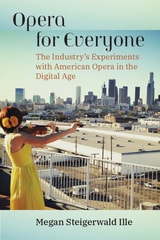
Opera for Everyone
The Industry's Experiments with American Opera in the Digital AgeMegan Steigerwald Ille
University of Michigan Press, 2024
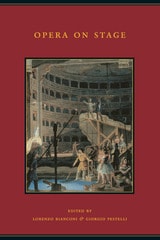
Opera on Stage
Edited by Lorenzo Bianconi and Giorgio Pestelli
University of Chicago Press, 2002
Opera on Stage, the second book of this multi-volume work to be published in English-in an expanded and updated version-focuses on staging and viewing Italian opera, from the court spectacles of the late sixteenth century to modern-day commercial productions. Mercedes Viale Ferrero describes the history of theater and stage design, detailing the evolution of the art well into the twentieth century. Gerardo Guccini does the same for stage and opera direction and the development of the director's role as an autonomous creative force. Kathleen Kuzmick Hansell discusses the interrelationships between theatrical ballet and Italian opera, from the age of Venetian opera to the early twentieth century. The visual emphasis of all three contributions is supplemented by over one hundred illustrations, and because much of this material-on the more "spectacular" visual aspects of Italian opera-has never before appeared in English, Opera on Stage will be welcomed by scholars and opera enthusiasts alike.
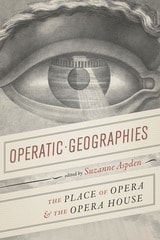
Operatic Geographies
The Place of Opera and the Opera HouseEdited by Suzanne Aspden
University of Chicago Press, 2019
Operatic Geographies invites us to reconsider the opera house’s spatial production. Looking at opera through the lens of cultural geography, this anthology rethinks the opera house’s landscape, not as a static backdrop, but as an expression of territoriality. The essays in this anthology consider moments across the history of the genre, and across a range of geographical contexts—from the urban to the suburban to the rural, and from the “Old” world to the “New.” One of the book’s most novel approaches is to consider interactions between opera and its environments—that is, both in the domain of the traditional opera house and in less visible, more peripheral spaces, from girls’ schools in late seventeenth-century England, to the temporary arrangements of touring operatic troupes in nineteenth-century Calcutta, to rural, open-air theaters in early twentieth-century France. The essays throughout Operatic Geographies powerfully illustrate how opera’s spatial production informs the historical development of its social, cultural, and political functions.