Results by title
597 books match the query 'Psychological aspects' and 15 start with o
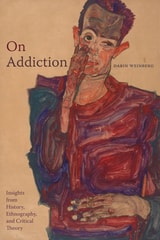
On Addiction
Insights from History, Ethnography, and Critical TheoryDarin Weinberg
Duke University Press, 2024
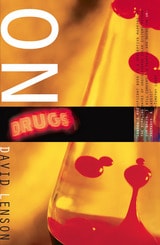
On Drugs
David Lenson
University of Minnesota Press, 1995
A critical exploration of the user’s perspective on drug consciousness-now in paperback!
Engaging, articulate, and brilliantly argued, On Drugs is destined to become a revolutionary classic that redefines what it means to be “high.” Calling for the acceptance of a “diversity of consciousness,” Lenson delivers a searing critique of the War on Drugs as an effort based, like all attempts to eradicate “getting high,” on an incomplete understanding of human nature.
In lucid prose, Lenson ventures outside the conventional genres of drug writing and offers a new look at the drug debate from a lost, and often forbidden, point of view: the user’s. Walking a fine line between the antidrug hysteria of the 1980s and an uncritical advocacy of drug use, he describes in provocative detail the experiences and dynamics of drugs of pleasure and desire-from nicotine to marijuana, alcohol to LSD, and caffeine to cocaine.From lotus-eaters to hippies to crackheads, history has shown the state’s inability to legislate the bloodstreams of its citizens. After considering several specific issues associated with drug use-including sex, violence, and money-On Drugs asks what drugs really do and challenges society’s accepted notions of sobriety and addiction. Lenson concludes with his vision of the end of the War on Drugs by questioning the sense in condemning millions of Americans to lives of concealment and deceit.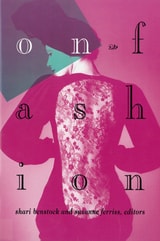
On Fashion
Benstock, Shari
Rutgers University Press, 1994
Until recently, fashion was considered the "F-word" in intellectual circles, dismissed as unworthy of serious attention. Yet no area of life, no individual moment, stands outside fashion's discourses. Intuitively, we all know that clothing is a language, incessantly communicating messages about its wearer. But who speaks this language, to whom is it addressed, what does it mean, and how are its meanings established and transformed? On Fashion explores the ways our material, political, psychological, sexual, even intellectual lives are woven into fashion's fabric.
This stimulating collection of essays explores fashion's symbolic and figurative functions in photography, cinema, and video; in consumerism, postmodernism, and feminism; in political and material culture; and in self-definition and subjectivity. They demonstrate the pervasive reach of fashion and its expressions.
This collection contains over sixty photographs and illustrations and includes essays by Barbara Brodman, Mary Ann Caws, Linda Benn DeLibero, Hlne Cixous, Diana Fuss, Cheryl Herr, Karla Jay, Deborah Jenson, Douglas Kellner, Ingeborg Majer O'Sickey, Leslie W. Rabine, Andrew Ross, Sonia Rykiel, Carol Shloss, Kaja Silverman, Maureen Turim, and Iris Marion Young.
On Living with Television
Amy Holdsworth
Duke University Press, 2021
On Suffering
Pathways to Healing and HealthBeverley M. Clarke
Dartmouth College Press, 2011
On The Rim
Looking for the Grand CanyonMark Neumann
University of Minnesota Press, 2001
Why do nearly five million people travel to the Grand Canyon each year? Mark Neumann answers this question with a book as compelling as the panoramic vistas of the canyon. In On the Rim, he describes how the Grand Canyon became an internationally renowned tourist attraction and cultural icon, and delves into the meanings the place holds for the individuals who live, work, and travel there.
Weaving history, ethnography, documentary photography, and autobiography, Neumann exposes the roots—the personal and social dimensions—of America’s pursuit of leisure. He shows how people visiting the Grand Canyon create their own experiences, even while they are affected by one hundred years of social history and cultural expectations. On the Rim examines the lines between progress and nostalgia, science and spirituality, nature and culture, authenticity and mass production, and work and leisure—all of which crisscross the tourist experience.
To support his argument, Neumann uses evidence from tourist registers and Park Service records, first-person narratives, interviews, and scenes from television shows, Hollywood movies, and popular novels. Heavily illustrated with historical and contemporary photographs, the narrative shifts back and forth between early descriptions of the canyon and modern tourist stories, the past illuminating the present at every step.
From Albert Einstein’s visit and the hunt for the fugitive Danny Horning to the everyday experiences of local Native Americans, park rangers, and vacationing families, Neumann reminds us that every trip to the Grand Canyon is a complex journey, fueled by shared expectations but always open to the possibility of surprise. On the Rim is a multilayered, nuanced study of the place and its many visitors.
On the Edge of the Abyss
The Jewish Unconscious before FreudClémence Boulouque
University of Chicago Press, 2025
When Sigmund Freud published his theory of the unconscious, in 1899, he popularized an idea that had fascinated generations of Jewish philosophers before him. In this book, Clémence Boulouque charts the development of the pre-Freudian unconscious from subcultural inquiry to dominant discourse during the long nineteenth century. Although Freud’s scientific notion differed from Schelling’s mythical description of the abyss from which creation springs, its resonance with older ideas was celebrated as an opportunity to express specifically Jewish contributions to modernity. Indeed, Boulouque shows that the pre-Freudian unconscious emerged from conversations in Jewish mysticism about otherness and coexistence. In the hopeful years before World War I, Boulouque argues, such reflections offered the possibility of emancipation not only to Jews but to all.
Only a Joke Can Save Us
A Theory of ComedyTodd McGowan
Northwestern University Press, 2017
Only a Joke Can Save Us presents an innovative and comprehensive theory of comedy. Using a wealth of examples from high and popular culture and with careful attention to the treatment of humor in philosophy, Todd McGowan locates the universal source of comedy in the interplay of the opposing concepts lack and excess.
After reviewing the treatment of comedy in the work of philosophers as varied as Aristotle, G. W. F. Hegel, Sigmund Freud, Henri Bergson, and Alenka Zupancic, McGowan, working in a psychoanalytic framework, demonstrates that comedy results from the deployment of lack and excess, whether in contrast, juxtaposition, or interplay.
Illustrating the power and flexibility of this framework with analyses of films ranging from Buster Keaton and Marx Brothers classics to Dr. Strangelove and Groundhog Day, McGowan shows how humor can reveal gaps in being and gaps in social order. Scholarly yet lively and readable, Only a Joke Can Save Us is a groundbreaking examination of the enigmatic yet endlessly fascinating experience of humor and comedy.
Oppositional Consciousness
The Subjective Roots of Social ProtestEdited by Jane J. Mansbridge and Aldon Morris
University of Chicago Press, 2001
Each essay employs a recent historical case to demonstrate how oppositional consciousness actually worked in the experience of a subordinate group. Based on participant observation and interviews, chapters focus on the successful social movements of groups such as African Americans, people with disabilities, sexually harassed women, Chicano workers, and AIDS activists. Ultimately, Oppositional Consciousness sheds new light on the intricate mechanisms that drive the important social movements of our time.
Contributors: Naomi Braine, Sharon Groch, Fredrick C. Harris, Jane Mansbridge, Anna-Maria Marshall, Aldon Morris, Marc Simon Rodriguez, Brett C. Stockdill, Lori G. Waite

Ordinary Reactions to Extraordinary Events
Edited by Ray B. Browne and Arthur B. Neal
University of Wisconsin Press, 2001
Our Grateful Dead
Stories of Those Left BehindVinciane Despret
University of Minnesota Press, 2021
An award-winning exploration of the presence of the dead in the lives of the living
A common remedy after suffering the loss of a loved one is to progress through the “stages of grief,” with “acceptance” as the final stage in the process. But is it necessary to leave death behind, to stop dwelling on the dead, to get over the pain? Vinciane Despret thinks not. In her fascinating, elegantly translated book, this influential thinker argues that, in practice, people in all cultures continue to enjoy a lively, inventive, positive relationship with their dead.
Through her unique storytelling woven from ethnographic sources and her own family history, Despret assembles accounts of those who have found ways to live their daily lives with their dead. She rejects the idea that one must either subscribe to “complete mourning” (in a sense, to get rid of the dead) or else fall into fantasy and superstition. She explores instead how the dead still play an active, tangible role through those who are living, who might assume their place in a family or in society; continue their labor or art; or thrive from a shared inheritance or an organ donation. This is supported by dreams and voices, novels, television and popular culture, the work of clairvoyants, and the everyday stories and activities of the living. For decades now, in the West, the dead have been discreet and invisible. Today, especially as a result of the Covid-19 pandemic, Despret suggests that perhaps we will be willing to engage with the dead in ways that bring us happiness despite our loss.
Despret’s unique method of inquiry makes her book both entertaining and instructive. Our Grateful Dead offers a new, pragmatic approach to social and cultural research and may indeed provide compassionate therapy for those of us coping with death.
Out for Glamour in Africa
A History of Black Urban Femininities in Drum MagazineWanjiru G. Mbure
University of Michigan Press, 2026
Out for Glamour in Africa critically reflects on how Black women utilized Drum magazine, a leading publication in Africa during the era of independence, for political empowerment and constructing notions of Black femininity. Wanjirũ G. Mbure terms the concept of femme urbAfricana, a model of Black femininity depicted as urban, political, fashionable, paradoxically Afrocentric, heteronormative, and transnational. Foregrounding stories of the women who embodied these traits and the social, political, and economic forces that shaped their presence in Drum, Mbure argues that these representations of Black women from Africa, the Caribbean, Europe, and the United States produced a novel form of Black urban femininity. Utilizing a breadth of archival materials from cover girl photographs, advertisements, and columns, to readers’ comments, Mbure reveals the complex relationship between the Black urban woman and the era’s contested ideals within a transnational matrix.
Out in the Center
Public Controversies and Private StrugglesHarry C. Denny
Utah State University Press, 2018
A diverse group of contributors interweaves personal experience with writing center theory and critical race theory, as well as theories on the politics and performance of identity. In doing so, Out in the Center extends upon the writing center corpus to disrupt and reimagine conventional approaches to writing center theory and practice. Out in the Center proposes that practitioners benefit from engaging in dialogue about identity to better navigate writing center work—work that informs the local and carries forth a social and cultural impact that stretches well beyond academic institutions.
Contributors:
Allia Abdullah-Matta, Nancy Alvarez, Hadi Banat, Tammy S. Conard-Salvo, Michele Eodice, Rochell Isaac, Sami Korgan, Ella Leviyeva, Alexandria Lockett, Talisha Haltiwanger Morrison, Anna Rita Napoleone, Beth A. Towle, Elizabeth Weaver, Tim Zmudka
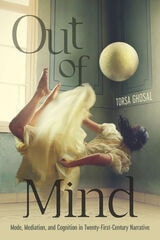
Out of Mind
Mode, Mediation, and Cognition in Twenty-First-Century NarrativeTorsa Ghosal
The Ohio State University Press, 2021
Out of Mind makes a compelling case for understanding narrative forms and cognitive-scientific frameworks as co-emergent and cross-pollinating. To this end, Ghosal harnesses narrative theory, multimodality studies, cognitive sciences, and disability studies to track competing perspectives on remembering, reading, and sense of place and self. Through new readings of the works of Kamila Shamsie, Aleksandar Hemon, Mark Haddon, Lance Olsen, Steve Tomasula, Jonathan Safran Foer, and others, Out of Mind generates unique insights into literary imagination’s influence on how we think and perceive amid twenty-first-century social, technological, and environmental changes.
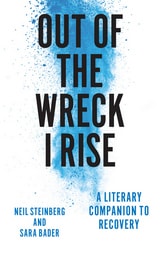
Out of the Wreck I Rise
A Literary Companion to RecoveryNeil Steinberg and Sara Bader
University of Chicago Press, 2016
Addiction is easy to fall into and hard to escape. It destroys the lives of individuals, and has a devastating cost to society. The National Institute of Health estimates seventeen million adults in the United States are alcoholics or have a serious problem with alcohol. At the same time, the country is seeing entire communities brought to their knees because of opioid additions. These scourges affect not only those who drink or use drugs but also their families and friends, who witness the horror of addiction. With Out of the Wreck I Rise, Neil Steinberg and Sara Bader have created a resource like no other—one that harnesses the power of literature, poetry, and creativity to illuminate what alcoholism and addiction are all about, while forging change, deepening understanding, and even saving lives.
Structured to follow the arduous steps to sobriety, the book marshals the wisdom of centuries and explores essential topics, including the importance of time, navigating family and friends, relapse, and what Raymond Carver calls “gravy,” the reward that is recovery. Each chapter begins with advice and commentary followed by a wealth of quotes to inspire and heal. The result is a mosaic of observations and encouragement that draws on writers and artists spanning thousands of years—from Seneca to David Foster Wallace, William Shakespeare to Patti Smith. The ruminations of notorious drinkers like John Cheever, Charles Bukowski, and Ernest Hemingway shed light on the difficult process of becoming sober and remind the reader that while the literary alcoholic is often romanticized, recovery is the true path of the hero.
Along with traditional routes to recovery—Alcoholics Anonymous, out-patient therapy, and intensive rehabilitation programs—this literary companion offers valuable support and inspiration to anyone seeking to fight their addiction or to a struggling loved one.
Featuring Charles Bukowski, John Cheever, Dante, Ricky Gervais, Ernest Hemingway, Billie Holiday, Anne Lamott, John Lennon, Haruki Murakami, Anaïs Nin, Mary Oliver, Samuel Pepys, Rainer Maria Rilke, J. K. Rowling, Patti Smith, Kurt Vonnegut, and many more.