325 books match the query 'Race identity' and 9 start with o

cover of Object Lessons

Object Lessons

Robyn Wiegman

Duke University Press, 2012
No concept has been more central to the emergence and evolution of identity studies than social justice. In historical and theoretical accounts, it crystallizes the progressive politics that have shaped the academic study of race, gender, and sexuality. Yet few scholars have deliberated directly on the political agency that notions of justice confer on critical practice. In Object Lessons, Robyn Wiegman contemplates this lack of attention, offering the first sustained inquiry into the political desire that galvanizes identity fields. In each chapter, she examines a key debate by considering the political aspirations that shape it. Addressing Women's Studies, she traces the ways that "gender" promises to overcome the exclusions of "women." Turning to Ethnic Studies, she examines the deconstruction of "whiteness" as an antiracist methodology. As she explores American Studies, she links internationalization to the broader quest for noncomplicity in contemporary criticism. Her analysis of Queer Studies demonstrates how the commitment to antinormativity normalizes the field. In the penultimate chapter, Wiegman addresses intersectionality as the most coveted theoretical approach to political resolution in all of these fields.
[more]
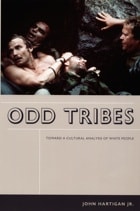
cover of Odd Tribes: Toward a Cultural Analysis of White People

Odd Tribes

Toward a Cultural Analysis of White People

John Hartigan Jr.

Duke University Press, 2005

Odd Tribes challenges theories of whiteness and critical race studies by examining the tangles of privilege, debasement, power, and stigma that constitute white identity. Considering the relation of phantasmatic cultural forms such as the racial stereotype “white trash” to the actual social conditions of poor whites, John Hartigan Jr. generates new insights into the ways that race, class, and gender are fundamentally interconnected. By tracing the historical interplay of stereotypes, popular cultural representations, and the social sciences’ objectifications of poverty, Hartigan demonstrates how constructions of whiteness continually depend on the vigilant maintenance of class and gender decorums.

Odd Tribes engages debates in history, anthropology, sociology, and cultural studies over how race matters. Hartigan tracks the spread of “white trash” from an epithet used only in the South prior to the Civil War to one invoked throughout the country by the early twentieth century. He also recounts how the cultural figure of “white trash” influenced academic and popular writings on the urban poor from the 1880s through the 1990s. Hartigan’s critical reading of the historical uses of degrading images of poor whites to ratify lines of color in this country culminates in an analysis of how contemporary performers such as Eminem and Roseanne Barr challenge stereotypical representations of “white trash” by claiming the identity as their own. Odd Tribes presents a compelling vision of what cultural studies can be when diverse research methodologies and conceptual frameworks are brought to bear on pressing social issues.
[more]
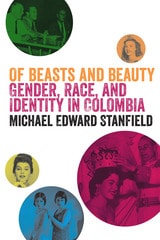
cover of Of Beasts and Beauty: Gender, Race, and Identity in Colombia

Of Beasts and Beauty

Gender, Race, and Identity in Colombia

By Michael Edward Stanfield

University of Texas Press, 2013

All societies around the world and through time value beauty highly. Tracing the evolutions of the Colombian standards of beauty since 1845, Michael Edward Stanfield explores their significance to and symbiotic relationship with violence and inequality in the country. Arguing that beauty holds not only social power but also economic and political power, he positions it as a pacific and inclusive influence in a country “ripped apart by violence, private armies, seizures of land, and abuse of governmental authority, one hoping that female beauty could save it from the ravages of the male beast.” One specific means of obscuring those harsh realities is the beauty pageant, of which Colombia has over 300 per year. Stanfield investigates the ways in which these pageants reveal the effects of European modernity and notions of ethnicity on Colombian women, and how beauty for Colombians has become an external representation of order and morality that can counter the pathological effects of violence, inequality, and exclusion in their country.
[more]
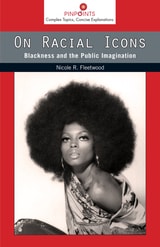
cover of On Racial Icons: Blackness and the Public Imagination

On Racial Icons

Blackness and the Public Imagination

Fleetwood, Nicole R

Rutgers University Press, 2015

[more]
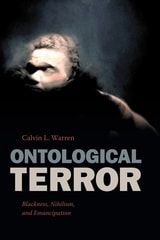
cover of Ontological Terror: Blackness, Nihilism, and Emancipation

Ontological Terror

Blackness, Nihilism, and Emancipation

Calvin L. Warren

Duke University Press, 2018
In Ontological Terror Calvin L. Warren intervenes in Afro-pessimism, Heideggerian metaphysics, and black humanist philosophy by positing that the "Negro question" is intimately imbricated with questions of Being. Warren uses the figure of the antebellum free black as a philosophical paradigm for thinking through the tensions between blackness and Being. He illustrates how blacks embody a metaphysical nothing. This nothingness serves as a destabilizing presence and force as well as that which whiteness defines itself against. Thus, the function of blackness as giving form to nothing presents a terrifying problem for whites: they need blacks to affirm their existence, even as they despise the nothingness they represent. By pointing out how all humanism is based on investing blackness with nonbeing—a logic which reproduces antiblack violence and precludes any realization of equality, justice, and recognition for blacks—Warren urges the removal of the human from its metaphysical pedestal and the exploration of ways of existing that are not predicated on a grounding in being.
[more]
cover of Other Germans: Black Germans and the Politics of Race, Gender, and Memory in the Third Reich

Other Germans

Black Germans and the Politics of Race, Gender, and Memory in the Third Reich

Tina M. Campt

University of Michigan Press, 2005
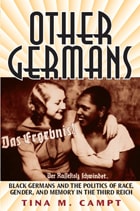
It's hard to imagine an issue or image more riveting than Black Germans during the Third Reich. Yet accounts of their lives are virtually nonexistent, despite the fact that they lived through a regime dedicated to racial purity.
Tina Campt's Other Germans tells the story of this largely forgotten group of individuals, with important distinctions from other accounts. Most strikingly, Campt centers her arguments on race, rather than anti-semitism. She also provides oral history as background for her study, interviewing two Black Germans for the book.
In the end, the author comes face to face with an inevitable question: Is there a relationship between the history of Black Germans and those of other black communities?
The answers to Campt's questions make Other Germans essential reading in the emerging study of what it meant to be black and German in the context of a society that looked at anyone with non-German blood as racially impure at best.
Tina Campt is Associate Professor of Women's Studies at Duke University.
[more]
cover of Otherwise Worlds: Against Settler Colonialism and Anti-Blackness

Otherwise Worlds

Against Settler Colonialism and Anti-Blackness

Tiffany Lethabo King, Jenell Navarro, and Andrea Smith, editors

Duke University Press, 2020

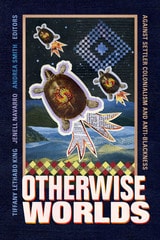
The contributors to Otherwise Worlds investigate the complex relationships between settler colonialism and anti-Blackness to explore the political possibilities that emerge from such inquiries. Pointing out that presumptions of solidarity, antagonism, or incommensurability between Black and Native communities are insufficient to understand the relationships between the groups, the volume's scholars, artists, and activists look to articulate new modes of living and organizing in the service of creating new futures. Among other topics, they examine the ontological status of Blackness and Indigeneity, possible forms of relationality between Black and Native communities, perspectives on Black and Indigenous sociality, and freeing the flesh from the constraints of violence and settler colonialism. Throughout the volume's essays, art, and interviews, the contributors carefully attend to alternative kinds of relationships between Black and Native communities that can lead toward liberation. In so doing, they critically point to the importance of Black and Indigenous conversations for formulating otherwise worlds.

Contributors. Maile Arvin, Marcus Briggs-Cloud, J. Kameron Carter, Ashon Crawley, Denise Ferreira da Silva, Chris Finley, Hotvlkuce Harjo, Sandra Harvey, Chad B. Infante, Tiffany Lethabo King, Jenell Navarro, Lindsay Nixon, Kimberly Robertson, Jared Sexton, Andrea Smith, Cedric Sunray, Se’mana Thompson, Frank B. Wilderson
 
[more]
cover of Our Caribbean Kin: Race and Nation in the Neoliberal Antilles

Our Caribbean Kin

Race and Nation in the Neoliberal Antilles

Reyes-Santos, Alaí

Rutgers University Press, 2015

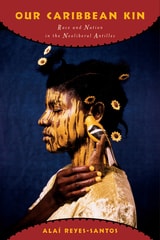
Beset by the forces of European colonialism, US imperialism, and neoliberalism, the people of the Antilles have had good reasons to band together politically and economically, yet not all Dominicans, Haitians, and Puerto Ricans have heeded the calls for collective action. So what has determined whether Antillean solidarity movements fail or succeed? In this comprehensive new study, Alaí Reyes-Santos argues that the crucial factor has been the extent to which Dominicans, Haitians, and Puerto Ricans imagine each other as kin. 

Our Caribbean Kin considers three key moments in the region’s history: the nineteenth century, when the antillanismo movement sought to throw off the yoke of colonial occupation; the 1930s, at the height of the region’s struggles with US imperialism; and the past thirty years, as neoliberal economic and social policies have encroached upon the islands. At each moment, the book demonstrates, specific tropes of brotherhood, marriage, and lineage have been mobilized to construct political kinship among Antilleans, while racist and xenophobic discourses have made it difficult for them to imagine themselves as part of one big family. 
 
Recognizing the wide array of contexts in which Antilleans learn to affirm or deny kinship, Reyes-Santos draws from a vast archive of media, including everything from canonical novels to political tracts, historical newspapers to online forums, sociological texts to local jokes. Along the way, she uncovers the conflicts, secrets, and internal hierarchies that characterize kin relations among Antilleans, but she also discovers how they have used notions of kinship to create cohesion across differences.


[more]
cover of Out of Whiteness: Color, Politics, and Culture

Out of Whiteness

Color, Politics, and Culture

Vron Ware and Les Back

University of Chicago Press, 2002

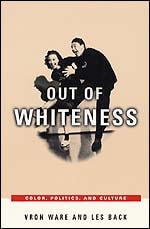
What happens when people in societies stratified by race refuse to accept the privileges inherent in whiteness? What difference does it make when whites act in a manner that contradicts their designated racial identity? Out of Whiteness considers these questions and argues passionately for an imaginative and radical politics against all forms of racism.

Vron Ware and Les Back look at key points in recent American and British culture where the "color line" has been blurred. Through probing accounts of racial masquerades in popular literature, the growth of the white power music scene on the Internet, the meteoric rise of big band jazz during the Second World War, and the pivotal role of white session players in crafting rhythm and blues classics by black artists, Ware and Back upset the idea of race as a symbol of inherent human attributes. Their book gives us a timely reckoning of the forces that continue to make people "white," and reveals to us the polyglot potential of identities and cultures.
[more]