436 books match the query 'Renaissance' and 6 start with o

cover of Oeconomies in the Age of Newton: 2003 Supplement, Volume 35

Oeconomies in the Age of Newton

2003 Supplement, Volume 35

Margaret Schabas and Neil De Marchi

Duke University Press, 0
While the history of early modern science is well-charted terrain, less has been recorded on the economic thinking of the same period and less still on the intersection of these fields. Addressing this gap in scholarship, Oeconomies in the Age of Newton offers a detailed account of economic concepts of the seventeenth and eighteenth centuries. The volume focuses on “oeconomics”—as “economics” was spelled at that time—which implies a view of economics as shaped by the Greek concept of the household. Examining a range of “oeconomic” curiosities, Oeconomies in the Age of Newton provides intriguing insights into a historical conceptualization of economic relations that differs markedly from the more narrowly defined economics of today.
[more]
cover of Old English Tradition: Essays in Honor of J. R. Hall

Old English Tradition

Essays in Honor of J. R. Hall

Edited by Lindy Brady

Arizona Center for Medieval and Renaissance Studies, 2021

Old English Tradition contains eighteen new essays by leading scholars in the field of Old English literary studies. The collection is centered around five key areas of research—Old English poetics, Anglo-Saxon Christianity, Beowulf, codicology, and early Anglo-Saxon studies—on which the work of scholar J. R. Hall, the volume’s honorand, has been influential over the course of his career.  

The volume’s contents range from fresh insights on individual Old English poems such as The Wife’s Lament and Beowulf; new studies in Old English metrics and linguistics; codicological examinations of individual manuscripts; fresh editions of understudied texts; and innovative examinations of the role of early antiquarians in shaping the field of Old English literary studies as we know it today.
[more]
cover of Old Thiess, a Livonian Werewolf: A Classic Case in Comparative Perspective

Old Thiess, a Livonian Werewolf

A Classic Case in Comparative Perspective

Carlo Ginzburg and Bruce Lincoln

University of Chicago Press, 2020

In 1691, a Livonian peasant known as Old Thiess boldly announced before a district court that he was a werewolf. Yet far from being a diabolical monster, he insisted, he was one of the “hounds of God,” fierce guardians who battled sorcerers, witches, and even Satan to protect the fields, flocks, and humanity—a baffling claim that attracted the notice of the judges then and still commands attention from historians today.

In this book, eminent scholars Carlo Ginzburg and Bruce Lincoln offer a uniquely comparative look at the trial and startling testimony of Old Thiess. They present the first English translation of the trial transcript, in which the man’s own voice can be heard, before turning to subsequent analyses of the event, which range from efforts to connect Old Thiess to shamanistic practices to the argument that he was reacting against cruel stereotypes of the “Livonian werewolf” a Germanic elite used to justify their rule over the Baltic peasantry. As Ginzburg and Lincoln debate their own and others’ perspectives, they also reflect on broader issues of historical theory, method, and politics. Part source text of the trial, part discussion of historians’ thoughts on the case, and part dialogue over the merits and perils of their different methodological approaches, Old Thiess, a Livonian Werewolf opens up fresh insight into a remarkable historical occurrence and, through it, the very discipline of history itself.
[more]
cover of Ordering Customs: Ethnographic Thought in Early Modern Venice

Ordering Customs

Ethnographic Thought in Early Modern Venice

Kathryn Taylor

University of Delaware Press, 2023
Ordering Customs explores how Renaissance Venetians sought to make sense of human difference in a period characterized by increasing global contact and a rapid acceleration of the circulation of information. Venice was at the center of both these developments. The book traces the emergence of a distinctive tradition of ethnographic writing that served as the basis for defining religious and cultural difference in new ways. Taylor draws on a trove of unpublished sources—diplomatic correspondence, court records, diaries, and inventories—to show that the study of customs, rituals, and ways of life not only became central in how Venetians sought to apprehend other peoples, but also had a very real impact at the level of policy, shaping how the Venetian state governed minority populations in the city and its empire. In contrast with the familiar image of ethnography as the product of overseas imperial and missionary encounters, the book points to a more complicated set of origins. 

 
[more]
cover of Ornamentalism: The Art of Renaissance Accessories

Ornamentalism

The Art of Renaissance Accessories

Edited and with an Introduction by Bella Mirabella

University of Michigan Press, 2011

Ornamentalism is the first book to focus on Renaissance accessories, their histories and meanings. The collection's eminent contributors bring accessories to the center of a discussion about material culture, dress, and adornment, exploring their use, significance, and multiple lives. Defining an “accessory” in the broadest sense—including scents, veils, handkerchiefs, lingerie, codpieces, dildos, jewels, ruffs, wax seals, busks, shoes, scissors, and even boys—the book provides a rich cultural history that’s eclectic and bold, including discussions of bodily functions, personal hygiene, and sexuality.

Lively, well-written, and richly illustrated with color plates, Ornamentalism will appeal to scholars of the material past and social practice, and those interested in fashion studies, manners and morals, gender and sexuality, theater and performance.
[more]
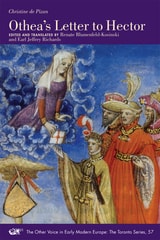
cover of Othea’s Letter to Hector

Othea’s Letter to Hector

Christine de Pizan

Iter Press, 2017

Othea’s Letter to Hector, one of Christine de Pizan’s most popular works, is at the same time one of her most complex creations. Combining a somewhat Sibylline verse text based on a mythological figure with extensive citation of pagan sapiential authorities, the Bible, and the Church Fathers, it showcases Christine’s extraordinary learning and her innovative approach to didacticism. An appendix provides new insights on her skillful use of patristic sources and creative command of Latin authors.
[more]