Results by title
50 books match the query 'Roots' and 2 start with o
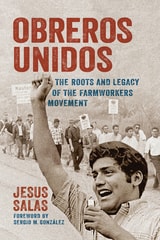
Obreros Unidos
The Roots and Legacy of the Farmworkers MovementJesus Salas
Wisconsin Historical Society Press, 2023
In an expansive narrative, noted labor leader Jesus Salas shares an insider’s look at the farm workers movement, from its roots in southern political uprisings to its lasting legacy of activism. During his childhood, Salas and his family joined the migrant workers who traveled from their hometown in Texas to work on farms in Wisconsin, Illinois, and other states. In riveting detail, he describes the brutal working conditions and overcrowded labor camps experienced by the Mexican American workers who fueled the Midwest’s agriculture industry.
Taking inspiration from César Chávez, as a young man Salas and others led a historic march from Wautoma to Madison to demand that lawmakers address rampant violations of Wisconsin’s minimum wage laws and housing codes. These young labor leaders founded Obreros Unidos—Workers United—to continue the fight for fairness and respect, as well as to provide much-needed services to migrant families. This memoir of a movement details how their work went beyond the fields to have lasting impacts on representation in community organizations and access to education, empowering later generations to demand better.
Winner of the 2024 Benjamin Franklin Award for Multicultural Books
Winner of the 2024 Hamlin Garland Prize in Popular History from the Midwest History Association
“In recounting the story of Tejano settlement and struggle in Wisconsin, Salas unsettles this story line and, in the process, demonstrates the power of personal narrative and the lasting political implications of retrieving and restoring Latino history.”
—Sergio M. González, author of Mexicans in Wisconsin
“Salas’s story is an essential chapter in the history of Wisconsin and Milwaukee and mirrors the growth, progress and dreams of the Latinx community. His reflections speak to not only the importance of the Latinx community, but the need to build alliances across lines of race and gender and fulfill the promise of a multiracial democracy.”
—Barbara Miner, Milwaukee Magazine
[more]
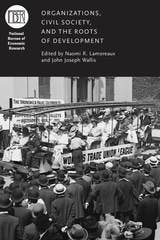
Organizations, Civil Society, and the Roots of Development
Edited by Naomi R. Lamoreaux and John Joseph Wallis
University of Chicago Press, 2017
Modern developed nations are rich and politically stable in part because their citizens are free to form organizations and have access to the relevant legal resources. Yet in spite of the advantages of open access to civil organizations, it is estimated that eighty percent of people live in countries that do not allow unfettered access. Why have some countries disallow the formation of organizations as part of their economic and political system?
The contributions to Organizations, Civil Society, and the Roots of Development seek to answer this question through an exploration of how developing nations throughout the eighteenth and nineteenth centuries, including the United States, United Kingdom, France, and Germany, made the transition to allowing their citizens the right to form organizations. The transition, contributors show, was not an easy one. Neither political changes brought about by revolution nor subsequent economic growth led directly to open access. In fact, initial patterns of change were in the opposite direction, as political coalitions restricted access to specific organizations for the purpose of maintaining political control. Ultimately, however, it became clear that these restrictions threatened the foundation of social and political order. Tracing the path of these modern civil societies, Organizations, Civil Society, and the Roots of Development is an invaluable contribution to all interested in today’s developing countries and the challenges they face in developing this organizational capacity.
The contributions to Organizations, Civil Society, and the Roots of Development seek to answer this question through an exploration of how developing nations throughout the eighteenth and nineteenth centuries, including the United States, United Kingdom, France, and Germany, made the transition to allowing their citizens the right to form organizations. The transition, contributors show, was not an easy one. Neither political changes brought about by revolution nor subsequent economic growth led directly to open access. In fact, initial patterns of change were in the opposite direction, as political coalitions restricted access to specific organizations for the purpose of maintaining political control. Ultimately, however, it became clear that these restrictions threatened the foundation of social and political order. Tracing the path of these modern civil societies, Organizations, Civil Society, and the Roots of Development is an invaluable contribution to all interested in today’s developing countries and the challenges they face in developing this organizational capacity.
[more]