117 books match the query 'Rural conditions' and 2 start with o
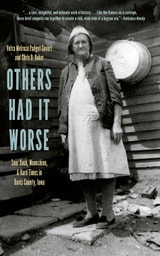
cover of Others Had It Worse: Sour Dock, Moonshine, and Hard Times in Davis County, Iowa

Others Had It Worse

Sour Dock, Moonshine, and Hard Times in Davis County, Iowa

Vetra Melrose Padget Covert and Chris D. Baker

University of Iowa Press, 2013
In 1977, while studying journalism at the University of Iowa, Chris Baker gave his grandmother a notebook and asked her to write about her childhood. Years later, long after her death in 1990, he found the tattered yellow notebook. In twenty-nine handwritten pages, the woman he knew as Grandma Covert had recorded her younger life in rural Iowa between 1920 and 1929. Writing about herself from the ages of four to thirteen, Vetra Covert sent a simple message back to her grandson: “That’s just the way it was. Others had it worse. We got by.”
 
Captivated by this glimpse of a woman very different from the more formidable grandmother of his memory, Chris Baker reframed Vetra’s journal to create a narrative of her childhood and a window into rural Iowa life in the 1920s. Transcribing her words into nine chapters that illuminate home, family, neighbors, school, and social life, he has composed a collection of candid, whimsical, sometimes ornery stories that will resonate with anyone who has ever tried to decipher the lives found in old letters and photos.
 
Vetra’s was not a romantic little-house-on-the-prairie childhood. She grew up with seven brothers and sisters (every new baby was “a supprise”) in a dilapidated log cabin near a small town now vanished from the Iowa map. Two rooms up, two rooms down, no plumbing, no electricity, holes in the roof and floor so big “you could of throwed a cat through them.” Her father was a bootlegger-farmer who measured his corn yield in gallons, not bushels, a moonshiner occasionally harassed by federal agents. Although family stories now present him as a quaint old-timer, the reality of living with him was much starker.
 
In his introduction to Vetra’s recollections, Chris Baker reveals the harsh truths underlying her authentic, uncomplaining account. By honoring her legacy, he discovered a newfound respect for her and for her family’s ability to survive despite the devastating forces of poverty, isolation, and the looming Great Depression. Together he and his grandmother have created an enduring chapter in family history.

[more]
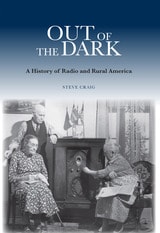
cover of Out of the Dark: A History of Radio and Rural America

Out of the Dark

A History of Radio and Rural America

Steve Craig

University of Alabama Press, 2009

From the Grand Ole Opry to the National Barn Dance, how radio changed life in rural America

Out of the Dark: A History of Radio and Rural America shows how radio—especially clear channel network stations—brought news, markets, weather, religion, and entertainment into isolated farm homes between the 1920s and 1950s, narrowing rural–urban divides while also sustaining distinctly rural tastes (e.g., barn dance music). Craig argues that battery “farm radios,” high power stations, and national networking transformed daily life, work rhythms, consumer habits, and political participation, making radio the central domestic technology of the Depression era and beyond. 

Craig blends regulatory and industry milestones, such as the Radio Act of 1927, with sociological studies, USDA extension records, FCC surveys, census tables, and rich case studies including WLS Chicago’s “National Barn Dance,” WSM Nashville’s “Grand Ole Opry,” and others. He mines audience research, diaries, program schedules, and tables that track the spread of radio. The book’s distinctive contributions include detailed charts (ownership by region; clear channel assignments) and vivid narratives of stations, formats, and personalities that connected farm families to national culture while preserving local identity. 

The book is ideal for scholars and students of US social, rural, and media history; communication policy and political communication; country and bluegrass music history; agricultural extension; and American studies. It will also engage librarians, curators, and public historians seeking context for rural collections; journalists and podcasters tracing the roots of today’s information ecosystems; and general readers interested in how radio re made community life long before the internet.

[more]