Results by title
238 books match the query 'Social Classes & Economic Disparity' and 4 start with o
Oligarchy in America
Power, Justice, and the Rule of the FewLuke Winslow
University of Alabama Press, 2024
Roderick P. Hart Outstanding Book Award for the National Communication Association's Political Communication Division
A fascinating survey of the history of political and economic ideas in the US that have led to an increasingly entrenched ultra-rich class of oligarchs.
To an American, oligarchy is something that happens somewhere else. In Oligarchy in America, Luke Winslow reveals oligarchy’s deep intellectual roots and alarming growth in America. The book provides conceptual tools the lack of which have prevented Americans from recognizing oligarchy at home.
Winslow argues that generic labels like “billionaires” for a class of ultra-rich masks the pervasive structures that entrench their power. He introduces instead the concept of democratic oligarchy—an institutional arrangement in which the ultra-rich form a class consciously creating and leveraging state power to accumulate wealth.
Like a master class in political ideas, Winslow traces the intellectual lineage of oligarchy in the US. His lively and compulsively readable survey examines key rhetorical sources such as Herbert Spencer, Andrew Carnegie, Friedrich Hayek, Lewis Powell, Milton Friedman, Charles Koch, Donald Trump, Tucker Carlson, and others.
Oligarchy in America maps the connective web of oligarchic ideas uniting these disparate figures. By offering a lucid framework through which to view oligarchic ideas ambient in American culture, Winslow makes a vital contribution to readers and scholars of communication and rhetorical studies, public address, economics, and political science.
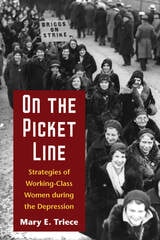
On the Picket Line
Strategies of Working-Class Women during the DepressionMary Triece
University of Illinois Press, 2006
Bonnie Ritter Book Award, National Communication Association's Feminist and Women Studies Division, 2008.
On the Picket Line uncovers the voices of working-class women, particularly those active in the Communist Party, U.S.A., in order to examine how these individuals confronted the tensions between their roles as workers, wives, mothers, and consumers. Combining critical analysis, Marxist and feminist theory, and labor history, Mary E. Triece analyzes the protest tactics employed by working class women to challenge dominant ideologies surrounding domesticity.
She details the rhetorical strategies used by women to argue for their rights as workers in the paid labor force and as caregivers in the home. Their overtly coercive tactics included numerous sit-ins, strikes, and boycotts that won tangible gains for working poor and unemployed women. The book also gives voice to influential figures in the 1930s labor movement (many of whom were members of the Communist Party, U.S.A.), such as Ella Reeve Bloor, Margaret Cowl, Anna Damon, Ann Burlak, and Grace Hutchins. Triece ultimately argues that these confrontational protest tactics of the 1930s remain relevant in today’s fights for more humane workplaces and better living conditions.
Origins and Destinations
The Making of the Second GenerationRenee Luthra
Russell Sage Foundation, 2018
Using surveys of second generation immigrant adults in New York and Los Angeles, Origins and Destinations explains why second generation experiences differ across national origin groups and why immigrant offspring with the same national background often follow different trajectories. Inter-group disparities stem from contexts of both emigration and immigration. Origin countries differ in value orientations: immigrant parents transmit lessons learned in varying contexts of emigration to children raised in the U.S. A system of migration control sifts immigrants by legal status, generating a context of immigration that favors some groups over others. Both contexts matter: schooling is higher among immigrant children from more secular societies (South Korea) than among those from more religious countries (the Philippines). When immigrant groups enter the U.S. migration system through a welcoming door, as opposed to one that makes authorized status difficult to achieve, education propels immigrant children to better jobs.
Diversity is also evident among immigrant offspring whose parents stem from the same place. Immigrant children grow up with homeland connections, which can both hurt and harm: immigrant offspring get less schooling when a parent lives abroad, but more schooling if parents in the U.S. send money to relatives living abroad. Though all immigrants enter the U.S. as non-citizens, some instantly enjoy legal status, while others spend years in the shadows. Children born abroad, but raised in the U.S. are all everyday Americans, but only some have become de jure Americans, a difference yielding across-the-board positive effects, even among those who started out in the same country.
Disentangling the sources of diversity among today’s population of immigrant offspring, Origins and Destinations provides a compelling new framework for understanding the second generation that is transforming America.
Out of Sync & Out of Work
History and the Obsolescence of Labor in Contemporary CultureBurges, Joel
Rutgers University Press, 2018