Results by title
322 books match the query 'Social Policy' and 4 start with o
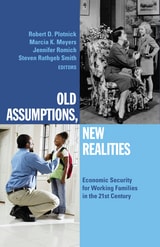
Old Assumptions, New Realities
Ensuring Economic Security for Working Families in the 21st CenturyRobert D. Plotnick
Russell Sage Foundation, 2011
The way Americans live and work has changed significantly since the creation of the Social Security Administration in 1935, but U.S. social welfare policy has failed to keep up with these changes. The model of the male breadwinner-led nuclear family has given way to diverse and often complex family structures, more women in the workplace, and nontraditional job arrangements. Old Assumptions, New Realities identifies the tensions between twentieth-century social policy and twenty-first-century realities for working Americans and offers promising new reforms for ensuring social and economic security. Old Assumptions, New Realities focuses on policy solutions for today's workers—particularly low-skilled workers and low-income families. Contributor Jacob Hacker makes strong and timely arguments for universal health insurance and universal 401(k) retirement accounts. Michael Stoll argues that job training and workforce development programs can mitigate the effects of declining wages caused by deindustrialization, technological changes, racial discrimination, and other forms of job displacement. Michael Sherraden maintains that wealth-building accounts for children—similar to state college savings plans—and universal and progressive savings accounts for workers can be invaluable strategies for all workers, including the poorest. Jody Heymann and Alison Earle underscore the potential for more extensive work-family policies to help the United States remain competitive in a globalized economy. Finally, Jodi Sandfort suggests that the United States can restructure the existing safety net via state-level reforms but only with a host of coordinated efforts, including better information to service providers, budget analyses, new funding sources, and oversight by intermediary service professionals. Old Assumptions, New Realities picks up where current policies leave off by examining what's not working, why, and how the safety net can be redesigned to work better. The book brings much-needed clarity to the process of creating viable policy solutions that benefit all working Americans. A West Coast Poverty Center Volume
[more]
Ordinary Poverty
A Little Food and Cold StorageWilliam DiFazio
Temple University Press, 2005
At St. John's Bread and Life, a soup kitchen in the Bedford-Stuyvesant section of Brooklyn, more than a thousand people line up for breakfast and lunch five days a week. During the twelve-year era of welfare reform, William DiFazio observed the daily lives of poor people at St. John's and throughout New York City.
In this trenchant and groundbreaking work, DiFazio presents the results of welfare reform—from ending entitlements to diminished welfare benefits—through the eyes and voices of those who were most directly affected by it. Ordinary Poverty concludes with a program to guarantee universal rights to a living wage as a crucial way to end poverty. Ultimately, DiFazio articulates the form a true poor people's movement would take—one that would link the interests of all social movements with the interests of ending poverty.
In this trenchant and groundbreaking work, DiFazio presents the results of welfare reform—from ending entitlements to diminished welfare benefits—through the eyes and voices of those who were most directly affected by it. Ordinary Poverty concludes with a program to guarantee universal rights to a living wage as a crucial way to end poverty. Ultimately, DiFazio articulates the form a true poor people's movement would take—one that would link the interests of all social movements with the interests of ending poverty.
[more]
Organizational State
Social Choice: In National Policy DomainsEdward O. Laumann
University of Wisconsin Press, 1987
The Federal Government in the United States is a government “of the people, by the people, and for the people.” Presidents are elected by popular vote in the nation (filtered through the electoral college), Senators are elected by popular vote in their states, and Representatives are elected by popular vote in their Congressional districts. Cabinet members and agency heads are appointed by the elected president, as are members of the Supreme Court.
But this says nothing about politics. Professor Lauman and Knoke have asked, in this book, how policies were made, in the period 1977-1980, in the areas of energy and health. The question is a very different one from the question of how the positions of president and Congress are filled.
[more]

Organized Labour and Politics in Mexico
Changes, Continuities and ContradictionsGraciela Bensusan and Kevin J. Middlebrook
University of London Press, 2012
As a consequence of market-oriented reforms and historic shifts in governmentpolicy toward labor, the Mexican organized labor movement has declined substantially in size, bargaining strength, and political influence since the 1980s. Democratization has expanded workers' choices at the ballot box, and some unions have bolstered their position by forging alliances with counterparts in Canada and the United States. By analyzing the changes, continuities, and contradictions characterizing labor politics in Mexico, this book contributes to a broader assessment of organized labor's role in contemporary Latin America. Democratization has had remarkably little impact on the state-labor relations regimeinstitutionalized following the Mexican Revolution of 1910-1920. This legal regimeboth underpins the position of unrepresentative union leaders and grants governmentofficials extensive controls over labor organizations. The combination of weakenedunions, unaccountable leaders, and strong government controls fundamentally constrainsworkers' capacity to defend their interests.
This state of affairs - especially the failure to enact progressive labor law reform since democratic regime change in 2000 - limits democracy and imposes heavy costs on society as a whole.
This state of affairs - especially the failure to enact progressive labor law reform since democratic regime change in 2000 - limits democracy and imposes heavy costs on society as a whole.
[more]