168 books match the query 'Social Theory' and 4 start with o
cover of On the Way to Theory

On the Way to Theory

Lawrence Grossberg

Duke University Press, 2024
In On the Way to Theory, Lawrence Grossberg introduces the major ways of thinking that provide the backstory for contemporary Western theory. Asking readers to think about thinking, Grossberg traces cultural and critical theory’s foundations from the contested enlightenments to modern and postmodern conceptualizations of power, experience, language, and existence. He introduces key figures as historical characters and lays out the unique set of tools for thought that their “deep theories” offer. Through finely tuned and accessible descriptions of their concepts and logics, Grossberg highlights thinkers including Spinoza, Kant, Hegel, Marx, Nietzsche, Wittgenstein, Heidegger, Derrida, Foucault, Deleuze, and Hall, defining the possibilities of their thought. This book is essential for those interested in how theories shape our understanding of the world, influence our choices, and define our realities. It challenges us to recognize the multiplicity and complexities of ways of thinking in our quest for knowledge and understanding. By setting out a story of theoretical foundations, Grossberg invites readers to think toward the future of theory and expand conversations around theoretical scrutiny and criticism.
[more]
cover of Orienting to Chance: Probabilism and the Future of Social Theory

Orienting to Chance

Probabilism and the Future of Social Theory

Michael Strand and Omar Lizardo

University of Chicago Press, 2025

Explores the implications of chance and uncertainty in social theory and offers a new interpretation of the sociological canon.
 
Since the founding of the discipline, sociologists have endeavored to understand the structures of groups, organizations, and societies, and how these entities condition our behavior. While some of the foundational theorists saw these processes as largely deterministic, sociological theory has increasingly insisted on the importance of culture in shaping our position in and responses to social groups. In Orienting to Chance, sociologists Michael Strand and Omar Lizardo aim to show that the social order bears an unmistakable link to chance and urge us to think about how it conditions our actions.

Strand and Lizardo provide a sweeping overview of a new social theory framework that they call probabilism. Using examples of probabilism in sociology, particularly in the work of Max Weber, W. E. B. Du Bois, and Pierre Bourdieu, they describe probabilism’s place in multiple fields of science. As the authors argue, their effort at redefinition and recovery helps position sociology as a field of the future, while also keeping it grounded in core issues of action, structure, culture, inequality, and inequity. By sharing these groundbreaking insights and revealing wider theoretical claims about mortality, fate, and technology in the contemporary era, Strand and Lizardo demonstrate how probabilism is an essential intervention for understanding the inevitable role of uncertainty in social life.
 
[more]
cover of Out of Sync & Out of Work: History and the Obsolescence of Labor in Contemporary Culture

Out of Sync & Out of Work

History and the Obsolescence of Labor in Contemporary Culture

Burges, Joel

Rutgers University Press, 2018
Out of Sync & Out of Work explores the representation of obsolescence, particularly of labor, in film and literature during a historical moment in which automation has intensified in capitalist economies. Joel Burges analyzes texts such as The Invention of Hugo Cabret, Wreck-It Ralph, Fantastic Mr. Fox, and Iron Council, and examines their “means” of production. Those means include a range of subjects and narrative techniques, including the “residual means” of including classic film stills in a text, the “obstinate means” of depicting machine breaking, the “dated means” of employing the largely defunct technique of stop-motion animation, and the “obsolete” means of celebrating a labor strike. In every case, the novels and films that Burges scrutinizes call on these means to activate the reader’s/viewer’s awareness of historical time. Out of Sync & Out of Work advances its readers’ grasp of the complexities of historical time in contemporary culture, moving the study of temporality forward in film and media studies, literary studies, critical theory, and cultural critique.
[more]
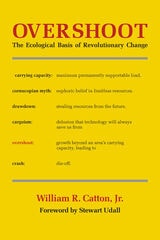
cover of Overshoot: The Ecological Basis of Revolutionary Change

Overshoot

The Ecological Basis of Revolutionary Change

William R. Catton, Jr.

University of Illinois Press, 1980

Our day-to-day experiences over the past decade have taught us that there must be limits to our tremendous appetite for energy, natural resources, and consumer goods. Even utility and oil companies now promote conservation in the face of demands for dwindling energy reserves. And for years some biologists have warned us of the direct correlation between scarcity and population growth. These scientists see an appalling future riding the tidal wave of a worldwide growth of population and technology.

A calm but unflinching realist, Catton suggests that we cannot stop this wave - for we have already overshot the Earth's capacity to support so huge a load. He contradicts those scientists, engineers, and technocrats who continue to write optimistically about energy alternatives. Catton asserts that the technological panaceas proposed by those who would harvest from the seas, harness the winds, and farm the deserts are ignoring the fundamental premise that "the principals of ecology apply to all living things." These principles tell us that, within a finite system, economic expansion is not irreversible and population growth cannot continue indefinitely. If we disregard these facts, our sagging American Dream will soon shatter completely.

[more]