Results by title
72 books match the query 'Social structure' and 5 start with o
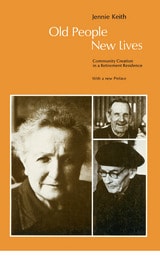
Old People, New Lives
Community Creation in a Retirement ResidenceJennie Keith
University of Chicago Press, 1982
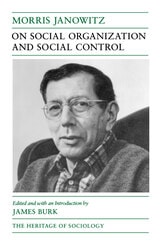
On Social Organization and Social Control
Morris Janowitz
University of Chicago Press, 1991
In this volume, James Burk selects from Janowitz's scholarly writings to provide a comprehensive overview of his wide-ranging interests. Organized to demonstrate the common logic of inquiry and substantive unity of Janowitz's contribution to several subfields of sociology, the collection includes analyses of the concept of social control, ethnic intolerance and hostility, citizenship in Western societies, models for urban education, and the professionalization of military elites. Burk provides a richly detailed, critical account of Janowitz's intellectual development, placing his writings in historical context and showing their continuing relevance for sociological research. Useful to both students and specialists, the volume is an important source for the ideas and methods of one of sociology's leading figures.
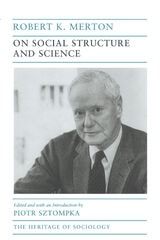
On Social Structure and Science
Robert K. Merton
University of Chicago Press, 1996
This definitive compilation encompasses the breadth and brilliance of his works, from the earliest to the most recent. Merton's foundational writings on social structure and process, on the sociology of science and knowledge, and on the discipline and trajectory of sociology itself are all powerfully represented, as are his autobiographical insights in a fascinating coda. Anchored by Piotr Sztompka's contextualizing introduction, Merton's vast oeuvre emerges as a dynamic and profoundly coherent system of thought, a constant source of vitality and renewal for present and future sociology.
On the Verge of Convergence
Social Stratification in Eastern EuropeHenryk Domanski
Central European University Press, 2000
Open Society Unresolved
The Contemporary Relevance of a Contested IdeaChristof Royer
Central European University Press, 2023
Is the concept of open society still relevant in the 21st century? Do the current social, moral, and political realities call for a drastic revision of this concept? Here fifteen essays address real-world contemporary challenges to open society from a variety of perspectives. What unites the individual authors and chapters is an interest in open society’s continuing usefulness and relevance to address current problems. And what distinguishes them is a rich variety of geographical and cultural backgrounds, and a wide range of academic disciplines and traditions.
While focusing on probing the contemporary relevance of the concept, several chapters approach it historically. The book features a comprehensive introduction to the history and current ‘uses’ of the theory of open society. The authors link the concept to contemporary themes including education, Artificial Intelligence, cognitive science, African cosmology, colonialism, and feminism. The diversity of viewpoints in the analysis reflects a commitment to plurality that is at the heart of this book and of the idea of open society itself.