Results by title
479 books match the query 'Sources' and 6 start with o
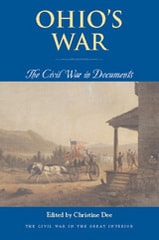
Ohio’s War
The Civil War in DocumentsChristine Dee
Ohio University Press, 2006
In 1860, Ohio was among the most influential states in the nation. As the third-most-populous state and the largest in the middle west, it embraced those elements that were in concert-but also at odds-in American society during the Civil War era. Ohio’s War uses documents from that vibrant and tumultuous time to reveal how Ohio’s soldiers and civilians experienced the Civil War. It examines Ohio’s role in the sectional crises of the 1850s, its contribution to the Union war effort, and the war’s impact on the state itself. In doing so, it provides insights into the war’s meaning for northern society.
Ohio’s War introduces some of those soldiers who left their farms, shops, and forges to fight for the Union. It documents the stories of Ohio’s women, who sustained households, organized relief efforts, and supported political candidates. It conveys the struggles and successes of free blacks and former slaves who claimed freedom in Ohio and the distinct wartime experiences of its immigrants. It also includes the voices of Ohioans who differed over emancipation, freedom of speech, the writ of habeas corpus, the draft, and the war’s legacy for American society.
From Ohio’s large cities to its farms and hamlets, as the documents in this volume show, the war changed minds and altered lives but left some beliefs and values untouched. Ohio’s War is a documentary history not only of the people of one state, but also of a region and a nation during the pivotal epoch of American history.
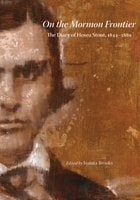
On the Mormon Frontier
The Diary of Hosea Stout, 1844-1889Juanita Brooks
University of Utah Press, 2009
This edition of On the Mormon Frontier presents Stout’s diary in a single volume, proving that it continues to be an essential work in the study of Mormon and American history.
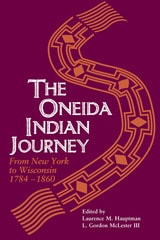
Oneida Indian Journey
From New York to Wisconsin, 1784–1860Edited by Laurence M. Hauptman and L. Gordon McLester III
University of Wisconsin Press, 1999
For the first time, the traumatic removal of the Oneida Indians from New York to Wisconsin is examined in a groundbreaking collection of essays, The Oneida Indian Journey from New York to Wisconsin, 1784–1860. To shed light on this vital period of Oneida history, editors Laurence Hauptman and L. Gordon McLester, III, present a unique collaboration between an American Indian nation and the academic community. Two professional historians, a geographer, anthropologist, archivist and attorney join in with eighteen voices from the Oneida community—local historians, folklorists, genealogists, linguists, and tribal elders—discuss tribal dispossession and community; Oneida community perspectives of Oneida history; and the means of studying Oneida history.
Contributors include: Debra Anderson, Eileen Antone, Jim Antone, Abrahms Archiquette, Oscar Archiquette, Jack Campisi, Richard Chrisjohn, Amelia Cornelius, Judy Cornelius, Katie Cornelius, Melissa Cornelius, Jonas Elm, James Folts, Reginald Horsman, Elizabeth Huff, Francis Jennings, Arlinda Locklear, Jo Margaret Mano, Loretta Metoxen, Liz Obomsawin, Jessie Peters, Sarah Summers, and Rachel Swamp
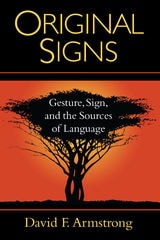
Original Signs
Gesture, Sign, and the Sources of LanguageDavid F. Armstrong
Gallaudet University Press, 2002
In the ongoing debate about evolution, scholars frequently argue either the perspective that humans stand as the end product of a deliberate process or that they derive from a series of random acts of natural selection. David F. Armstrong’s new book Original Signs embraces the Darwinian concept of natural selection and extends it to apply to the formation of language. While most current linguistic theory envisions language as a system for translating the contents of the mind into linear strings of arbitrary symbols, Armstrong asserts that this model does not characterize signed languages. He shows that language is inherently a multichannel activity, of which the two primary channels are auditory and visual.
Original Signs employs a more expansive notion of language that takes into account the full range of human communicative behavior. By making no strict separation between language and gesture, this thought-provoking work reveals that the use by deaf people of signs to create a fully formed language is also a natural facet of communication development for hearing people.
Armstrong explores the influences of Plato and Descartes on modern linguistics, and delineates the theories of earlier anthropological linguists Edward Sapir and Benjamin Lee Whorf, who thought of language as natural experiments connected to individual cultures. This exceptional work of scholarship methodically demonstrates that the intricacies of how languages develop, whether they depend upon words or signs, and that the complexity among languages that contact one another cannot be accounted for by the sequential hierarchical processes previously put forth by linguists and logicians. Original Signs will prove to be a fascinating, watershed work invaluable to linguists, anthropologists, and all other scholars and students engaged in the search for the origin of language.
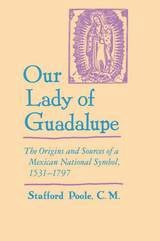
Our Lady of Guadalupe
The Origins and Sources of a Mexican National Symbol, 1531–1797Stafford Poole
University of Arizona Press, 1995
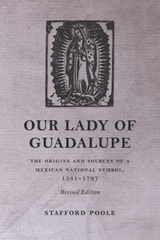
Our Lady of Guadalupe
The Origins and Sources of a Mexican National Symbol, 1531–1797Stafford Poole
University of Arizona Press, 2017