Results by title
260 books match the query 'Soviet Union' and 6 start with o
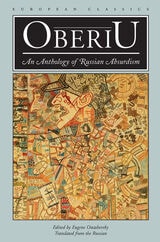
OBERIU
An Anthology of Russian AbsurdismEugene Ostashevsky
Northwestern University Press, 2006
Some called it the last of the Russian avant-garde, and others called it the first (and last) instance of Absurdism in Russia. Though difficulty to pigeon-hole, OBERIU and the pleasures of its poetry and prose are, with this volume, at long last fully open to English-speaking readers. Skillfully translated to preserve the weird charm of the originals, these poems and prose pieces display all the hilarity and tragedy, the illogical action and puppetlike violence and eroticism, and the hallucinatory intensity that brought down the wrath of the Soviet censors. Today they offer an uncanny reflection of the distorted reality they reject.

On Internal War
American and Soviet Approaches to Third World Clients and InsurgentsWilliam E. Odom
Duke University Press, 1992
On Internal War reviews the contrasting theory and practice in Soviet and American approaches to their competition in the Third World and relates them to indigenous causes of internal wars. Odom also integrates the military dimensions of insurgencies with external influences and internal politics. Drawing on political development theory, he underscores the sources of instability in Third World states that make insurgencies more likely and offers ways to assess the prospects for democracy in specific cases.
The centerpiece of the study is a practical application of the author’s analysis to three case studies—El Salvador, Guatemala, and the Philippines—and a regional assessment of the Middle East. Odom provides no panaceas but suggests that more promising strategies can be devised.

Only Among Women
Philosophies of Community in the Russian and Soviet Imagination, 1860–1940Anne Eakin Moss
Northwestern University Press, 2020

Open Skies
Eisenhower's Proposal of July 21, 1955By W.W. Rostow
University of Texas Press, 1982
In 1955 the United States and the Soviet Union were matching steps in a race to develop missiles tipped with thermonuclear weapons. American officials were frustrated and alarmed by their inability to learn the scale and progress of the Soviet program, which directly threatened the security of the United States, and they were convinced that serious arms control measures required reliable means for mutual inspection. The result: President Dwight D. Eisenhower's dramatic Open Skies proposal, advanced—and rejected—at the Geneva summit of 1955.
Vetoed by Nikita Khrushchev, Eisenhower's proposal to allow mutual aerial inspection between the United States and the U.S.S.R. was accepted as policy only after satellite photography became feasible. But at the time of the 1955 summit, it was a stunning, if transient, psychological and political victory for the United States and its president.
W. W. Rostow was an active participant in this important episode in American history, and his is the first authoritative account of how Eisenhower's Open Skies proposal came to be. His insider's knowledge, combined with data from hitherto unexploited documentary sources, vividly brings to life the discussions and events that preceded the president's proposal.
Rostow explores the diplomatic forces that led to Eisenhower's reluctant acceptance of a summit with the Soviets. He tracks the origins of the Open Skies concept to an obscure meeting organized at Quantico Marine Corps Base by presidential adviser Nelson Rockefeller. He describes the tensions between Rockefeller and Secretary of State John Foster Dulles that complicated Eisenhower's task in mounting the initiative for Open Skies and explains the differences between Eisenhower himself and Rockefeller over postsummit policy that provoked the latter's resignation. He examines Soviet motives and objectives at Geneva. Finally, Rostow reflects on the meaning of this fascinating episode in American history, in particular its importance to later arms control negotiations.
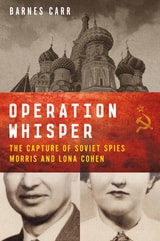
Operation Whisper
The Capture of Soviet Spies Morris and Lona CohenBarnes Carr
University Press of New England, 2016

Osiris, Volume 23
Intelligentsia Science: The Russian Century, 1860-1960Edited by Michael Gordin, Karl Hall, and Alexei Kojevnikov
University of Chicago Press, 2008
The contributors argue that it was the generation of the 1860s that transformed “intelligentsia” into a central notion of Russian popular discourse, cementing its association with revolutionary politics—and with science. Science became the cornerstone of the intelligentsia’s ideological and political projects, either as an alternative to socialism, or more often as its nominal raison d’être. The Russian century may in fact be over, but the interrelation of the intelligentsia and science to form “intelligentsia science” proves enduring.