389 books match the query 'State' and 5 start with o

cover of Ogoni Women's Activism: The Transnational Struggle for Justice against Big Oil and the State

Ogoni Women's Activism

The Transnational Struggle for Justice against Big Oil and the State

Domale Dube

University of Illinois Press, 2025

In 1995, Nigeria’s dictatorial government executed nine Ogoni leaders fighting for civil rights and against Shell Oil’s depredations of Ogoni land. Domale Dube draws on interviews and participant observation to tell the long-ignored story of how women carved out a role in the Ogoni pursuit of justice.

Dube’s account examines and documents the issues that drew women into the movement, from concerns for themselves and their communities to grander visions for the Ogoni. As she shows, these issues not only influenced organizing in Nigeria but also the diaspora in general and the United States in particular. Ogoni women relied upon nonviolent protest to realize their aims. Dube looks at their campaigns and how their actions reflected their concerns, values, interests, and priorities. The result is a rare account of Black women and transnational organizing for women’s, climate, and environmental justice that merges a history of their involvement with an in-depth analysis of the racial, gender, and ethnic dimensions of the Ogoni Struggle.
[more]
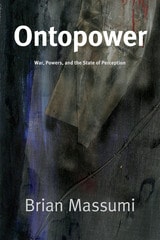
cover of Ontopower: War, Powers, and the State of Perception

Ontopower

War, Powers, and the State of Perception

Brian Massumi

Duke University Press, 2015
Color coded terror alerts, invasion, drone war, rampant surveillance: all manifestations of the type of new power Brian Massumi theorizes in Ontopower. Through an in-depth examination of the War on Terror and the culture of crisis, Massumi identifies the emergence of preemption, which he characterizes as the operative logic of our time. Security threats, regardless of the existence of credible intelligence, are now felt into reality. Whereas nations once waited for a clear and present danger to emerge before using force, a threat's felt reality now demands launching a preemptive strike. Power refocuses on what may emerge, as that potential presents itself to feeling. This affective logic of potential washes back from the war front to become the dominant mode of power on the home front as well. This is ontopower—the mode of power embodying the logic of preemption across the full spectrum of force, from the “hard” (military intervention) to the "soft" (surveillance). With Ontopower, Massumi provides an original theory of power that explains not only current practices of war but the culture of insecurity permeating our contemporary neoliberal condition.
 
[more]
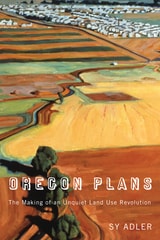
cover of Oregon Plans: The Making of an Unquiet Land Use Revolution

Oregon Plans

The Making of an Unquiet Land Use Revolution

Sy Adler

Oregon State University Press, 2012

Oregon Plans provides a rich, detailed, and nuanced analysis of the origins and early evolution of Oregon’s nationally renowned land use planning program.
 
Drawing primarily on archival sources, Sy Adler describes the passage of key state laws that set the program into motion by establishing the agency charged with implementing those laws, adopting the land-use planning goals that are the heart of the Oregon system, and monitoring and enforcing the implementation of those goals through a unique citizen organization.
 
Oregon Plans documents the consequential choices and compromises that were made in the 1970s to control growth and preserve Oregon's quality of life. Environmental activists, farmers, industry groups, local governments, and state officials all played significant roles. Adler brings these actors—among them governors Tom McCall and Robert Straub, business leaders John Gray and Glenn Jackson, 1000 Friends of Oregon, and the Oregon Home Builders Association—to life.

"Adler's story is about unusual conditions, purposeful action, dynamic personalities, and the messiness of democratic and bureaucratic processes. His conclusions reveal much about how Oregonians defined liveability in the late twentieth century." —William L. Lang, from the Preface
 
A volume in the Culture and Environment in the West series. Series editor: William L. Lang
[more]
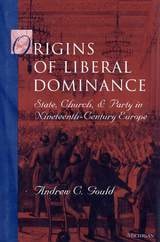
cover of Origins of Liberal Dominance: State, Church, and Party in Nineteenth-Century Europe

Origins of Liberal Dominance

State, Church, and Party in Nineteenth-Century Europe

Andrew C. Gould

University of Michigan Press, 1999
How did liberal movements reshape the modern world? Origins of Liberal Dominance offers a revealing account of how states, churches, and parties joined together in France, Belgium, Switzerland, and Germany to produce fundamentally new forms of organization that have shaped contemporary politics.
Modern political life emerged when liberal movements sought to establish elections, constitutions, free markets, and religious liberty. Yet liberalism even at its height faced strong and often successful opposition from conservatives. What explains why liberals overcame their opponents in some countries but not in others? This book compares successful and unsuccessful attempts to build liberal political parties and establish liberal regimes in France, Belgium, Switzerland, and Germany from 1815 to World War I.
Andrew Gould argues that relations between states and churches set powerful conditions on any attempt at liberalization. Liberal movements that enhanced religious authority while reforming the state won clerical support and successfully built liberal institutions of government. Furthermore, liberal movements that organized peasant backing around religious issues founded or sustained mass movements to support liberal regimes.
Origins of Liberal Dominance offers striking new insights into the emergence of modern states and regimes. It will be of interest to political scientists, sociologists, comparative historians, and those interested in comparative politics, regime change and state-building, democratization, religion and politics, and European politics.
Andrew C. Gould is Assistant Professor of Government and Kellogg Institute Fellow, University of Notre Dame.
[more]
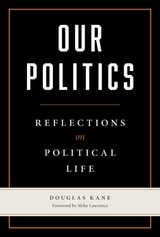
cover of Our Politics: Reflections on Political Life

Our Politics

Reflections on Political Life

Douglas Kane, with a foreword by Mike Lawrence

Southern Illinois University Press, 2019

Douglas Kane, an American politician and economist, offers readers a straightforward, personal account of what it is like to run for and hold public office—the demands, conflicts, temptations, and rewards created by political, economic, and social forces. Throughout the book, Kane references Illinois and Wisconsin politics. The campaigns of his wife, Kathleen Vinehout, and her years in the Wisconsin senate show that the centralization of political power, the structure of campaign organizations, and the policy decisions that Kane experienced as an Illinois legislator are not unique to any one state.
 
In Our Politics Kane reflects on his nearly fifty years of active engagement in state and local politics. In a series of essays, he seeks to understand the forces, motivations, incentives and technologies that shape our politics and produce the consequences that we live with every day.  He describes how candidates and officeholders deal with the fundamental contradictions inherent in the democratic process, and how and why the political power structure has changed. He also explores the personal experience of being a legislator, from deciding how to vote to building relationships with party leaders, fellow legislators, the governor, and the voters in the district. Kane concludes by considering the possibility of change, how it might happen, and the steps that candidates, political parties, activists and others might take to better our politics with results more to our liking.
 
While many journalists record politics from the outside, and numerous political memoirs focus on personalities and what happened to whom and when, this book gives an insider’s view of politics at the level of state government. This book is not about those politicians but about our politics, which together we have created and together we must deal with.
[more]