Results by title
244 books match the query 'Study' and 6 start with o

On Manly Courage
A Study of Plato's LachesWalter T. Schmid. Foreword by George Kimball Plochmann
Southern Illinois University Press, 1992
Walter T. Schmid offers the first original interpretation of the Laches since Hermann Bonitz in the nineteenth century in the only full-length commentary on the Laches available in English.
Schmid divides the book into five main discussions: the historical background of the dialogue; the relation of form and content in a Platonic dialogue and specific structural and aesthetic features of the Laches; the first half of the dialogue, which introduces the characters and considers the theme of the education of young men; the inquiry with Laches, which examines the traditional Greek conception of military courage; and the inquiry with Nicias in which two nontraditional conceptions of courage are mooted, one closely associated with the sophistic movement in Athens, the other with Socrates himself. Furnishing a detailed paragraph-by-paragraph reading that traces Socrates’ ongoing quest for virtue and wisdom—a wisdom founded in the action of a whole human life—Schmid conclusively shows how and why the Laches fills an important niche in Plato’s moral theory.

Only in Arkansas
A Study of the Endemic Plants and Animals of the StateHenry Robison
University of Arkansas Press, 1995

Our Primary Expertise
A Future for the Study of ReligionRussell T. McCutcheon
Rutgers University Press, 2026
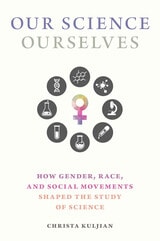
Our Science, Ourselves
How Gender, Race, and Social Movements Shaped the Study of ScienceChrista Kuljian
University of Massachusetts Press, 2024
When Christa Kuljian arrived on the Harvard College campus as a first-year student in the fall of 1980 with copies of Our Bodies, Ourselves and Ms. magazine, she was concerned that the women’s movement had peaked in the previous decade. She soon learned, however, that there was a long way to go in terms of achieving equality for women and that social movements would continue to be a critical force in society. She began researching the history of science and gender biases in science, and how they intersect with race, class, and sexuality.
In Our Science, Ourselves, Kuljian tells the origin story of feminist science studies by focusing on the life histories of six key figures—Ruth Hubbard, Rita Arditti, Evelyn Fox Keller, Evelynn Hammonds, Anne Fausto-Sterling, and Banu Subramaniam. These women were part of a trailblazing network of female scientists in the 1970s, 80s, and 90s who were drawn to the Boston area—to Harvard, MIT, and other universities—to study science, to network with other scientists, or to take a job. Inspired by the social and political activism of the women’s movement and organizations such as Science for the People, the Genes and Gender Collective, and the Combahee River Collective, they began to write and teach about women in science, gender and science, and sexist and racist bias and exclusion. They would lead the critiques of E. O. Wilson’s sociobiology in 1975 and Larry Summers’ comments about women in science thirty years later. The book also explores how these contributions differed from those of Nancy Hopkins’, author of the 1999 MIT report on women in science, and a “reluctant feminist.”
Drawing on a rich array of sources that combines published journal articles and books with archival materials and interviews with major luminaries of feminist science studies, Kuljian chronicles and celebrates the contributions that these women have made to our collective scientific knowledge and view of the world.

Out of One, Many Africas
Reconstructing the Study and Meaning of AfricaEdited by William G. Martin and Michael O. West
University of Illinois Press, 1999
By surveying the present predicament and the current grassroots impulse toward reconsidering the meaning of the continent, Out of One, Many Africas gives shape and momentum to a crucial dialogue aimed at transforming the study of Africa

Ozark Vernacular Houses
A Study of Rural Homeplaces in the Arkansas Ozarks, 1830-1930Jean Sizemore
University of Arkansas Press, 1991