Results by title
250 books match the query 'Subjects' and 3 start with o
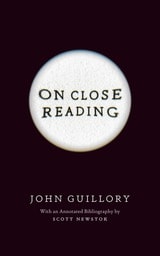
On Close Reading
John Guillory
University of Chicago Press, 2025
At a time of debate about the future of “English” as a discipline and the fundamental methods of literary study, few terms appear more frequently than “close reading,” now widely regarded as the core practice of literary study. But what exactly is close reading, and where did it come from? Here John Guillory, author of the acclaimed Professing Criticism, takes up two puzzles. First, why did the New Critics—who supposedly made close reading central to literary study—so seldom use the term? And second, why have scholars not been better able to define close reading?
For Guillory, these puzzles are intertwined. The literary critics of the interwar period, he argues, weren’t aiming to devise a method of reading at all. These critics were most urgently concerned with establishing the judgment of literature on more rigorous grounds than previously obtained in criticism. Guillory understands close reading as a technique, a particular kind of methodical procedure that can be described but not prescribed, and that is transmitted largely by demonstration and imitation.
Guillory’s short book will be essential reading for all college teachers of literature. An annotated bibliography, curated by Scott Newstok, provides a guide to key documents in the history of close reading along with valuable suggestions for further research.
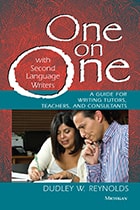
One on One with Second Language Writers
A Guide for Writing Tutors, Teachers, and ConsultantsDudley W. Reynolds
University of Michigan Press, 2009
One-on-one encounters with writers often contribute more to the development of student writing abilities than any classroom activity because they are personalized and responsive to individual needs. For the encounters to be successful, the writing tutor, teacher, or consultant must be prepared, must be knowledgeable of what it means to write and the factors that make writing more and less effective, and must also know the students.
This guide focuses on what those who conference with second language writers need to know to respond best to students, recognize their needs, and steer conversations in productive directions. One on One with Second Language Writers provides tips about activities that can be adapted to individual contexts, student writing samples that can be analyzed for practice, a glossary, a list of useful resources, and a checklist for conferencing sessions.
The book is appropriate for use in university and secondary school writing or learning centers, teacher training programs for both general composition and ESOL instructors, and as an individual reference tool. The book uses non-technical language where possible, but terminology is introduced where it might be useful when conferencing with students.
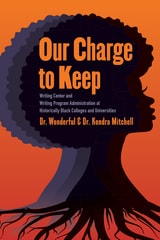
Our Charge to Keep
Writing Center and Writing Program Administration at Historically Black Colleges and UniversitiesWonderful Faison
Utah State University Press, 2026
The first book to explore writing center (WC) and writing program (WP) administration in HBCUs, Our Charge to Keep nuances ideas of ethical tutoring, explores Black college students’ beliefs about using Black Language in academic writing, provides new theories about tutoring, and gives insights into infrastructure and challenges facing WC and WP administrators in HBCU settings.
Many writing center directors have taken up the challenge to interrogate the impact of systemic racism on writing center theory, research, pedagogy, praxes, and daily operations, but the focus has largely been on predominantly white institutions (PWIs). As a result, writing center theory and research has unintentionally excluded the practices of everyday HBCU writing centers—their pedagogies, praxes, theories, and research. This edited volume rectifies this marginality by centering the epistemologies, practices, and wisdom of HBCU writing administrators, theorists, and practitioners. Chapters examine antiracist pedagogy, first-year writing challenges, the role of the larger HBCU community, and more.
Our Charge to Keep is a collection of writings that ultimately demystifies the administration of HBCU writing centers and inspires critical curiosity about them. Dr. Wonderful and Kendra Mitchell frame and showcase the resilience of HBCU writing center directors in combating the residual impact of systemic oppression and point the way forward for PWIs to shift toward new HBCU-centered perspectives on how to institute true antiracist policies and initiatives.