Results by title
461 books match the query 'Teaching' and 7 start with o
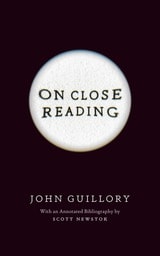
On Close Reading
John Guillory
University of Chicago Press, 2025
At a time of debate about the future of “English” as a discipline and the fundamental methods of literary study, few terms appear more frequently than “close reading,” now widely regarded as the core practice of literary study. But what exactly is close reading, and where did it come from? Here John Guillory, author of the acclaimed Professing Criticism, takes up two puzzles. First, why did the New Critics—who supposedly made close reading central to literary study—so seldom use the term? And second, why have scholars not been better able to define close reading?
For Guillory, these puzzles are intertwined. The literary critics of the interwar period, he argues, weren’t aiming to devise a method of reading at all. These critics were most urgently concerned with establishing the judgment of literature on more rigorous grounds than previously obtained in criticism. Guillory understands close reading as a technique, a particular kind of methodical procedure that can be described but not prescribed, and that is transmitted largely by demonstration and imitation.
Guillory’s short book will be essential reading for all college teachers of literature. An annotated bibliography, curated by Scott Newstok, provides a guide to key documents in the history of close reading along with valuable suggestions for further research.
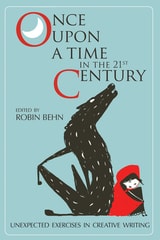
Once Upon a Time in the Twenty-First Century
Unexpected Exercises in Creative WritingEdited by Robin Behn
University of Alabama Press, 2020
Inspiring writers through creativity, experimentation, and unexpected discovery.
Once Upon a Time in the Twenty-First Century: Unexpected Exercises in Creative Writing is a unique creative writing text that will appeal to a wide range of readers and writers—from grade nine through college and beyond. Successful creative writers from numerous genres constructed these exercises, including poetry, fiction, and creative nonfiction to one-act plays, song lyrics, genre fiction, travel guides, comics and beyond. The exercises use a broad range of creative approaches, aesthetics, and voices, all with an emphasis on demystifying the writing process and having fun.
Editor Robin Behn has divided the book into three writing sections: Genres and Forms, Sources and Methods, and Style and Subject. In each section, Behn offers a brief introduction which explains how to get started and specific ways to develop one’s writing. Each introduction is followed by extensive exercises that draw on literature from classic to contemporary, as well as other art forms and popular culture. Examples range from Flannery O’Connor and Langston Hughes to Allen Ginsberg and Gertrude Stein, from Jamaica Kincaid and James Joyce to Arlo Guthrie and Harryette Mullen. Integrated within the exercises are apt examples of student writings that have emerged from actual use of the exercises in both the classroom and in writing groups. The book concludes with general advice and direction on how to get published.
Based on years of hands-on experiences in the teaching of creative writing in high schools, colleges, and after-school writing clubs, this volume of exercises offers inestimable value to students and teachers in the traditional classroom, as well as a growing number of homeschoolers, those who are part of a writing club or group, and independent writers and learners of all ages.
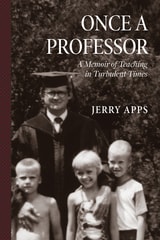
Once a Professor
A Memoir of Teaching in Turbulent TimesJerry Apps
Wisconsin Historical Society Press, 2018
“I never wanted to be a professor,” writes Jerry Apps in the introduction to Once a Professor. Yet a series of unexpected events and unplanned experiences put him on an unlikely path—and led to a thirty-eight-year career at the University of Wisconsin.
In this continuation of the Apps life story begun in his childhood memoir Limping through Life, Wisconsin’s celebrated rural storyteller shares stories from his years at the University of Wisconsin–Madison from 1957 to 1995, when he left the university to lecture and write fulltime. During those years Apps experienced the turmoil of protests and riots at the UW in the 1960s, the struggles of the tenure process and faculty governance, and the ever-present pressure to secure funding for academic research and programs.
Through it all, the award-winning writer honed a personal philosophy of education—one that values critical thinking, nontraditional teaching approaches, and hands-on experiences outside of the classroom. Colorful characters, personal photos, and journal entries from the era enrich this account of an unexpected campus career.
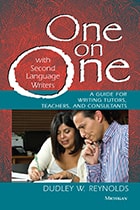
One on One with Second Language Writers
A Guide for Writing Tutors, Teachers, and ConsultantsDudley W. Reynolds
University of Michigan Press, 2009
One-on-one encounters with writers often contribute more to the development of student writing abilities than any classroom activity because they are personalized and responsive to individual needs. For the encounters to be successful, the writing tutor, teacher, or consultant must be prepared, must be knowledgeable of what it means to write and the factors that make writing more and less effective, and must also know the students.
This guide focuses on what those who conference with second language writers need to know to respond best to students, recognize their needs, and steer conversations in productive directions. One on One with Second Language Writers provides tips about activities that can be adapted to individual contexts, student writing samples that can be analyzed for practice, a glossary, a list of useful resources, and a checklist for conferencing sessions.
The book is appropriate for use in university and secondary school writing or learning centers, teacher training programs for both general composition and ESOL instructors, and as an individual reference tool. The book uses non-technical language where possible, but terminology is introduced where it might be useful when conferencing with students.
Open Your Hand
Teaching as a Jew, Teaching as an AmericanIlana M. Blumberg
Rutgers University Press, 2019
Our Body of Work
Embodied Administration and Teachingedited by Melissa Nicolas & Anna Sicari
Utah State University Press, 2022
Open exchanges enable complex and nuanced conversations about intersectionality and how racism, sexism, classism, and ableism (among other “isms”) create systems of power. Contributors examine how these conversations are framed around work, practices, policies, and research and identify ways to create inclusive, embodied practices in writing programs and classrooms. The collection is organized to maximize representation in the areas of race, gender, identity, ability, and class by featuring scholarly chapters followed by narratively focused interchapters that respond to and engage with the scholarly work.
The honest and emotionally powerful stories in Our Body of Work expose problematic and normalizing policies, practices, and procedures and offer diverse theories and methodologies that provide multiple paths for individuals to follow to make the academy more inclusive and welcoming for all bodies. It will be an important resource for researchers, as well a valuable addition to graduate and undergraduate syllabi on embodiment, writing instruction/pedagogy, and WPA work.
Contributors: Dena Arendall, Janel Atlas, Hayat Bedaiwi, Elizabeth Boquet, Lauren Brentnell, Triauna Carey, Denise Comer, Joshua Daniel, Michael Faris, Rebecca Gerdes-McClain, Morgan Gross, Nabila Hijazi, Jacquelyn Hoermann-Elliott, Maureen Johnson, Jasmine Kar Tang, Elitza Kotzeva, Michelle LaFrance, Jasmine Lee, Lynn C. Lewis, Mary Lourdes Silva, Rita Malenczyk, Anna Rita Napoleone, Julie Prebel, Rebecca Rodriguez Carey, Ryan Skinnell, Trixie Smith, Stacey Waite, Kelsey Walker, Shannon Walters, Isaac Wang, Jennie Young
Our Charge to Keep
Writing Center and Writing Program Administration at Historically Black Colleges and UniversitiesWonderful Faison
Utah State University Press, 2026
The first book to explore writing center (WC) and writing program (WP) administration in HBCUs, Our Charge to Keep nuances ideas of ethical tutoring, explores Black college students’ beliefs about using Black Language in academic writing, provides new theories about tutoring, and gives insights into infrastructure and challenges facing WC and WP administrators in HBCU settings.
Many writing center directors have taken up the challenge to interrogate the impact of systemic racism on writing center theory, research, pedagogy, praxes, and daily operations, but the focus has largely been on predominantly white institutions (PWIs). As a result, writing center theory and research has unintentionally excluded the practices of everyday HBCU writing centers—their pedagogies, praxes, theories, and research. This edited volume rectifies this marginality by centering the epistemologies, practices, and wisdom of HBCU writing administrators, theorists, and practitioners. Chapters examine antiracist pedagogy, first-year writing challenges, the role of the larger HBCU community, and more.
Our Charge to Keep is a collection of writings that ultimately demystifies the administration of HBCU writing centers and inspires critical curiosity about them. Dr. Wonderful and Kendra Mitchell frame and showcase the resilience of HBCU writing center directors in combating the residual impact of systemic oppression and point the way forward for PWIs to shift toward new HBCU-centered perspectives on how to institute true antiracist policies and initiatives.