Results by title
333 books match the query 'Television' and 8 start with o
On Living with Television
Amy Holdsworth
Duke University Press, 2021
On Story—The Golden Ages of Television
Edited by Maya Perez and Barbara Morgan; foreword by Noah Hawley
University of Texas Press, 2018
“On Story is film school in a box, a lifetime’s worth of filmmaking knowledge squeezed into half-hour packages.”
—Kenneth Turan, film critic for the Los Angeles Times
Austin Film Festival (AFF) is the first organization to focus on writers’ creative contributions to film and television. Its annual Film Festival and Conference offers screenings, panels, workshops, and roundtable discussions that help new writers and filmmakers connect with mentors and gain advice and insight from masters, as well as reinvigorate veterans with new ideas. To extend the Festival’s reach, AFF produces On Story, a television series currently airing on PBS-affiliated stations and streaming online that presents high-caliber artists talking candidly and provocatively about the art and craft of screenwriting and filmmaking, often using examples from their own work.
On Story—The Golden Ages of Television explores the transformation of television’s narrative content over the past several decades through interviews with some of TV’s best creators and writers, including Garry Shandling (The Larry Sanders Show), Carl Reiner (The Dick Van Dyke Show), Issa Rae (Insecure), Vince Gilligan (Breaking Bad), Greg Daniels (The Office), Paula Pell (Saturday Night Live), Noah Hawley (Fargo), Liz Meriwether (New Girl), David Chase (The Sopranos), Alan Yang (Master of None), Marta Kauffman (Friends), Jenji Kohan (Orange Is the New Black), and many more. Their insights, behind-the-scenes looks at the creative process, production tales, responses to audiences’ reactions, and observations on how both TV narratives and the industry have changed make this book ideal for TV lovers, pop culture fans, students taking screenwriting courses, and filmmakers and writers seeking information and inspiration.

On Television
Stuart Hood and Thalia Tabary-Peterssen
Pluto Press, 1997
On Television and Journalism
Pierre Bourdieu
Pluto Press, 1998
On The Wire
Linda Williams
Duke University Press, 2014
One Night on TV Is Worth Weeks at the Paramount
Popular Music on Early TelevisionMurray Forman
Duke University Press, 2012
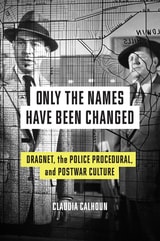
Only the Names Have Been Changed
Dragnet, the Police Procedural, and Postwar CultureClaudia Calhoun
University of Texas Press, 2022
Winner of the 2022 Peter C. Rollins Book Prize, Northeast Popular Culture Association (NEPCA)
In the postwar era, the police procedural series Dragnet informed Americans on the workings of the criminal justice system and instructed them in their responsibilities as citizens.
Among shifting politics, tastes, and technology in television history, one genre has been remarkably persistent: the cop show. Claudia Calhoun returns to Dragnet, the pioneering police procedural and an early transmedia franchise, appearing on radio in 1949, on TV and in film in the 1950s, and in later revivals. More than a popular entertainment, Dragnet was a signifier of America’s postwar confidence in government institutions—and a publicity vehicle for the Los Angeles Police Department.
Only the Names Have Been Changed shows how Dragnet’s “realistic” storytelling resonated across postwar culture. Calhoun traces Dragnet’s “semi-documentary” predecessors, and shows how Jack Webb, Dragnet’s creator, worked directly with the LAPD as he produced a series that would likewise inspire public trust by presenting day-to-day procedural justice, rather than shootouts and wild capers. Yet this realism also set aside the seething racial tensions of Los Angeles as it was. Dragnet emerges as a foundational text, one that taught audiences to see police as everyday heroes not only on TV but also in daily life, a lesson that has come under scrutiny as Americans increasingly seek to redefine the relationship between policing and public safety.
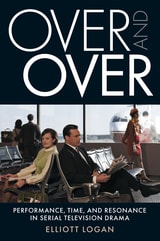
Over and Over
Performance, Time, and Resonance in Serial Television DramaElliott Logan
Rutgers University Press, 2026
How does serial drama earn, keep, and reward our attention for so long—over episodes, seasons, months, and years? While we know that characters are the focus of story and viewer interest in television fiction, scholars have for decades overlooked the way those characters are performed on-screen and the lure of performance as a key formal and thematic aspect of long-form television storytelling. In Over and Over, Elliott Logan offers close readings of performance in some of the most celebrated television dramas of the century, casting new light on the attractions and significance of the medium’s seriality. The book shows how the patterning and expressive resonance of performers on-screen binds together otherwise unconnected episodes of shows like The Sopranos and Mad Men. In doing so, it highlights the provisionality of identity and meaning as crucial to their interest in the sustenance of human relationships over long periods of time. In accounting for the resonance of performance over time in serial drama, this book shows, we find the terms of our own attachment to its compelling depictions of human life