Results by title
967 books match the query 'Theater' and 17 start with o
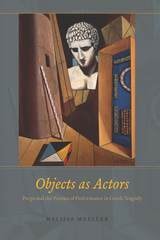
Objects as Actors
Props and the Poetics of Performance in Greek TragedyMelissa Mueller
University of Chicago Press, 2015
As Mueller shows, props such as weapons, textiles, and even letters were often fully integrated into a play’s action. They could provoke surprising plot turns, elicit bold viewer reactions, and provide some of tragedy’s most thrilling moments. Whether the sword of Sophocles’s Ajax, the tapestry in Aeschylus’s Agamemnon, or the tablet of Euripides’s Hippolytus, props demanded attention as a means of uniting—or disrupting—time, space, and genre.
Insightful and original, Objects as Actors offers a fresh perspective on the central tragic texts—and encourages us to rethink ancient theater as a whole.
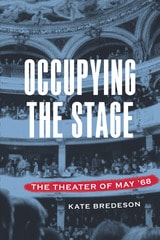
Occupying the Stage
The Theater of May '68Kate Bredeson
Northwestern University Press, 2018
The book shows how French theater artists during this period used a strategy of occupation-occupying buildings, streets, language, words, traditions, and artistic processes-as their central tactic of protest and transformation. It further proposes that the Theater of May '68 has left imprints on contemporary artists and activists, and that this theater offers a scaffolding on which to build a meaningful analysis of contemporary protest and performance in France, North America, and beyond.
At the book's heart is an inquiry into how artists of the period used theater as a way to engage in political work and, concurrently, questioned and overhauled traditional theater practices so their art would better reflect the way they wanted the world to be. Occupying the Stage embraces the utopic vision of May '68 while probing the period's many contradictions. It thus affirms the vital role theater can play in the ongoing work of social change.
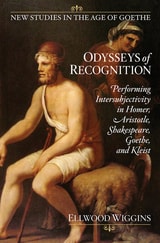
Odysseys of Recognition
Performing Intersubjectivity in Homer, Aristotle, Shakespeare, Goethe, and KleistWiggins, Ellwood
Bucknell University Press, 2019
Published by Bucknell University Press. Distributed worldwide by Rutgers University Press.
Of Borders And Thresholds
Theatre History, Practice, and TheoryMichal Andrzej Kobialka
University of Minnesota Press, 1999

Off Book
Devised Performance and Higher EducationEdited by Heather Fitzsimmons Frey, Nicola Hyland, and James McKinnon
Intellect Books, 2022
In the theater industry, “off book” refers to the date by which performers are to have memorized their lines and will no longer carry their play script—the “book”—on stage. But for the authors of this volume, the question is not when the book needs to be memorized, but why is there a need to be “on” book in the first place? Practitioners of devised performance choose to compose live performances from scratch rather than follow instructions in someone else’s script; educators of devised performance prefer to practice learning, too, as a generative and creative process that can never be confused with mere memorization. In its usual context, “off book” implies that theater is (literally) authorized by the book—the dramatic text—that represents its essential core or contains its meaning. Yet the “book” is not essential, and the chapters here highlight higher education theater practices that throw away the “book” altogether, creating space for actors and learners to do more than memorize. The conventional rules and hierarchies of theater creation, research, training, and education are not always relevant, or desirable, in these contexts. Instead, the questions and practices that go beyond the “book” matter.
Lively and engaging, Off Book will be a valuable and unique resource for university students, drama educators, theater historians, and practicing devised theater artists.
Off Sites
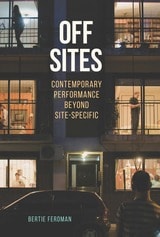
Contemporary Performance beyond Site-SpecificBertie Ferdman
Southern Illinois University Press, 2018
Contextualizing the techniques and methods of the incredibly rich and vital genre of site-specific performance, author Bertie Ferdman traces the evolution of that term. Originally used for experimental staging practices and then later also for engaged situational events, site-specific is no longer sufficient for the genre’s many contemporary variations.
Using the term off-site, Ferdman illustrates five distinct ways artists have challenged the disciplinary framework of site-specific theatre: blurring the traditional boundaries between the fictional and the real; changing how the audience and actor interact with each other and whether they are physically together or apart; fabricating sites from physically bound, conceptually constructed, or virtual spaces; staging live situations in real/nonreal and often mediated encounters; and challenging our preconceived notions of time and space. Tracing the genealogy of site-based work through the twentieth and twenty-first centuries, Ferdman outlines the theoretical groundwork for her study in the introduction. Individual chapters focus on distinct types of off-sites—the interdisciplinary discourse of disciplinary sites; the spaces of audience engagement with spectator sites; the dislocation of time for temporal sites; and the historiographical spaces of mapping for urban sites.
Ferdman examines site-based work being done in the Americas by contemporary companies and artists experimenting with new forms and practices for site-driven theatre. Key productions discussed include Private Moment by David Levine, Geyser Land by Mary Ellen Strom and Ann Carlson, Jim Findlay’s Dream of the Red Chamber, and Lola Arias’ Mi Vida Después.
On Broadway
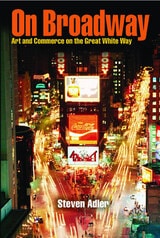
Art and Commerce on the Great White WaySteven Adler
Southern Illinois University Press, 2004
At a critical, transitional moment in the history of Broadway—and, by extension, of American theatre itself—former Broadway stage manager Steven Adlerenlists insider perspectives from sixty-six practitioners and artists to chronicle the recent past and glimpse the near future of the Great White Way. From marquee names to behind-the-scenes power brokers, Adler has assembled a distinctly knowledgeable cast of theatre’s elite, including Stephen Sondheim, Arthur Laurents, Des McAnuff, Frank Rich, Robin Wagner, Rocco Landesman, Robert Longbottom, Todd Haimes, Bernard Gersten, and Alan Eisenberg.
On Broadway: Art and Commerce on the Great White Way spotlights the differing vantage points of performers, artists, writers, managers, producers, critics, lawyers, theatre owners, union leaders, city planners, and other influential players. Each details his or her firsthand account of the creative and economic forces that have wrought extraordinary changes in the way Broadway theatre is conceived, produced, marketed, and executed. Once the paramount site of American theatre, Broadway today is becoming a tourist-driven, family-friendly, middle-class entertainment oasis in Midtown, an enterprise inextricably bound to the larger mosaic of national and international professional theatre.
Accounting for this transformation and presaging Broadway’s identity for the twenty-first century, Adler and his interviewees assess the impact of the advent of corporate producers, the ascendance of not-for-profit theatres on Broadway, and the growing interdependence between regional and Broadway productions. Also critiqued are the important roles of the radical urban redevelopment staged in Times Square and the changing demographics and appetites of contemporary theatre audiences in New York and around the globe.
Actors and administrators, performers and producers, theatre students and theatregoers will all benefit from the perceptive insights in this authoritative account of theatre making for the new millennium.
Open Wounds
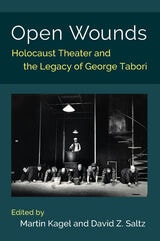
Holocaust Theater and the Legacy of George TaboriEdited by Martin Kagel and David Z. Saltz
University of Michigan Press, 2022
This volume collects original essays on Hungarian-German playwright and screenwriter George Tabori (1914–2007) and his remarkable contributions to the stage. Tabori, a Jewish refugee and a truly transnational author, was best known for his work in New York theater that irreverently explored the Jewish experience, particularly the Holocaust. Although his illustrious career spanned a century, two continents, several languages, and a variety of literary genres, Tabori’s work has received scant attention in American letters, in spite of its significance for U.S. theater and Holocaust studies.
Until Tabori, most dramas about the Holocaust were either rooted in American domestic realism, striving to create a strong empathetic connection between the audience and Holocaust victims, or featured an unembellished documentary style. Tabori staked out a third position, beyond realism and documentation. The volume brings together the voices of international scholars to provide a comprehensive introduction to Tabori’s theater as well as in-depth analyses of his work, discussing all of his major plays. Individual essays address Tabori’s postdramatic theater in relation to sacrificial ritual, performance studies, and post-humanist approaches to the contemporary stage, as well as performance aspects of his productions, questions of ethics and aesthetics raised by his theater, and his plays’ relation to Holocaust representation in popular culture.
Opera Production II
A HandbookQuaintance Eaton
University of Minnesota Press, 1974
Opera Production II was first published in 1974. Minnesota Archive Editions uses digital technology to make long-unavailable books once again accessible, and are published unaltered from the original University of Minnesota Press editions.
For the world of opera this is an indispensable basic reference work which provides essential information about more than 350 operas. Producers, singers, directors, students, orchestras, and audiences will find useful, concise information in this handbook, a sequel to the author's earlier book Opera Production I: A Handbook, which contains similar information about more than 500 other operas. While the first volume concentrates on more familiar operas, this book is devoted principally to lesser known works, both old and new, including many as yet unperformed contemporary operas.
The details given about each opera are those needed to assess the production requirements for a given work: the number and importance of settings; size of orchestra, chorus, and ballet; number of singers, their relative importance and individual requirements; vocal and acting demands of performers, including vocal ranges in most cases; plot synopsis; and brief historical material to anchor the reader in the necessary knowledge of the period and source of the libretto. The information is compressed into capsule form so that anyone using the book can tell at a glance the suitability of a work to the particular facilities, talents, or tastes of an opera company or its public.
In addition to the reference material, there is a chapter "Production Problems in Handel's Opera" by Randolph Mickelson, a helpful feature since nine of Handel's operas are included and they are apt to pose special production problems.

Opera Production
A HandbookQuaintance Eaton
University of Minnesota Press, 1961
Opera Production was first published in 1961. Minnesota Archive Editions uses digital technology to make long-unavailable books once again accessible, and are published unaltered from the original University of Minnesota Press editions.
Designed particularly as a reference work for opera producers, students, performers, and writers, this book provides basic production information about more than 500 operas. Anyone planning to produce an opera will find here the essential information he needs in order to judge whether a given opera is appropriate to his resources for production.
Information for individual operas is given concerning the number and importance of settings; size of orchestra, chorus, and ballet; number of singers, their relative importance and individual requirements; sources for obtaining musical materials' previous performances in America; and the opera story, its period, and composer.
Extensive information about 150 full-length operas and 109 short operas is provided, with supplementary information about more than 260 other operas. The operas are alphabetized by title for easy reference. In order to condense the information as much as possible, codes and abbreviations are used, with keys and indexes at the back of the book.
This book will be invaluable to those working in either amateur or professional companies, in opera workshops, in school, college, or civic opera groups. Those whose interest in opera is confined to the other side of the footlights will find the book absorbing, too, just as a glimpse backstage would be.
Opera Scenes for Class and Stage
Mary Elaine Wallace and Robert Wallace
Southern Illinois University Press, 1979
Musically sound and fully annotated, this new reference work provides ready access to over 700 excerpts from 100 operas, by voice categories, and thus provides information on a wide variety of matters of interest to directors, teachers, and singers. A table of voice categories, coded excerpts (including length and reference to accessible scores), character descriptions (including estimations of degrees of difficulty of the music), summaries of the action of each excerpt, and indexes to titles, composers, and well-known arias and ensembles make this book an indispensable tool.
Othello and Interpretive Traditions
Edward Pechter
University of Iowa Press, 1999
Our Land is Made of Courage and Glory
Nationalist Performance of Nicaragua and GuatemelaE. J. Westlake
Southern Illinois University Press, 2005
Our Land Is Made of Courage and Glory: Nationalist Performance of Nicaragua and Guatemala adds to a growing and timely body of work on nationalist drama. Examining important twentieth-century plays that few people have written about in English, E. J. Westlake analyzes the phenomenon of nation as performance by focusing on the definition of a people, national metaphors, and the uses of national history.
Westlake discerns the common characteristics that constitute nationalist plays, a genre that seeks to legitimate the nature of a nation by defining its boundaries, race, language, citizens, and history. Particularly relevant in an era influenced by imperialism, migration, and globalization, the volume probes the concepts of nation and nationalism in the context of postcolonial literary and performance theory.
Our Land Is Made of Courage and Glory covers the political and theatrical history of Nicaragua and Guatemala. Westlake examines how the blending of races factors into nationalism with a look at the play El tren amarillo by Manuel Galich and uses Nobel laureate Miguel Ángel Asturias’s Soluna to show how nationalists appropriate Mayan culture to create a sense of the Guatemalan people and culture. She discusses the mapping of history as a linear progression in Alan Bolt’s Banana republic and as a cycle of patricide in Por los caminos van los campesinos by Pablo Cuadra. Westlake also suggests that Rolando Steiner’s La noche de Wiwilí, a play taken from an eyewitness account, acts as a site of official national memory, and she examines as well the canonizing of the folk ballet El Güegüence to further explore the notion of sites of memory versus lived memory.
Raising essential questions about the future of nationalism and nationalist performance, Our Land Is Made of Courage and Glory will be of interest to scholars and students in drama, Latin American theatre studies, political science, and history.

Our Moonlight Revels
"A Midsummer Night's Dream" in the TheatreGary Jay Williams
University of Iowa Press, 1997
Many ingenious theatrical worlds have been created for the fairy world of A Midsummer Night's Dream, from the baroque to the postmodern. This is the quintessential play for understanding the ways in which scenery, costumes, music, lighting, and playing spaces affect our experience of Shakespeare. A Midsummer Night's Dream also proves to be extraordinarily responsive to the cultural winds of each era, easily circulating a variety of sometimes competing social interests.
In his richly detailed, beautifully illustrated history of Shakespeare's most popular play—the first comprehensive study of A Midsummer Night's Dream in the theatre—Gary Jay Williams covers four hundred years of landmark productions in Europe, the United States, and Canada as well as important opera, dance, and film adaptations. Williams shows how the visual and musical vocabularies of production can be read as cultural texts and how these meditative texts determine this play's available meanings from generation to generation. His account, then, is the story of our imaginative and astonishing uses of Shakespeare's play.
Many famous theatre artists have been drawn to this play, and many of their productions have been turning points in theatre history. Williams offers detailed theatrical and cultural analyses of the productions of David Garrick, Ludwig Tieck, Elizabeth Vestris, Charles Kean, Harley Granville-Barker, Sir Herbert Beerbohm Tree, Max Reinhardt, Peter Brook, Liviu Ciulei, and other artists. His engaging, intelligent study will be invaluable to scholars and teachers of Shakespeare and theatre history and to professional directors, designers, critics, and actors.
•The Wedding-play Myth and the Dream in Full Play•Shakespeare Absolute: Fairies, Gods, and Oranges in Purcell's Fairy Queen
•“Signor Shakespearelli”
•The Scenic Language of Empire
•These Antique Fables . . . These Fairy Toys”
•The National and Natural Dream
•The Dream of Modernism: The “New Hieroglyphic Language of Scenery” and the Theology of the Text
•The Dream of Modernism: The Sacred and the Secular
•Postmodernism: “The Fierce Vexation of a Dream”
Our Musicals, Ourselves
A Social History of the American Musical TheatreJohn Bush Jones
Brandeis University Press, 2004
Outside Theater
Alliances That Shape MexicoStuart A. Day
University of Arizona Press, 2017
Taking a cue from influential French philosopher Jacques Rancière, who in The Emancipated Spectator rejects the idea of the passive, ignorant, duped spectators in need of instruction to become active, Stuart A. Day’s goal in Outside Theater is to highlight written words and performances that exemplify effective strategies, past and present, to reveal and promote civic engagement, to provoke disruptions, or to highlight fissures—and opportunities—in oppressive social structures.
Through the study of one or two primary models per chapter, as well as multiple examples in the introduction and conclusion, Day presents Mexican plays from 1905 to 2015, including the 2010 Mexico City performance of Zoot Suit by Chicano playwright Luis Valdez. Using these plays, Day explores the concept of “outside theater,” where people or groups translate the tools of the theatrical trade to a different stage, outside the walls of the theater, and play the part of fictional or real life Celestinas—matchmakers who unite seemingly disparate entities to promote social awareness and social action by working the borders between life and art.
Each work in this innovative analysis reveals productive social connections that, with the help of crucial artistic alliances, contradict the perception that art is somehow secondary to or disconnected from the public sphere of influence and the struggles of everyday life. With this book, Day shows that Mexican theater can and does bolster civil society and thus the country’s fragile democracy.
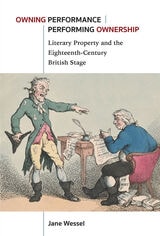
Owning Performance | Performing Ownership
Literary Property and the Eighteenth-Century British StageJane Wessel
University of Michigan Press, 2022
Owning Performance follows the careers of some of the 18th century’s most influential playwrights, actors, and theater managers as they vied for control over the period’s most popular shows. Without protection for dramatic literary property, these figures developed creative extra-legal strategies for controlling the performance of drama—quite literally performing their ownership. Their various strategies resulted in a culture of ephemerality, with many of the period’s most popular works existing only in performance and manuscript copies. Author Jane Wessel explores how playwrights and actors developed strategies for owning their works and how, in turn, theater managers appropriated these strategies, putting constant pressure on artists to innovate. Owning Performance reveals the wide-reaching effects of property law on theatrical culture, tracing a turn away from print that affected the circulation, preservation, and legacy of 18th century drama.