Results by title
493 books match the query 'Theory' and 15 start with o
Object Lessons
The Novel as a Theory of ReferenceJami Bartlett
University of Chicago Press, 2016
Of Borders And Thresholds
Theatre History, Practice, and TheoryMichal Andrzej Kobialka
University of Minnesota Press, 1999
On Location
Theory and Practice in Classroom-Based Writing Tutoringedited by Candace Spigelman & Laurie Grobman
Utah State University Press, 2005
Classroom-based writing tutoring is a distinct form of writing support, a hybrid instructional method that engages multiple voices and texts within the college classroom. Tutors work on location in the thick of writing instruction and writing activity.
On Location is the first volume to discuss this emerging practice in a methodical way. The essays in this collection integrate theory and practice to highlight the alliances and connections on-location tutoring offers while suggesting strategies for resolving its conflicts. Contributors examine classroom-based tutoring programs located in composition courses as well as in writing intensive courses across the disciplines.
On Music Theory, and Making Music More Welcoming for Everyone
Philip Ewell
University of Michigan Press, 2023
Winner of the 2024 Association of American Publishers PROSE Award for Music and Performing Arts
Since its inception in the mid-twentieth century, American music theory has been framed and taught almost exclusively by white men. As a result, whiteness and maleness are woven into the fabric of the field, and BIPOC music theorists face enormous hurdles due to their racial identities. In On Music Theory, Philip Ewell brings together autobiography, music theory and history, and theory and history of race in the United States to offer a black perspective on the state of music theory and to confront the field’s white supremacist roots. Over the course of the book, Ewell undertakes a textbook analysis to unpack the mythologies of whiteness and western-ness with respect to music theory, and gives, for the first time, his perspective on the controversy surrounding the publication of volume 12 of the Journal of Schenkerian Studies. He speaks directly about the antiblackness of music theory and the antisemitism of classical music writ large and concludes by offering suggestions about how we move forward. Taking an explicitly antiracist approach to music theory, with this book Ewell begins to create a space in which those who have been marginalized in music theory can thrive.

On Paradox
The Claims of TheoryElizabeth S. Anker
Duke University Press, 2022

On the Economic Theory of Socialism
Oskar Lange
University of Minnesota Press, 1938
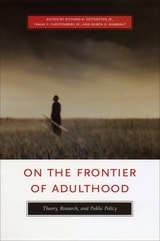
On the Frontier of Adulthood
Theory, Research, and Public PolicyEdited by Richard A. Settersten Jr., Frank F. Furstenberg, and Rubén G. Rumbaut
University of Chicago Press, 2005
This volume considers the nature and consequences of changes in early adulthood by drawing upon a wide variety of historical and contemporary data from the United States, Canada, and Western Europe. Especially dramatic shifts have occurred in the conventional markers of adulthood—leaving home, finishing school, getting a job, getting married, and having children—and in how these experiences are configured as a set. These accounts reveal how the process of becoming an adult has changed over the past century, the challenges faced by young people today, and what societies can do to smooth the transition to adulthood.
"This book is the most thorough, wide-reaching, and insightful analysis of the new life stage of early adulthood."—Andrew Cherlin, Johns Hopkins University
"From West to East, young people today enter adulthood in widely diverse ways that affect their life chances. This book provides a rich portrait of this journey-an essential font of knowledge for all who care about the younger generation."—Glen H. Elder Jr., University of North Carolina at Chapel Hill
"On the Frontier of Adulthood adds considerably to our knowledge about the transition from adolescence to adulthood. . . . It will indeed be the definitive resource for researchers for years to come. Anyone working in the area—whether in demography, sociology, economics, or developmental psychology—will wish to make use of what is gathered here."—John Modell, Brown University
"This is a must-read for scholars and policymakers who are concerned with the future of today's youth and will become a touchpoint for an emerging field of inquiry focused on adult transitions."—Jeanne Brooks-Gunn, Columbia University
On the Way to Theory
Lawrence Grossberg
Duke University Press, 2024
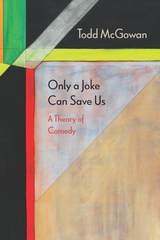
Only a Joke Can Save Us
A Theory of ComedyTodd McGowan
Northwestern University Press, 2017
Only a Joke Can Save Us presents an innovative and comprehensive theory of comedy. Using a wealth of examples from high and popular culture and with careful attention to the treatment of humor in philosophy, Todd McGowan locates the universal source of comedy in the interplay of the opposing concepts lack and excess.
After reviewing the treatment of comedy in the work of philosophers as varied as Aristotle, G. W. F. Hegel, Sigmund Freud, Henri Bergson, and Alenka Zupancic, McGowan, working in a psychoanalytic framework, demonstrates that comedy results from the deployment of lack and excess, whether in contrast, juxtaposition, or interplay.
Illustrating the power and flexibility of this framework with analyses of films ranging from Buster Keaton and Marx Brothers classics to Dr. Strangelove and Groundhog Day, McGowan shows how humor can reveal gaps in being and gaps in social order. Scholarly yet lively and readable, Only a Joke Can Save Us is a groundbreaking examination of the enigmatic yet endlessly fascinating experience of humor and comedy.

Open Marxism 2
Theory and PracticeWerner Bonefeld
Pluto Press, 1992
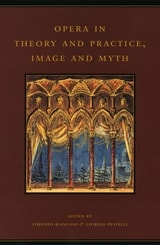
Opera in Theory and Practice, Image and Myth
Edited by Lorenzo Bianconi and Giorgio Pestelli
University of Chicago Press, 2003
This sixth volume in the series centers on the sociological and critical aspects of opera in Italy, considering the art in the context of an Italian literary and cultural canon rarely revealed in English and American studies. In its six chapters, contributors survey critics' changing attitudes toward opera over several centuries, trace the evolution of formal conventions among librettists, explore the historical relationships between opera and Italian literature, and examine opera's place in Italian popular and national culture. In perhaps the volume's most striking contribution, German scholar Carl Dahlouse offers his most important statement on the dramaturgy of opera.
Oratorical Culture in Nineteenth-Century America
Transformations in the Theory and Practice of RhetoricGregory Clark and S. Michael Halloran
Southern Illinois University Press, 1993
Gregory Clark and S. Michael Halloran bring together nine essays that explore change in both the theory and the practice of rhetoric in the nineteenth-century United States.
In their introductory essay, Clark and Halloran argue that at the beginning of the nineteenth century, rhetoric encompassed a neoclassical oratorical culture in which speakers articulated common values to establish consensual moral authority that directed community thought and action. As the century progressed, however, moral authority shifted from the civic realm to the professional, thus expanding participation in the community as it fragmented the community itself. Clark and Halloran argue that this shift was a transformation in which rhetoric was reconceived to meet changing cultural needs.
Part I examines the theories and practices of rhetoric that dominated at the beginning of the century. The essays in this section include "Edward Everett and Neoclassical Oratory in Genteel America" by Ronald F. Reid, "The Oratorical Poetic of Timothy Dwight" by Gregory Clark, "The Sermon as Public Discourse: Austin Phelps and the Conservative Homiletic Tradition in Nineteenth-Century America" by Russel Hirst, and "A Rhetoric of Citizenship in Nineteenth-Century America" by P. Joy Rouse.
Part 2 examines rhetorical changes in the culture that developed during that century. The essays include "The Popularization of Nineteenth-Century Rhetoric: Elocution and the Private Learner" by Nan Johnson, "Rhetorical Power in the Victorian Parlor: Godey’s Lady’s Book and the Gendering of Nineteenth-Century Rhetoric" by Nicole Tonkovich, "Jane Addams and the Social Rhetoric of Democracy" by Catherine Peaden, "The Divergence of Purpose and Practice on the Chatauqua: Keith Vawter’s Self-Defense" by Frederick J.Antczak and Edith Siemers, and "The Rhetoric of Picturesque Scenery: A Nineteenth-Century Epideictic" by S. Michael Halloran.
Ordinary Meaning
A Theory of the Most Fundamental Principle of Legal InterpretationBrian G. Slocum
University of Chicago Press, 2015
Legal interpretation is built around one key question: by what standard should legal texts be interpreted? The traditional doctrine is that words should be given their “ordinary meaning”: words in legal texts should be interpreted in light of accepted standards of communication. Yet often, courts fail to properly consider context, refer to unsuitable dictionary definitions, or otherwise misconceive how the ordinary meaning of words should be determined. In this book, Brian Slocum builds his argument for a new method of interpretation by asking glaring, yet largely ignored, questions. What makes one particular meaning the “ordinary” one, and how exactly do courts conceptualize the elements of ordinary meaning? Ordinary Meaning provides a much-needed, revised framework, boldly instructing those involved with the law in how the components of ordinary meaning should properly be identified and developed in our modern legal system.
Out in Theory
The Emergence of Lesbian and Gay AnthropologyEdited by Ellen Lewin and William L. Leap
University of Illinois Press, 2002
This compelling collection of essays details the scholarly and personal factors that affected the emergence of lesbian and gay anthropology and speculates on the directions it will take as it continues to grow and diversify. Seeking to legitimize the field's scholarship and address issues in terminology, the essays also define the lesbian and gay anthropology's scope and subject matter and locate factors that separate it from the wider concerns of the profession.
Specific essays track the emergence of lesbian and gay studies in social and cultural anthropology, linguistics, archaeology, and in various areas of anthropological activism. They also consider how feminist anthropology helped define the field and how transgendered experience, queer theory, and race and class studies are promoting new directions of inquiry within lesbian and gay anthropology.
Overhead Electric Power Lines
Theory and practiceSurajit Chattopadhyay
The Institution of Engineering and Technology, 2021