Results by title
66 books match the query 'Veterans' and 3 start with o
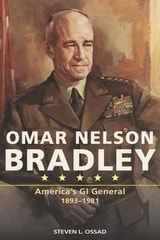
Omar Nelson Bradley
America's GI General, 1893-1981Steven L. Ossad
University of Missouri Press, 2017
When Omar Nelson Bradley began his military career more than a century ago, the army rode horses into combat and had less than 200,000 men. No one had heard of mustard gas. At the height of his career, Bradley (known as “Brad” and “The GI’s General”) led 1.23 million men as commander of 12 Army Group in the Western Front to bring an end to World War II.
Omar Nelson Bradley was the youngest and last of nine men to earn five-star rank and the only army officer so honored after World War II. This new biography by Steven L. Ossad gives an account of Bradley’s formative years, his decorated career, and his postwar life.
Bradley’s decisions shaped the five Northwest European Campaigns from the D-Day landings to VE Day. As the man who successfully led more Americans in battle than any other in our history, his long-term importance would seem assured. Yet his name is not discussed often in the classrooms of either civilian or military academies, either as a fount of tactical or operational lessons learned, or a source of inspiration for leadership exercised at Corps, Army, Group, Army Chief, or Joint Chiefs of Staff levels.
The Bradley image was tailor-made for the quintessential homespun American heroic ideal and was considered by many to be a simple, humble country boy who rose to the pinnacle of power through honesty, hard work, loyalty and virtuous behavior. Even though his classmates in both high school and at West Point made remarks about his looks, and Bradley was always self-conscious about smiling because of an accident involving his teeth, he went on to command 12 Army Group, the largest body of American fighting men under a single general.
Bradley’s postwar career as administrator of the original GI Bill and first Chairman of the Joint Chiefs of Staff during the Korean War ensures his legacy. These latter contributions, as much as Bradley’s demonstrable World War II leadership, shaped U.S. history and culture in decisive, dramatic, and previously unexamined ways.
Drawing on primary sources such as those at West Point, Army War College and Imperial War Museum, this book focuses on key decisions, often through the eyes of eyewitness and diarist, British liaison officer Major Thomas Bigland. The challenges our nation faces sound familiar to his problems: fighting ideologically-driven enemies across the globe, coordinating global strategy with allies, and providing care and benefits for our veterans.
[more]
Ordinary Lives
Platoon 1005 and the Vietnam WarW. Ehrhart
Temple University Press, 1999
In the summer of 1966, in the middle of the Vietnam War, eighty young volunteers arrived at the Marine Corps Recruit Depot on Parris Island, South Carolina, from all over the Eastern United States. For the next eight weeks, as Platoon 1005, they endured one of the most intense basic training programs ever devised. Parris Island was not a place for idle conversation or social gatherings, and these men remained from start to finish almost complete strangers. Ehrhart did get to know one Marine, his bunkmate John Harris, who quietly shared his sweetheart's letters. He was a friend who died in Vietnam only a year later.
Twenty-seven years after basic training. Ehrhart began what became a five-year search for the men of his platoon. Who were these men alongside whom he trained? Why had they joined the Marines at a time when being sent to war and of the country that sent them to fight it? What does the Corps mean to them? What Ehrhart learned offers an extraordinary window into the complexities of the Vietnam Generation and the United States of America then and now.
Based on supporting materials from military records and family members as well as interviews -- some of which Ehrhart held in such active secondary roles as dairy farmhand, fishing companion, and impromptu guest at a family wedding -- this book records the more-than-30-year journey that each man took after his boot-camp graduation on August 12, 1966. Photos of the men, both then and now, accompany the profiles. Their stories are diverse, but as Ehrhart says, "It was, in short, history, and each of these men was and is a part of that history....There are, no doubt, scoundrels and liars and losers among these men, but as a group they have mostly impressed me with their decency and their loyalty and their hard work and their perseverance in the face of hardships and hurdles, the everyday obstacles that make ordinary lives extraordinary."
[more]
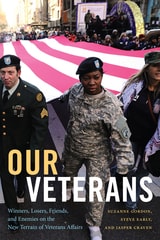
Our Veterans
Winners, Losers, Friends, and Enemies on the New Terrain of Veterans AffairsSuzane Gordon, Steve Early, and Jasper Craven
Duke University Press, 2022
In Our Veterans, Suzanne Gordon, Steve Early, and Jasper Craven explore the physical, emotional, social, economic, and psychological impact of military service and the problems that veterans face when they return to civilian life. The authors critically examine the role of advocacy organizations, philanthropies, corporations, and politicians who purport to be “pro-veteran.” They describe the ongoing debate about the cost, quality, and effectiveness of healthcare provided or outsourced by the Department of Veterans Affairs (VA). They also examine generational divisions and political tensions among veterans, as revealed in the tumultuous events of 2020, from Black Lives Matter protests to the Trump-Biden presidential contest. Frank and revealing, Our Veterans proposes a new agenda for veterans affairs linking service provision to veterans to the quest for broader social programs benefiting all Americans.
[more]