Results by title
186 books match the query 'Volume 2' and 4 start with o

Ocean Yearbook, Volume 2
Edited by Elisabeth Mann Borgese and Norton Ginsburg
University of Chicago Press, 1981
[more]
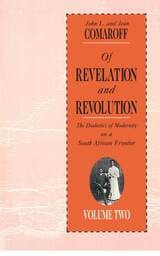
Of Revelation and Revolution, Volume 2
The Dialectics of Modernity on a South African FrontierJohn L. Comaroff and Jean Comaroff
University of Chicago Press, 1997
In the second of a proposed three-volume study, John and Jean Comaroff continue their exploration of colonial evangelism and modernity in South Africa. Moving beyond the opening moments of the encounter between the British Nonconformist missions and the Southern Tswana peoples, Of Revelation and Revolution, Volume II, explores the complex transactions—both epic and ordinary—among the various dramatis personae along this colonial frontier.
The Comaroffs trace many of the major themes of twentieth-century South African history back to these formative encounters. The relationship between the British evangelists and the Southern Tswana engendered complex exchanges of goods, signs, and cultural markers that shaped not only African existence but also bourgeois modernity "back home" in England. We see, in this volume, how the colonial attempt to "civilize" Africa set in motion a dialectical process that refashioned the everyday lives of all those drawn into its purview, creating hybrid cultural forms and potent global forces which persist in the postcolonial age.
This fascinating study shows how the initiatives of the colonial missions collided with local traditions, giving rise to new cultural practices, new patterns of production and consumption, new senses of style and beauty, and new forms of class distinction and ethnicity. As noted by reviewers of the first volume, the Comaroffs have succeeded in providing a model for the study of colonial encounters. By insisting on its dialectical nature, they demonstrate that colonialism can no longer be seen as a one-sided relationship between the conquering and the conquered. It is, rather, a complex system of reciprocal determinations, one whose legacy is very much with us today.
[more]
On Job, Volume 2
Franklin T. St. Albert the Great
Catholic University of America Press, 2025
Even prior to his death on 15 November 1280, the Dominican master Albert of Lauingen was legendary for his erudition. He was widely recognized for the depth and breadth of his learning in the philosophical disciplines as well as in the study of God, earning him the titles Doctor universalis and Doctor expertus. Moreover, his authoritative teaching merited him the moniker Magnus, an appellation bestowed on no other man of the High Middle Ages.
This volume contains the second half of Albert the Great’s commentary On Job (on chs. 22-42), translated into English for the first time; a translation of the first half of the work appeared in an earlier volume of the Fathers of the Church, Mediaeval Continuation series (vol. 19, 2019). Albert completed Super Iob in 1272 or 1274, when he was over seventy years old, at the Dominican Kloster of Heilige Kreuz in Cologne, where, as lector emeritus of the Order, he likely lectured on this profound biblical book. Significantly, Albert may have been inspired to produce On Job by his most famous student, Thomas Aquinas, who had written his own Joban commentary, the Expositio super Iob ad litteram, while serving as conventual lector at San Domenico in Orvieto from 1261 to 1264. Yet Albert occupies a unique position in the history of the interpretation of Job: he is the first and only exegete in history who explicitly reads the whole book as a debate in the mode of an academic or scholastic disputation among Job and his friends about divine providence concerning human affairs. Albert understands God, in the final chapters of Job, to determine the disputed question in favor of Job and against his friends, namely declaring that He (i.e., God) rules human life with no consideration of human works, but rather that divine governance is dissimilar to every mode of human rule.
[more]
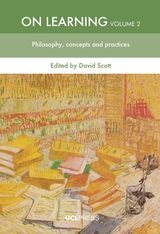
On Learning, Volume 2
Philosophies, Concepts and PracticesEdited by David Scott
University College London, 2024
An original and provocative interpretation of learning as a concept and as a practice.
The contributors to this volume focus on two meta-concepts: knowledge and learning, on the relationship between the two, and the way these can be framed in epistemic, social, political, and economic terms. Knowledge and learning, as meta-concepts, are positioned in various networks or constellations of meaning, principally: their antecedents, their relations to other relevant concepts, and the way the concepts are used in the lifeworld.
The various authors in this book explore several important concepts that are relevant to the idea of learning: Meta-concepts such as epistemology, inferential role semantics, phenomenology, rationality, thinking, hermeneutics, critical realism, and pragmatism. Meso-concepts such as probability, woman, training, assessment, education, system, race, friendship, Bildung, curriculum, ecology and pedagogy. Like David Scott’s first volume of On Learning, this collection also focuses on philosophy, concepts, and practices as a response to empiricist and positivist conceptions of knowledge. It challenges reductionist ideas of learning that have filtered through to the management of our schools, colleges, and universities; confronts over-simplified messages about learning, knowledge, curriculum, and assessment; and fosters the denial that values are central to understanding how we live and how we should live, the normative dimension to social policy and social theory.
[more]