Results by title
644 books match the query 'Wars & Conflicts' and 13 start with o
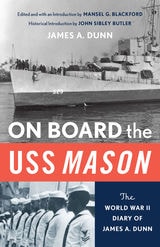
ON BOARD THE USS MASON
THE WORLD WAR II DIARY OF JAMES A. DUNNMANSEL G. BLACKFORD
The Ohio State University Press, 2016
Dunn kept a day-to-day diary during his spare time on board the Mason. Such diaries are a rarity, for the navy (and other armed services) forbade the keeping of diaries, fearful lest secret information fall into enemy hands. The diary chronicles the Mason’s wartime activities, from the first convoy to the final return to the United States. It captures the feeling and meaning of life on board with an immediacy not fully found in retrospective accounts. The diary accurately records the mortal danger Dunn and his shipmates were in while attacking enemy submarines or dealing with extreme weather conditions in the North Atlantic. It conveys the boredom the men encountered while confined on long, tedious convoys and the joy of shore leaves. Here is the daily life aboard ship—the duties and the pastimes that made shipboard life endurable.
Equally interesting, the diary reveals what it meant to be an African American in a white navy within a segregated American society, the shipboard tensions, and the shipboard cooperation and sense of unity. It also portrays the life of an African American onshore in the United States, Great Britain, and North Africa and the love story that unfolded between James and his wife, Jane.
Supplemented by additional sources, including interviews with Dunn, this diary is a personal view into an important part of American history. Like the Tuskegee airmen, the men of the USS Mason paved the way for desegregation in America’s armed forces, contributing to a civil rights movement that changed the face of a nation.
Of War and Men
World War II in the Lives of Fathers and Their FamiliesRalph LaRossa
University of Chicago Press, 2011
Fathers in the fifties tend to be portrayed as wise and genial pipe-smokers or distant, emotionless patriarchs. This common but limited stereotype obscures the remarkable diversity of their experiences and those of their children. To uncover the real story of fatherhood during this transformative era, Ralph LaRossa takes the long view—from the attack on Pearl Harbor up to the election of John F. Kennedy—revealing the myriad ways that World War II and its aftermath shaped men.
Offering compelling accounts of people both ordinary and extraordinary, Of War and Men digs deep into the terrain of fatherhood. LaRossa explores the nature and aftereffects of combat, the culture of fear during the Cold War, the ways that fear altered the lives of racial and sexual minorities, and how the civil rights movement affected families both black and white. Overturning some calcified myths, LaRossa also analyzes the impact of suburbanization on fathers and their kids, discovering that living in the suburbs often strengthened their bond. And finally, looking beyond the idealized dad enshrined in TV sitcoms, Of War and Men explores the brutal side of family life in the postwar years. LaRossa’s richly researched book dismantles stereotypes while offering up a fascinating and incisive chronicle of fatherhood in all its complexity.
On The Ho Chi Minh Trail
The Blood Road, The Women Who Defended It, The LegacySherry Buchanan
Asia Ink, 2020
Offering both a personal and historical exploration of the Ho Chi Minh Trail, this book highlights the critical role the Trail and the young women soldiers who helped build and defend it played in the Vietnam War. Accompanied by two traveling companions, Sherry Buchanan winds her way from Hanoi in the north to Ho Chi Minh City, formerly Saigon, in the south. Driving through the spectacular scenery of Vietnam and Laos, she encounters locations from the Truong Son mountains, the Phong Nha Caves, ancient citadels, and Confucian temples to the Khmer Temple of Wat Phu at the western-most point of the Trail in Laos.
Buchanan records her interactions—both scheduled and spontaneous—with those who experienced the Vietnam War firsthand. She listens to the women who defended the Trail roads against the greatest bombing campaign in modern times, walks through minefields with the demolition teams hunting for unexploded ordnance, and meets American veterans who have returned to Vietnam with an urge to “do something.” Buchanan weaves informative, and often humorous, tales from her journey with excerpts from the accounts of others, situating the locations she visits in their historical and political context. On the Ho Chi Minh Trail brings together geography, history, and personal accounts to reveal the scale of the tragedy, its harmful legacies, and our memory of it. Buchanan challenges American exceptionalism and calls for redress for those harmed by US military actions during the Vietnam War and America’s subsequent wars.
On War and Writing
Samuel Hynes
University of Chicago Press, 2018
Samuel Hynes knows war personally: he served as a Marine Corps pilot in the Pacific Theater during World War II, receiving the Distinguished Flying Cross. He has spent his life balancing two careers: pilot and professor of literature. Hynes has written a number of major works of literary criticism, as well as a war-memoir, Flights of Passage, and several books about the World Wars. His writing is sharp, lucid, and has provided some of the most expert, detailed, and empathetic accounts of a disappearing generation of fighters and writers.
On War and Writing offers for the first time a selection of Hynes’s essays and introductions that explore the traditions of war writing from the twentieth century to the present. Hynes takes as a given that war itself—the battlefield uproar of actual combat—is unimaginable for those who weren’t there, yet we have never been able to turn away from it. We want to know what war is really like: for a soldier on the Somme; a submariner in the Pacific; a bomber pilot over Germany; a tank commander in the Libyan desert. To learn, we turn again and again to the memories of those who were there, and to the imaginations of those who weren’t, but are poets, or filmmakers, or painters, who give us a sense of these experiences that we can’t possibly know.
The essays in this book range from the personal (Hynes’s experience working with documentary master Ken Burns, his recollections of his own days as a combat pilot) to the critical (explorations of the works of writers and artists such as Thomas Hardy, E. E. Cummings, and Cecil Day-Lewis). What we ultimately see in On War and Writing is not military history, not the plans of generals, but the feelings of war, as young men expressed them in journals and poems, and old men remembered them in later years—men like Samuel Hynes.
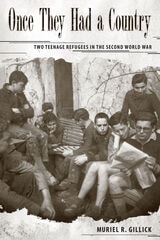
Once They Had a Country
Two Teenage Refugees in the Second World WarMuriel R. Gillick
University of Alabama Press, 2010
A powerful true story of survival, displacement, and hope in a world at war.
Muriel Gillick draws from a remarkable set of primary source materials, including letters, telegrams, and police records to relate the story of two teenage refugees during World War II. Once They Had a Country conveys well what it was like to establish a new life in a foreign country—over and over again and in constant fear for one’s life. The work tells of the extraordinary experiences of the author’s parents in Europe and demonstrates how citizens and the governments of Belgium, France, Switzerland, Brazil, America, China, and postwar Germany treated refugees. This story also reveals the origins of the Convention Relating to the Status of Refugees, the basis of contemporary international law affecting refugees in many countries today.
In addition to the dramatic human story it tells, this work brings the plight of refugees home to the reader—and with over 8 million refugees worldwide today, the subject of how individuals and nation states respond to these individuals is indeed timely.
One Sunny Day
A Child's Memories of HiroshimaHideko Tamura Snider
Oregon State University Press, 2023
Hideko was ten years old when the atomic bomb devastated her home in Hiroshima. In this eloquent and moving narrative, Hideko recalls her life before the bomb, the explosion itself, and the influence of that trauma upon her subsequent life in Japan and the United States. Her years in America have given her unusual insights into the relationship between Japanese and American cultures and the impact of Hiroshima on our lives.
This new edition includes two expanded chapters and revisions throughout. A new epilogue brings the story up to date. This poignant story of courage and resilience remains deeply relevant today, offering a profoundly personal testament against the ongoing threat of nuclear warfare.
One Woman in the War
Hungary 1944-1945Alaine Polcz
Central European University Press, 2002
Operation Homecoming
Iraq, Afghanistan, and the Home Front, in the Words of U.S. Troops and Their Families, Updated Editionedited by Andrew Carroll
University of Chicago Press, 2008
“One of the chanted mantras of our time is, ‘But I support the troops.’ Terrific. Now read Operation Homecoming to find out who they are, what they think, feel, want, have learned, won and lost in Iraq and Afghanistan.”—Daniel Henninger, Wall Street Journal
“This anthology is the honest voice of war. . . . In the end, they are all one voice, a voice we must hear, and must not forget.”—Jeff Shaara
“These voices are stirring, chilling, and unforgettable.”—Bobbie Ann Mason
“[Captures] what journalists cannot, no matter how close they get—firsthand accounts from the warriors and the families they leave behind.”—Chicago Tribune

Orphan/Agent
A Korean Adoptee Life in Cold War AmericaElizabeth Lawrence
Lever Press, 2027
Roger Paul Clow, an orphaned refugee of the Korean War, was sent to America as a child in 1953. Seventy years later, his historian daughter grapples with the meaning of her father’s life while grieving his death.
Orphan/Agent is a personal narrative that doubles as an accessible introduction to key issues in transpacific history and Asian American studies. As the book follows Roger from a childhood in wartime Korea, to student years in the continental US, to a career in Hawai‘i, it reckons with the lasting consequences of war and challenges mythic narratives of the American Dream, the model minority, and American exceptionalism.
Blending family stories and historical analysis, Orphan/Agent models historical thinking for students. Readers may well be inspired to revisit their own family stories, with new questions, respect for their sources, and love.

Osiris, Volume 20
Politics and Science in Wartime: Comparative International Perspectives on the Kaiser Wilhelm InstituteEdited by Carola Sachse and Mark Walker
University of Chicago Press, 2005
Other Men's Lives
Experiences of a Doughboy, 1917–1919William J. Reddan
Westholme Publishing, 2017
“Who can explain the feelings or thoughts of a soldier during the last few minutes before a battle? He fixes his bayonet, sees that his rifle is working properly, loads it, turns the safety lock, doing a dozen things, automatically from force of training. Just a faint trace of nervousness. . . . A few of us were thinking of a wife and children hoping if it was our turn to ‘Go West,’ that the folks back home would not feel too badly.”—from Other Men’s Lives
Receiving orders in March 1917 to report for active service in the European war, Capt. William J. Reddan and his New Jersey National Guard unit joined the 29th Infantry Division of the U.S. Army. Following training for “Over There,” which included maneuvering under live machine gun and grenade fire and constant bayonet drills, Reddan assumed command of Company B, 114th Infantry—two hundred officers and men. Arriving in France in June 1918, Reddan and his company entered the frontline trenches along the Alsace front in August. Fighting side by side with the French, the 114th conducted patrols in “no man’s land,” repulsed attacks, and endured artillery and chemical barrages. Toward the end of September, the regiment was moved by truck to a new sector: the Argonne Forest. Here, Reddan and his company would be part of the Meuse-Argonne offensive, the largest in the history of the U.S. Army. This final Allied assault would last until the Armistice, November 11, 1918, and claim the most American lives of the war. On October 12, Reddan and the rest of the 114th Infantry were ordered to take a German position that was supposed to offer little resistance; instead, Reddan watched in horror as his company was destroyed: of his two hundred officers and men, only thirteen survived the ordeal. Wounded by both shrapnel and gas, Reddan was evacuated to a field hospital and did not return to his unit until after peace was declared.
Written in 1936, Other Men’s Lives: Experiences of a Doughboy, 1917–1919 recounts the complete story of Reddan’s company in the World War, including the true story of what happened in that tragic October battle as well as the political aftermath that sought to exonerate the upper command who had bungled the operation.
Our Latest Longest War
Losing Hearts and Minds in AfghanistanEdited by Aaron B. O'Connell
University of Chicago Press, 2017
America’s goals in Afghanistan were lofty to begin with: dismantle al Qaeda, remove the Taliban from power, remake the country into a democracy. But not only did the mission come completely unmoored from reality, the United States wasted billions of dollars, and thousands of lives were lost. Our Latest Longest War is a chronicle of how, why, and in what ways the war in Afghanistan failed. Edited by historian and Marine lieutenant colonel Aaron B. O’Connell, the essays collected here represent nine different perspectives on the war—all from veterans of the conflict, both American and Afghan. Together, they paint a picture of a war in which problems of culture and an unbridgeable rural-urban divide derailed nearly every field of endeavor. The authors also draw troubling parallels to the Vietnam War, arguing that deep-running ideological currents in American life explain why the US government has repeatedly used armed nation-building to try to transform failing states into modern, liberal democracies. In Afghanistan, as in Vietnam, this created a dramatic mismatch of means and ends that neither money, technology, nor the force of arms could overcome.
The war in Afghanistan has been the longest in US history, and in many ways, the most confounding. Few who fought in it think it has been worthwhile. These are difficult topics for any American or Afghan to consider, especially those who lost friends or family in it. This sobering history—written by the very people who have been fighting the war—is impossible to ignore.
Outpost Kelly
A Tanker's StoryJack R. Siewert, with a foreword by Paul M Edwards
University of Alabama Press, 2006
Heavy rains turned the mountainous terrain around Outpost Kelly into shin-deep mud and muck. At the height of the fighting, Siewert was able to bring to bear the guns of only one of his five tanks against the enemy. Forced to abandon traditional tank warfare doctrine, he improvised. Allowing members of the 15th Infantry to retake Outpost Kelly, Siewert offers an excellent analysis of how theory and experience come together in a point-of-the-spear military situation.
Outpost Kelly also paints a fascinating picture of the type of fighting, often overlooked, that characterized the second and third years of the Korean War. With truce talks proceeding in Panmunjom, both sides fought to claim incremental pieces of real estate along the demarcation line between North and South.